Lifting a mass from a point that is offset from its center of gravity

Click For Summary
SUMMARY

This discussion focuses on the physics of lifting a mass from a point that is offset from its center of gravity. It establishes that the force required to lift the mass does not increase with the distance of the offset lifting point, provided friction is negligible and the system remains aligned. The torque created by the offset can be countered using guide rollers and vertical rails, which prevents additional force from being required to lift the mass. A Free Body Diagram (FBD) is recommended as a crucial tool for visualizing the forces and torques involved in this scenario.

PREREQUISITES
  • Understanding of torque and its effects on lifting systems
  • Familiarity with Free Body Diagrams (FBD)
  • Basic principles of mechanics and force equilibrium
  • Knowledge of roller guides and their applications in lifting
NEXT STEPS
  • Study the principles of torque in mechanical systems
  • Learn how to create and interpret Free Body Diagrams (FBD)
  • Research adjustable lifting beams and their applications in balancing loads
  • Explore the effects of friction in lifting mechanisms and how to minimize it
USEFUL FOR

Engineers, physics students, and professionals involved in mechanical design or lifting operations will benefit from this discussion, particularly those interested in optimizing lifting techniques and understanding the mechanics of offset loads.

Big Tommy C
Messages
16
Reaction score
6
TL;DR
Does lifting an object from a point offset from is center of gravity incense force required to lift said object. Does torque that is countered add force required to lift a load?
Good Evening Everyone.

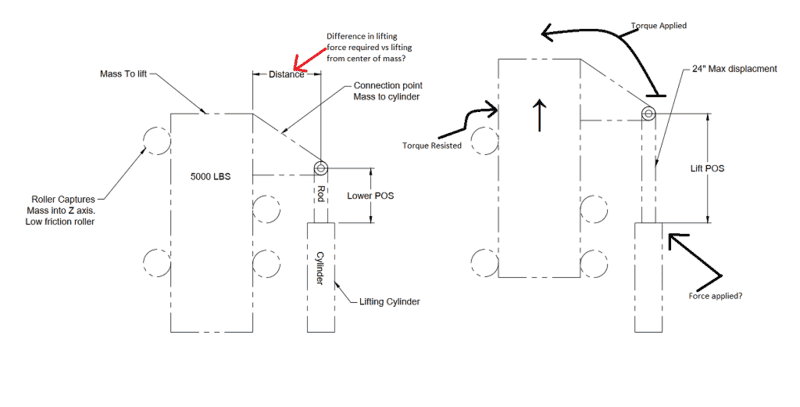
I am having trouble wrapping my head around the physics involved with the example below.
At first i was looking at this as if lifting may create a lever of some sort, but I don't believe it has a fulcrum.
I am trying to find a formula (if there is one) for lifting a mass from a point offset the the center of mass.
Does the force to lift a mass increase with the distance of an offset lifting point such as this in the example below?
I know the offset force will create a torque, assuming the mass is captive in a track of sorts, in this case a roller guide, would it be safe to assume the torque is cancelled out and wont add to the force required to lift this mass?
This is with the assumption that the roller create negligible friction in this example.
Example.png
 
Engineering news on Phys.org
Mark the centre of mass on your diagram.
Extend the axis of the force being applied, until it passes the centre of mass.

The torque on the load, due to the offset, will have an arm length equal to the shortest distance between the CofM and the extended axis of the applied force.

You must counter that torque, with say, guide rollers and a vertical rail, in order to avoid increasing the load on the cylinder.
 
  • Like
Likes   Reactions: Big Tommy C
Big Tommy C said:
I know the offset force will create a torque, assuming the mass is captive in a track of sorts, in this case a roller guide,
The offset will create a torque even if there are no roller guides. In such a case, the part will accelerate (rotation-wise).
Big Tommy C said:
would it be safe to assume the torque is cancelled out and wont add to the force required to lift this mass?
If some outside torque balances out the torque due to the offset (ex.: coming from roller guides), the mass doesn't accelerate (rotation-wise).
Big Tommy C said:
Does the force to lift a mass increase with the distance of an offset lifting point such as this in the example below?
No. (Assuming friction is negligible and that nothing locks up, i.e. everything stays perfectly straight.)
 
  • Like
Likes   Reactions: Big Tommy C
Big Tommy C said:
TL;DR Summary: Does lifting an object from a point offset from is center of gravity incense force required to lift said object. Does torque that is countered add force required to lift a load?

I am having trouble wrapping my head around the physics involved
The key to wrapping your mind around the physics is to create a Free Body Diagram (FBD) (search the term). If you do that for two different length arms, your mind will be wrapped. We will be happy to assist you in doing this.
 
  • Like
Likes   Reactions: Big Tommy C
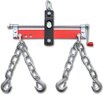
IIRC, a garage or similar work-shop would deploy an adjustable lifting beam, such that 'unbalanced' load is shackled to the ends, but hoisting eye may be moved along beam to balance point by winding threaded rod.

61OGJT6bZ1L._AC_SL1000_.jpg

Due Care, Please ??
 
  • Like
Likes   Reactions: Big Tommy C
Big Tommy C said:
Does torque that is countered add force required to lift a load?
Only when the moving parts are not perfectly aligned to be parallel in all planes.
 
Big Tommy C said:
I know the offset force will create a torque, assuming the mass is captive in a track of sorts, in this case a roller guide, would it be safe to assume the torque is cancelled out and wont add to the force required to lift this mass?
So long as all the surfaces that the rollers run on are vertical, the roller forces must remain horizontal, so there can be no vertical component of the roller force, that could change the force needed to support, lift or lower the mass.
 
Awesome, I understand now. Thanks for the help on this guys!
 
  • Like
Likes   Reactions: Baluncore, Lnewqban and berkeman

Similar threads

  • · Replies 9 ·
Replies
9
Views
2K
Replies
8
Views
3K
  • · Replies 5 ·
Replies
5
Views
5K
  • · Replies 10 ·
Replies
10
Views
2K
Replies
8
Views
2K
  • · Replies 12 ·
Replies
12
Views
3K
Replies
13
Views
3K
  • · Replies 2 ·
Replies
2
Views
4K
  • · Replies 8 ·
Replies
8
Views
3K
Replies
7
Views
2K