Discussion Overview
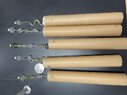
The discussion revolves around identifying the gases contained in old, unlabeled Geissler tubes from 1964-1965. Participants explore methods for identification, potential uses for the tubes, and safety considerations regarding their radioactive components.
Discussion Character
- Exploratory
- Technical explanation
- Debate/contested
- Experimental/applied
Main Points Raised
- One participant seeks assistance in identifying gases in Geissler tubes that are no longer functional for lighting.
- Another participant suggests that lighting the tubes would allow for spectral analysis to identify the gases.
- Some participants express curiosity about the tubes' potential uses, including demonstrating radioactivity and their historical significance.
- Concerns are raised about the safety of using the tubes, particularly regarding their radioactive glass content.
- Several participants propose methods to attempt lighting the tubes, including using high voltage sources and safety precautions.
- There are discussions about alternative demonstrations using modern equipment and techniques to illustrate similar concepts without using the old tubes.
- Some participants mention the possibility of using the tubes as Geiger sources if they cannot be lit.
- One participant shares a method for demonstrating absorption lines using sodium hydroxide and a Bunsen flame, suggesting that ionization may be necessary for the neon gas to exhibit absorption.
Areas of Agreement / Disagreement
Participants express a mix of curiosity and caution regarding the use of the Geissler tubes. There is no consensus on the best method for identifying the gases or demonstrating their properties, and multiple competing views on safety and feasibility remain present.
Contextual Notes
Participants highlight limitations related to the tubes' functionality, safety concerns regarding their radioactive components, and the need for proper identification methods that may not be straightforward.
Who May Find This Useful
This discussion may be of interest to educators, physics enthusiasts, and collectors of scientific apparatus, particularly those focused on historical instruments and their applications in teaching and demonstration.