Maglev train problem for high school physics exam

10 replies · 3K views · last reply
paulcaimp
Messages
9
Reaction score
2
Homework Statement
Find an exercise about maglev trains to which Maxwell's equations can be applied
Relevant Equations
Maxwell's Equations with derivative and integrals
Hi everyone, I'm an Italian High Schooler and I need a problem about maglev trains for the final exam. I apologize in advance if my english is bad or if I didn't follow some rules. I'm not native and new to this forum.
 
Welcome to PhysicsForums. :smile:

If I understand correctly, you are asked to come up with a homework-like problem about MagLev trains and solve that problem?

What reading have you been doing about MagLev in general and trains in particular? Can you posts to your reading so far? Thanks.
 
  • Like
Likes   Reactions: paulcaimp
Yes, so it's been a couple of days during which I've been looking up some videos on youtube () and reading articles (https://sites.tufts.edu/eeseniordesignhandbook/2015/maglev-magnetic-levitating-trains/) to grasp how currents and magnetic fields interact between each other during a maglev train ride. I also found out that two types of maglev trains exist, but for my work I will focus only on electrodynamic suspension trains. I also come across a report of functioning maglev trains that has all kind of datas, so it would be awesome if we can come up with a problem involving these real life figures. It is located at this url (https://www.osti.gov/servlets/purl/10134413) and the pages that treat eds systems are the 54 and 56. Thanks for your attention
 
  • Like
Likes   Reactions: Delta2
berkeman said:
Welcome to PhysicsForums. :smile:

If I understand correctly, you are asked to come up with a homework-like problem about MagLev trains and solve that problem?

What reading have you been doing about MagLev in general and trains in particular? Can you posts to your reading so far? Thanks.
Yes, so it's been a couple of days during which I've been looking up some videos on youtube () and reading articles (https://sites.tufts.edu/eeseniordesignhandbook/2015/maglev-magnetic-levitating-trains/) to grasp how currents and magnetic fields interact between each other during a maglev train ride. I also found out that two types of maglev trains exist, but for my work I will focus only on electrodynamic suspension trains. I also come across a report of functioning maglev trains that has all kind of datas, so it would be awesome if we can come up with a problem involving these real life figures. It is located at this url (https://www.osti.gov/servlets/purl/10134413) and the pages that treat eds systems are the 54 and 56. Thanks for your attention
 
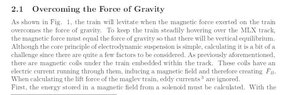
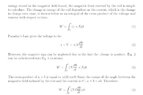
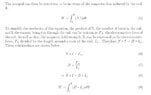
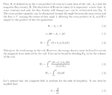
After a week of desperate searching, I've come across this document (on https://www.academia.edu/34876525/Magnetic_Levitation_Transportation) that shows a series of calculations that are perfect for my assignment. They are under the section "Overcoming the force of gravity" at pages 8-12. Although, I get lost around the sixth equation because I'm not sure the procedure is legit. What do you think?
 
I'm posting the screenshots of the calculations
 
Attachments
  • Printed text from a document section headed 2.1 Overcoming the Force of Gravity, explaining that a maglev train levitates when magnetic force equals gravity and describing magnetic coils in the track.
    1.JPG
    31.8 KB · Views: 268
  • Typeset page of equations (1) to (4): W equals the integral from 0 to t of (v cross I) dt, epsilon equals V equals minus N dPhi/dt, W equals the integral of (N dPhi/dt cross I) dt, and W equals the integral of (N I dPhi/dt) dt, with explanatory text on magnetic energy and Faraday's law.
    2.JPG
    23 KB · Views: 218
  • Typeset page of equations (5) to (9): W = integral from 0 to Phi of (NI) dPhi; N*I = F_m; B = F_m / L_f; N*I = B*L_f; W = integral from 0 to Phi of (H*L_f) dPhi, with explanatory text on the coil's flux and electromotive force.
    3.JPG
    20.2 KB · Views: 236
  • Typeset derivation of coil energy density: flux Φ = A_x × H, dΦ = A_x × dH, W = ∫(H·L_f)(A_x dH) from 0 to H, Wd = ∫ (B)dH, and B = H/μ₀ (Eqs. 10–15).
    4.JPG
    29.9 KB · Views: 233
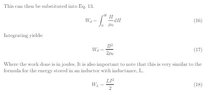
  • Typeset derivation of magnetic energy density: Wd = integral from 0 to H of mu0 H dH gives Wd = B^2/(2 mu0) (Eq. 17), compared with inductor energy WL = LI^2/2 (Eq. 18).
    5.JPG
    10.4 KB · Views: 239
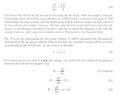
  • Handwritten-style typeset derivation of maglev magnetic energy: B^2/(2 mu_0) ~ LI^2/2 (19); V = g*A (20); W_d = B^2/(2 mu_0) (17 revisited); W = (LI^2/(2 mu_0)) * V (21); W = (LI^2/(2 mu_0)) * (g*A) (22), with explanatory paragraphs.
    6.JPG
    33.6 KB · Views: 215
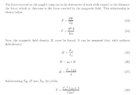
  • Typeset text with equations 23 to 28 for a maglev car: F = dW/dg, F = H^2 A / (2 mu0), H = Fm/Lf, H = mu0 * B, H = Fm * mu0 / g, and F = Fm^2 * mu0 * A / (2g)^2.
    7.JPG
    17.2 KB · Views: 231
I am now able to follow till the 24th passage. The only thing I'm not getting it's this costant switch between B and H, what's their difference? And also why at the 25th equation we have two forces?
 
paulcaimp said:
I am now able to follow till the 24th passage. The only thing I'm not getting it's this costant switch between B and H, what's their difference? And also why at the 25th equation we have two forces?
Do you mean equation 24? If so, can you describe your understanding up to that point, and what confuses you? B versus H usually involves the material that the magnetic field is in:

##B = \mu H##

so you will likely see H for non-ferrous regions and B for the field in a ferrous material.

Typeset page of equations (23) to (28) with explanatory text on a maglev train car's magnetic force, including F = dW/dg, F = H^2 A / (2 mu_0), H = F_m / L_f, H = mu_0 * B, H = F_m * mu_0 / g, and F = F_m^2 * mu_0 * A / (2g)^2.
 
Actually, after some efforts and thanks to your heads up, I was able to rewrite all the equations in the way I needed, so I'd say "problem solved". Thank you for the support, guidance and patience
 
  • Like
Likes   Reactions: berkeman