Magnetic monopole detection methods and symmetry breaking

2 replies · 2K views · last reply
jake jot
Messages
302
Reaction score
17
Here is a high quality article about it written by Ethan Siegel, with Ph.D. astrophysicist, author, and science communicator, who professes physics and astronomy at various colleges and has won numerous awards for science writing since 2008. So it's not a crackpot source.

The Enduring Mystery Of Detecting The Universe's Only Magnetic Monopole (forbes.com)
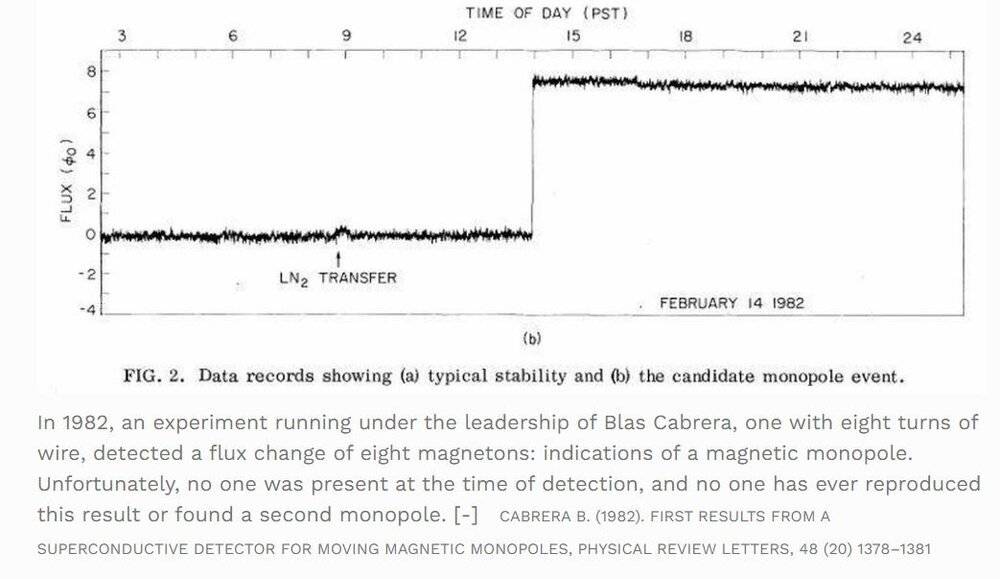
Line graph of flux in phi-0 against time of day (PST) from 3 to 24, Feb 14 1982, showing a flat baseline near zero, a small bump at LN2 TRANSFER around 9, and a sudden step up to about 7 near 14.


Comparing 1982 to 2020, it's nearly 40 years. Technology have evolved so much. So how do you build a monopole detector? Is there one now as small as thermal scanner? I need to get one to test something.

Another thing. The following is based on the articles. So if there are magnetic monopoles. Gauss's Law for Magnetism is not wrong, but only extended?
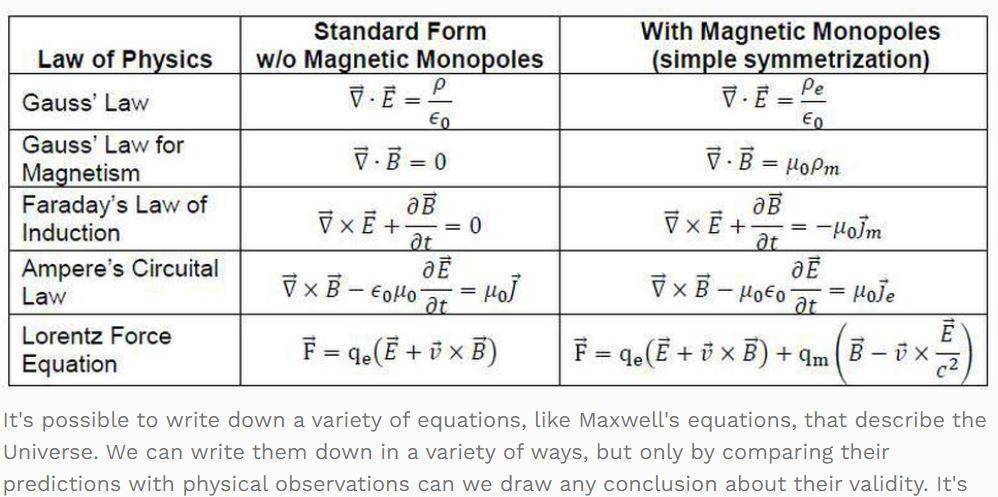
Table comparing five laws of physics in standard form without magnetic monopoles and with magnetic monopoles using simple symmetrization, including Gauss' Law, Gauss' Law for Magnetism, Faraday's Law, Ampere's Circuital Law and the Lorentz Force Equation.


In particle physics, they use the concept of symmetry breaking where at high temperature, there is more symmetry. So what efforts of this concept were used in the above? What I read in wiki is not clear on this, so asking for clarifications. Thanks.
 
jake jot said:
Comparing 1982 to 2020, it's nearly 40 years. Technology have evolved so much. So how do you build a monopole detector? Is there one now as small as thermal scanner? I need to get one to test something.

Another thing. The following is based on the articles. So if there are magnetic monopoles. Gauss's Law for Magnetism is not wrong, but only extended?
Reproducing Cabera's experiment is not a DIY project. The experiment consisted of two cylindrical, corrugated, mu-metal jackets; the outer jacket was needed to isolate the system from external magnetic noise and the inner jacket, which was bathed in liquid helium in a glass dewar, was mechanically expanded and transitioned through its superconducting critical temperature in order to reduce the ambient magnetic field. This brilliant procedure reduced the ambient field by an order of about ##10^{8}##. Within the inner jacket Cabera placed a superconducting coil attached to a SQUID magnetometer. If a magnetic monopole flew through the coil the SQUID would transition to a higher current state, in units of ##\phi_0##, according to its I-V curve, and be recorded on a chart recorder.
Although technology has changed the physical requirements of the experiment have not. The only advances of the last 40 years that I can see that would improve or simplify the experiment would be replacing the chart recorder and controlling the temperature with a computer.
 
Fred Wright said:
Reproducing Cabera's experiment is not a DIY project. The experiment consisted of two cylindrical, corrugated, mu-metal jackets; the outer jacket was needed to isolate the system from external magnetic noise and the inner jacket, which was bathed in liquid helium in a glass dewar, was mechanically expanded and transitioned through its superconducting critical temperature in order to reduce the ambient magnetic field. This brilliant procedure reduced the ambient field by an order of about ##10^{8}##. Within the inner jacket Cabera placed a superconducting coil attached to a SQUID magnetometer. If a magnetic monopole flew through the coil the SQUID would transition to a higher current state, in units of ##\phi_0##, according to its I-V curve, and be recorded on a chart recorder.
Although technology has changed the physical requirements of the experiment have not. The only advances of the last 40 years that I can see that would improve or simplify the experiment would be replacing the chart recorder and controlling the temperature with a computer.

Do you have a list of all magnetic monopole detectors in the world (in all countries)? Which of them are accessible to the public?

I want to try something none of them have literally tried before.
 
  • Skeptical
Likes   Reactions: Motore