Magnetic Shielding for Motion-Based Project

Click For Summary
SUMMARY

This discussion focuses on the challenges of magnetic shielding for a motion-based project involving a permanent magnet and a ferromagnetic recuperator. The user seeks a solution that avoids repulsion or attraction between the moving components, specifically a shield (S) that is 0.5mm thick with a 1mm opening. Mu-metal is suggested as a potential shielding material, but concerns about geometry and the inherent forces of magnetism are raised. The conversation emphasizes the impossibility of achieving the desired magnetic control without applying energy, highlighting the need for innovative mechanical solutions like a permanent magnetic chuck.

PREREQUISITES
  • Understanding of magnetic shielding principles
  • Familiarity with ferromagnetic materials and their properties
  • Knowledge of permanent magnets and their behavior in motion
  • Basic concepts of mechanical systems for magnetic control
NEXT STEPS
  • Research the properties and applications of Mu-metal for magnetic shielding
  • Explore the design and functionality of permanent magnetic chucks
  • Investigate mechanical methods for controlling magnetic flux without electricity
  • Study the principles of magnetic circuits and their practical applications
USEFUL FOR

Engineers, physicists, and hobbyists involved in mechanical design, magnetic systems, or those seeking to innovate in motion-based magnetic applications without electrical components.

MXM13
Messages
18
Reaction score
1
Hi, I'm working on a project, interested in your opinion
Need a material for magnetic "shielding"
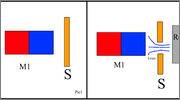
image.jpg


There must be no repulsion or attraction between M1 and S since non of them is stationary and it would affect the motion. There will be a ferromagnetic material behind S that cannot be affected by the magnet until S opens.
S should be 0.5mm thick with an opening of 1 mm

I don't think I could use diamagnetic materials since the distance between M1 and S should be 0.1 to 0.2 mm and there might be some repulsion effect.

It needs to be like in picture 2 with no repulsion/attraction between M and S
The magnetic flux must reach the recuperator (ferromagnetic so it will attract it, while S open)
Do not propose electromagnets - can't use electricity on this one
 
  • Like
Likes   Reactions: Symmetry777
Engineering news on Phys.org
MXM13 said:
There must be no repulsion or attraction between M1 and S since non of them is stationary and it would affect the motion.
I don't think this is possible. To act as shielding, S has to be influenced by the magnetic field, and this will always lead to forces.
Mu-metal is a common material for shielding, but then the geometry should be different.
Superconductors are (up to some field strength) ideal diamagnets and therefore great shields, but then you get a force between shield and magnet as well.
 
  • Like
Likes   Reactions: Symmetry777
Thank you for your reply, I greatly appreciate your advice
So, in my device I need to control the magnetic flux of a permanent magnet using the kinetic force of the device, the permanent magnet will be in motion but it's flux can only access the recuperator once it's at 1mm of it, so my solution was to put something between them that would open once the magnet is close enough and close once it distances it again.
One of the conditions was not to use electricity. Otherwise it would be too easy
I'll figure out something
 
What do you want to achieve with that setup? There could be alternative options with a different design.
 
I could use an electromagnet and the problem would be resolved but one of the conditions is not to use electricity, so I'm stuck with a permanent magnet
I just need to control it's flux, when the rec. will receive it and when not. So I only have some kinetic force to achieve this.
Shielding was the first thing to come to my mind but I just started working on it and it seemed a little problematic so I started this post.
If you have any ideas I welcome them
 
Magnetism is not possible to shield as you want it to. You must apply energy to do so. A coil around a permanent magnet could make an opposite magnetic field. If it WAS possible to do it the way you want it to, everyone could make themself a motor that is "powered" by controlling the force between permanent magnets without energy supply.

And as you sure know, energy cannot be created from nothing. Only transfer from one form to another.

Vidar
 
Thread closed for Moderation...

(Looks like we Mentors are piling on in this thread...) :-)

Thread re-opened for now. If we find out you are trying to get help with a PMM or over-unity device, this thread will be closed for good.
 
@MXM13: See X-Y-question. What is the problem you want to solve with that concept?

By the way:
Until yesterday, every physicist was laughing at this engine and its inventor, Roger Shawyer.
And we still do.

Edit: Sorry berkeman, didn't see your post.
 
  • Like
Likes   Reactions: Low-Q
This is an example where the concept of a magnetic circuit is useful. Rather than having a hole in a shield you could short circuit the permanent magnet's field by using a magnetic shunt fixed either side of the proposed aperture.
 
  • #10
Google permanent magnetic chuck. The magnetic force is "turned on and off" by mechanically moving permanent magnets in relation to each other internally while the face of the "magnet" stays fixed in place. No electricity is used, just a lever.
 
  • #11
montoyas7940 said:
Google permanent magnetic chuck. The magnetic force is "turned on and off" by mechanically moving permanent magnets in relation to each other internally while the face of the "magnet" stays fixed in place. No electricity is used, just a lever.
Thank you very much, I greatly appreciate your reply
 

Similar threads

  • · Replies 1 ·
Replies
1
Views
879
  • · Replies 11 ·
Replies
11
Views
2K
  • · Replies 16 ·
Replies
16
Views
2K
  • · Replies 8 ·
Replies
8
Views
3K
Replies
1
Views
2K
  • · Replies 10 ·
Replies
10
Views
7K
Replies
1
Views
2K
  • · Replies 4 ·
Replies
4
Views
1K
  • · Replies 9 ·
Replies
9
Views
2K