Markov chain on state {1, 2, 3, 4, 5, 6 , 7}

Click For Summary
SUMMARY

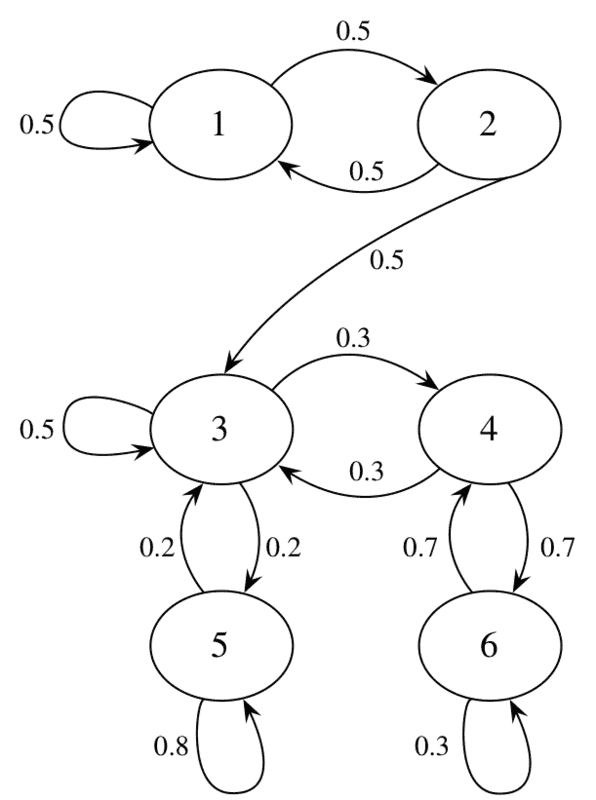
The discussion focuses on analyzing a Markov chain defined on the state set {1, 2, 3, 4, 5, 6, 7} for a programming project. The transition matrix is a 6 x 6 sparse matrix, and the long-term behavior is determined by evaluating the limit of the matrix raised to the power of n as n approaches infinity. The distribution of returns to state 1 follows a geometric distribution with a parameter of 1/4, and the key question is to determine the fraction of time the chain spends in state 3.

PREREQUISITES
  • Understanding of Markov chains and their properties
  • Familiarity with transition matrices and their applications
  • Knowledge of geometric distributions in probability theory
  • Ability to compute limits of matrix powers
NEXT STEPS
  • Study the construction and properties of transition matrices in Markov chains
  • Learn how to compute the long-term behavior of Markov chains using matrix exponentiation
  • Explore the concept of stationary distributions in Markov processes
  • Investigate the implications of geometric distributions in stochastic processes
USEFUL FOR

Students and professionals in mathematics, computer science, and data science who are working on projects involving Markov chains and stochastic modeling.
Janji
Messages
5
Reaction score
0
Member warned that some effort must be shown
Homework Statement
Let's suppose the chain starts at state 1. The distribution of the number of times that the chain returns to state 1 is geometric and the parameter would be 1/4.
Relevant Equations
In the long run, what fraction of the time does the chain spend in state 3?
I need this for a programming project. Could you help?
7_reducible.png
 
Last edited by a moderator:
Physics news on Phys.org
What have you tried? What do you mean formally with "in the long run"?
 
Math_QED said:
What have you tried? What do you mean formally with "in the long run"?
In the long run (n→∞):
 
Janji said:
Homework Statement:: Let's suppose the chain starts at state 1. The distribution of the number of times that the chain returns to state 1 is geometric and the parameter would be 1/4.
Relevant Equations:: In the long run, what fraction of the time does the chain spend in state 3?

I need this for a programming project. Could you help?View attachment 260957
The diagram can be represented by a transition matrix. For this problem it is a 6 x 6 sparse matrix; i.e., most of the entries are 0 since many transitions aren't defined. To find the long-term behavior, you look at ##\lim_{n \to \infty}A^n##, where A is the transition matrix.

Janji said:
The distribution of the number of times that the chain returns to state 1 is geometric and the parameter would be 1/4.
It's been many years since I've done problems like this -- I don't know how this information fits into the problem.
 
Janji said:
The distribution of the number of times that the chain returns to state 1 is geometric and the parameter would be 1/4.
Is that given or something to be proved? If given it would seem redundant - all the info is in the initial state and the diagram.
Janji said:
In the long run, what fraction of the time does the chain spend in state 3?
You must show some attempt.
Can you see how simplify the state diagram in respect of this question?
 

Similar threads

Replies
24
Views
4K
  • · Replies 4 ·
Replies
4
Views
1K
Replies
12
Views
4K
  • · Replies 7 ·
Replies
7
Views
2K
  • · Replies 7 ·
Replies
7
Views
5K
  • · Replies 3 ·
Replies
3
Views
3K
Replies
3
Views
2K
Replies
11
Views
2K
Replies
6
Views
2K
  • · Replies 3 ·
Replies
3
Views
2K