Material Waves and Wave Functions

  • Context: Undergrad 
  • Thread starter Thread starter deuteron
  • Start date Start date
  • Tags Tags
    Wave function
Click For Summary

Discussion Overview

The discussion revolves around the wave-like nature of particles, specifically electrons, as described by their wave functions in quantum mechanics. Participants explore the implications of experimental setups, such as the double-slit experiment, and the relationship between wave functions, probability distributions, and the physical reality of particles.

Discussion Character

  • Exploratory
  • Debate/contested
  • Technical explanation

Main Points Raised

  • Some participants question how the wave-like nature of electrons is demonstrated in experiments, suggesting that what is observed is the interference of the probability density function rather than the particles themselves behaving like waves.
  • Others argue that the interference pattern indicates that individual electrons can interfere with themselves, similar to photons and classical waves.
  • One participant clarifies that while electrons are detected as particles, the underlying field (the electron field) exhibits wave-like behavior, with the wave function representing this field mathematically.
  • There is a discussion about the relevance of the Schrödinger and Dirac equations in describing the wave function and its relation to the electron field.
  • Some participants express uncertainty about the concept of wave function collapse, with differing views on whether it represents a physical process or merely a mathematical description of the field's expectation value.
  • There is a distinction made between the DE Broglie matter wave and the wave function, with some asserting they are essentially the same while others highlight differences in their mathematical representations.

Areas of Agreement / Disagreement

Participants express multiple competing views regarding the interpretation of wave functions, the nature of wave-particle duality, and the implications of quantum field theory. The discussion remains unresolved, with no consensus on several key points.

Contextual Notes

Limitations include varying interpretations of wave function collapse, the distinction between physical and mathematical entities in quantum field theory, and the dependence on specific experimental arrangements for understanding wave behavior.

deuteron
Messages
64
Reaction score
14
TL;DR
.
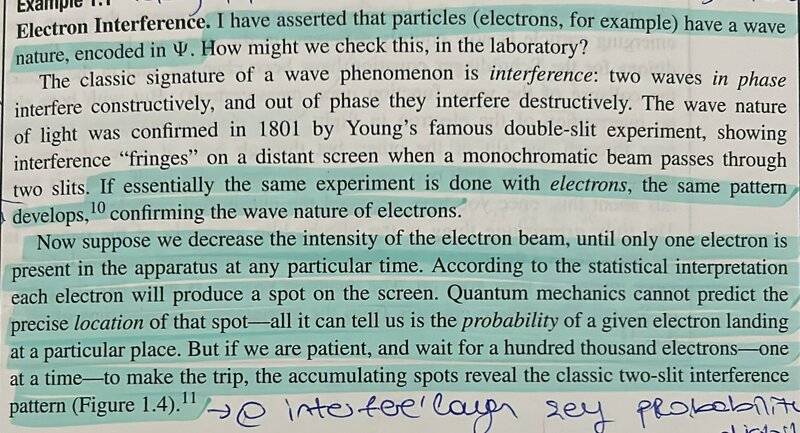
In Griffith's page 7, the following is mentioned:
67a30ee2-c315-4258-8487-af5da11bb8fb.jpeg


What confuses me here the most is the first sentence: "Particles have a wave nature, encoded in ##\psi##"

As far as I have understood, the square of the amplitude of the wave function gives us the probability of finding a function at a given point ##(x,t)##.

If we consider the experimental setup with two splits and a low intensity beam, such that only one electron passes the splits, we see the interference pattern of the wave function produced by the electrons on the screen, where the electrons correspond to a "point" on the screen. So the thing that interferes is the probability density function.

In that case, how is this experiment a proof of the wave-like nature of the electrons, from which I understand that electrons have a wave-like property. Isn't it that the probability distribution of the particles is a wave? How do we deduce from this experiment that the particles itself behave like a wave?
 
Physics news on Phys.org
deuteron said:
TL;DR Summary: .

How do we deduce from this experiment that the particles itself behave like a wave?
An individual particle itself never lands at any point on the screen where the interference is destructive.
 
Hill said:
An individual particle itself never lands at any point on the screen where the interference is destructive.
But it still is the interference of the probability density function, not the particle itself, isn't it?

I understand from the phrase "wave-like nature of the electron" that the electron itself behaves like a wave, just like photons or water waves; but the experiment doesn't show that, it shows the wave-like nature of the probability function, right?
 
deuteron said:
But it still is the interference of the probability density function, not the particle itself, isn't it?

I understand from the phrase "wave-like nature of the electron" that the electron itself behaves like a wave, just like photons or water waves; but the experiment doesn't show that, it shows the wave-like nature of the probability function, right?
It shows that one individual electron interferes with itself. Like photons and waves do.
If not for this interference, it would land anywhere on the screen. As it does when only one slit is open.
 
  • Like
Likes   Reactions: bhobba and deuteron
You are correct. The electron is never detected as a wave - it is always registered as a "detector click", a particle. What is waving is the quantized electron field. The electron is an excitation of that field, as the photon is an excitation of the electromagnetic field. In a given experimental arrangement, the field arranges itself in the form of a wave [i.e. the wave is the solution of the differential equation for the field] and every measurement of the field yields a quantized excitation: a photon for the electromagnetic field, an electron for the electron field, etc.
 
  • Love
  • Like
Likes   Reactions: bhobba and cianfa72
Rosenthal said:
You are correct. The electron is never detected as a wave - it is always registered as a "detector click", a particle. What is waving is the quantized electron field. The electron is an excitation of that field, as the photon is an excitation of the electromagnetic field. In a given experimental arrangement, the field arranges itself in the form of a wave [i.e. the wave is the solution of the differential equation for the field] and every measurement of the field yields a quantized excitation: a photon for the electromagnetic field, an electron for the electron field, etc.

Thank you! Is the differential equation you mentioned the Schrödinger equation? Otherwise I don't understand what SCH eqn. has to do with the experiment.
 
Well, it is actually the Dirac equation, but the Schroedinger equation (with the spin degree of freedom tacked on) is a good non-relativistic reduction.
 
So let me rephrase what I have understood so far:
  1. The Dirac / Schrödinger equations describe a wave function, ##\psi## which corresponds to a wave of the electron field.
  2. The excitations of the electron field "are" (?) the electrons, and when the electrons are measured, the wave collapses to a peak, which corresponds to the particle-like registry at the detector.
  3. The de Broglie material wave too is the wave function ##\psi## given by the Dirac / Schrödinger equation.
  4. The ##|\psi(x)|^2## corresponds to the probability distribution of finding the electron at location ##x## in space
Are these all correct?
 
A vector field is an assignment of a vector to all the points in a region of space-time, like the classic electric or magnetic fields. The basic quantum fields assign an operator to points of space-time, operators which, when acting on quantum states, increase or decrease the number of field quanta (photons, electrons, etc.) by 1. When you do an experiment and, say, detect one electron, you are sampling the quantized electron field in a particular way. Another experiment might only be sensitive to correlations among a pair of electrons; the same field would then be sampled in a different way. So what is the wave function of elementary quantum physics? It is the expectation value of the field under conditions appropriate to the experimental arrangement. I know this sounds super weird, but it is how things work.
I don’t know what you mean by “collapses to a peak”. The wavefunction is not the field – it is our representation of the expectation value of the field. The field is the physical entity, the wave function is a mathematical expression corresponding to a particular field and a particular experimental arrangement. Your listed item 4 is exactly correct, but there is nothing like a wave function collapse because the wave function is just a piece of information about the field. If there is only one electron in the initial state and we aren’t supplying any others or blasting things with enough energy to create electron-positron pairs, then after that electron is detected and so removed from the experiment, the resulting exact single particle wave function is zero. I guess you can call that a collapse but I don’t see what is gained by that terminology.
I agree that the excitations of the electron field are electrons. The DeBroglie matter wave is, as far as I can tell, just the wave function by another name.
 
  • Like
Likes   Reactions: deuteron
  • #10
Rosenthal said:
The field is the physical entity
I think the field is a mathematical entity.
Rosenthal said:
The DE Broglie matter wave is, as far as I can tell, just the wave function by another name.
The DE Broglie matter wave is defined by a real number. The wave function is generally an imaginary number. I have seen some "relation" but it is not clear.
 
  • Like
Likes   Reactions: deuteron

Similar threads

  • · Replies 9 ·
Replies
9
Views
2K
  • · Replies 36 ·
2
Replies
36
Views
8K
  • · Replies 10 ·
Replies
10
Views
1K
  • · Replies 13 ·
Replies
13
Views
2K
  • · Replies 3 ·
Replies
3
Views
5K
  • · Replies 8 ·
Replies
8
Views
2K
  • · Replies 11 ·
Replies
11
Views
3K
  • · Replies 3 ·
Replies
3
Views
2K
  • · Replies 32 ·
2
Replies
32
Views
4K
  • · Replies 16 ·
Replies
16
Views
1K