Matrices- conditions for unique and no solution

  • Context:
  • Thread starter Thread starter lyd123
  • Start date Start date
  • Tags Tags
    Conditions Matrices
Join the discussion
Ask a follow-up here, or get your own question answered by working scientists, mathematicians and engineers — people, not an autocomplete.
Real named experts · corrections over time · the nuance an AI answer skips
2 replies · 2K views
lyd123
Messages
11
Reaction score
0
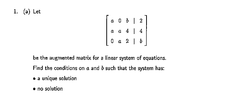
Hi,how do I go about answering the attached question? I know that for a matrix to have no solution, there needs to be a contradiction in some row. Unique solutions is when m* ${x}_{3}$ =c , where m* ${x}_{3}$ $\ne$ 0.

One way I tried was if a=0,
then from row (1) : b* ${x}_{3}$ =2
${x}_{3}$= 2/b (from row 2 : 2/b = 1 , so b=2)

then from row (2) : 4* ${x}_{3}$ =4
${x}_{3}$= 1

then from row (3) : 2* ${x}_{3}$ =b
${x}_{3}$= b/2 (from row 2 : b/2 = 1 , so b=2)

This seems to work, so when a=0, and b =1 , you have unique solutions?

How do I answer this question? Thanks.View attachment 8733
 

Attachments
  • 2019-01-02.png
    2019-01-02.png
    3.7 KB · Views: 190
Physics news on Phys.org
I see no reason not to just go ahead and try to solve the system. Since it is already in "augmented matrix form", row reduce the matrix. Start by subtracting the first row from the second row to get [tex]\begin{bmatrix}a & 0 & b & | & 2 \\ 0 & a & 4- b & | & 2 \\ 0 & a & 2 & | & b \end{bmatrix}[/tex].

Now subtract the second row from the third to get [tex]\begin{bmatrix}a & 0 & b & | & 2 \\ 0 & a & 4- b & | & 2 \\ 0 & 0 & b- 2 & | & b- 2\end{bmatrix}[/tex].

We now have the equations (b- 2)z= b- 2, ay+ (4- b)z= 2, and ax+ bz= 2. From the first equation we can say if [tex]b\ne 2[/tex] then z= 1. In that case the second equation becomes ay+ 4- b= 2 so ay= b- 2 and, if [tex]a\ne 0[/tex], [tex]y= \frac{b- 2}{a}[/tex]. In that case the third equation becomes ax+ b= 2 so again, if [tex]a\ne 0[/tex], [tex]z= \frac{2- b}{a}[/tex]. If [tex]b\ne 2[/tex] and [tex]a\ne 0[/tex] there is a unique solution.

Now, what if, in the case that [tex]b\ne 2[/tex], a is 0? In that case, the second equation becomes b- 2= 0 which, since this is the case [tex]b\ne 0[/tex] is impossible. In the case that [tex]b\ne 2[/tex], a= 0, there is no solution.

What if b= 2? In that case the first equation is satisfied for z any number. If a is not 0, we have [tex]y= \frac{2- (4- b)z}{a}[/tex] and [tex]x= \frac{2- bz}{a}[/tex] for all values of z so there are infinitely many solutions.

Last, what if b= 2 and a= 0? The equations reduce to 0= , 0= 2, and 2z= 2. 0= 2 is false no matter what x, y, and z are so there is no solution.
 
Makes perfect sense to me now!