Measuring the Top Quark: Techniques and Challenges

  • Context: Graduate 
  • Thread starter Thread starter robertjford80
  • Start date Start date
  • Tags Tags
    Quark
Click For Summary
SUMMARY

This discussion focuses on the techniques used to measure and identify the top quark in particle physics, particularly through modern particle detectors like silicon trackers. The top quark decays almost immediately into a W-boson and a b-quark, which then produce detectable long-lived particles. The tracks observed in particle detector images are reconstructed from points where charged particles interact with the detector. Key methods for particle identification include analyzing the behavior of particles in various detector components and measuring their velocity and momentum.

PREREQUISITES
  • Understanding of particle decay processes, specifically top quark decay into W-bosons and b-quarks.
  • Familiarity with modern particle detection technologies, particularly silicon trackers.
  • Knowledge of particle identification techniques and their applications in detectors.
  • Basic principles of momentum and energy measurement in high-energy physics.
NEXT STEPS
  • Research the operation and design of silicon tracking detectors used in particle physics experiments.
  • Study the principles of particle decay and the significance of the W-boson and b-quark in top quark measurements.
  • Explore advanced particle identification techniques, including time-of-flight and Cherenkov radiation methods.
  • Investigate the role of calorimeters in measuring energy and their limitations in high-energy particle detection.
USEFUL FOR

Particle physicists, researchers in high-energy physics, and students studying particle detection methods will benefit from this discussion, particularly those interested in the measurement and identification of fundamental particles like the top quark.

robertjford80
Messages
388
Reaction score
0
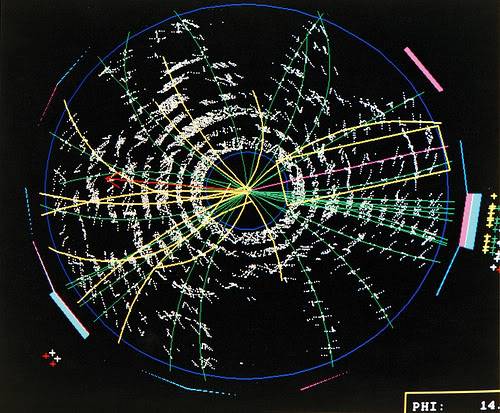
i wasn't exactly sure what happens inside particle colliders but i recently learned that they actually take photographs of particles. i looked for a photo of the top quark and this is what i found:
2826541870_6df1ec6916.jpg


what exactly is going on in this image? how can one take photos of a top quark? what do the lines on this photo mean? what do they represent? the wave lengths of gamma rays are 10^-14 to 10^-18m long and a quark is 10^-18 meters long so i don't see how you can actually get information about the top quark.
 
Physics news on Phys.org
Robert, Many of the elementary particles, such as the Higgs boson and the W and Z bosons, have extremely short lifetimes and therefore do not leave a track in a particle detector. We infer their presence from the tracks made by the other particles which they decay into.
 
While these images are nice and colorful, they are not really useful if you want to detect particles in modern detectors.
They show the detector and the tracks of charged long-living particles (long enough to cross the detector, which is everything above some nanoseconds).

After the production, a whole chain of decays happens:
The top-quarks decays nearly immediately into a W-boson and a b-quark. The W-boson then decays into other particles - one interesting option is the decay into a muon and a muon-antineutrino. The b-quark usually forms a high-energetic meson, together with some other particles flying in the same direction. After flying some millimeters, the meson with the b-quark decays into other particles.

After these decays, you eventually get long-living particles, which fly through the detector. The lines in the image are their tracks, reconstructed from the points of the detector where particles were observed.

Based on the image: The top-quark was produced in the center. I would expect that the b-quark flew towards the right (where you can see the yellow and green crosses and many lines pointing towards them), the neutrino from the W went to the left (indicated by the red arrow - it cannot be detected, but estimated with the help of momentum conservation) and the muon probably went to the right (pink line?).
 
but how does one actually get those grey track marks to appear on the image? and how does one know that the track marks are caused by neutrinos, muons and bottom quarks?
 
My guess is that your picture actually represents the tracking part of a modern particle detector, and that the pink and blue bars represent energy deposited in calorimeters outside the tracking detectors.

In the olden days tracking was done with bubble chambers and photographics emulsions, and in this case it is quite easy to understand how it works. See Wiki: http://en.wikipedia.org/wiki/Bubble_chamber

Nowadays however, it is mostly done with so called silicon trackers, which consist of a large number of silicon detectors organized around the collision point. Together the array of detectors can create the tracks of the particles.

Note that in the case of a bubble chamber or similar the picture is more or less an actual photograph. Today the picture is computer generated with help from the silicon tracking detectors.

When it comes to identifying particle types one uses their different properties to infer how they will react in the different types of detectors. This page has a good introduction: http://www.particleadventure.org/component_detector.html

Look around a bit on the last site, and you will probably find answers to many of your questions.
 
I believe the image is from the CDF detector at Fermilab.
 
robertjford80 said:
but how does one actually get those grey track marks to appear on the image? and how does one know that the track marks are caused by neutrinos, muons and bottom quarks?
Charged particles fly in straight lines (without magnetic field) or parts of circles (with magnetic field). Therefore, you can look at the hits in the detector for patterns which look like lines/circles. This is called tracking - finding the tracks of particles.

Particle identification is an interesting topic, and way too broad to cover it with forum posts here. But the general idea is that different particles behave different in the detector parts. Examples with the http://en.wikipedia.org/wiki/File:CMS_Slice.gif :
- Electrons produce hits in the tracking detectors and produce a cascade of particles (called "shower") in an element called electromagnetic calorimeter.
- Charged pions produce hits in the tracking detectors, cross the electromagnetic calorimeter and produce a shower in the hadronic calorimeter.
- Uncharged hadrons (like neutrons) do not produce hits in the tracking detectors (as they can detect charged particles only) and produce a shower in the hadronic calorimeter.
- Muons produce hits in the tracking detectors and cross the whole detector - they are the only particles detected in muon detectors behind the hadronic calorimeter.
- Neutrinos do not interact with the detector at all

There are some other concepts to identify particles. One important concept is to measure their velocity and their momentum. If both are known, the mass can be calculated.
 
Last edited by a moderator:
Velocity is without exception c or very close to it. I believe the mass is determined from comparing the particle's energy to its momentum.
 
It is tricky to get an energy measurement with the required precision, especially when the velocity is close to c. Calorimeters can measure the energy, but not with a resolution of ~10MeV which would be required for high-energetic particles (>1GeV).

However, the velocity can be measured:
- direct with time of flight for slow particles (used at ALICE at LHC, for example)
- via cherenkov radiation (used in the two RICH subdetectors at LHCb, excellent for pion/kaon/proton separation)
- via the Bethe formula (energy deposition depends on the velocity) (also used at ALICE)
- via transition radiation (sensitive to the relativistic gamma-factor, which is good to identify electrons) (also used at ALICE)

In combination with the momentum measurement (with the track radius in magnetic fields), the masses of the usual particles (electrons, pions, kaons, protons) are tested and the quality of this hypothesis is evaluated. Usually, everything which could fit is saved, and the individual analysis groups can decide how good the particle identification should be for their analysis.
 

Similar threads

  • · Replies 9 ·
Replies
9
Views
980
  • · Replies 6 ·
Replies
6
Views
2K
  • · Replies 7 ·
Replies
7
Views
3K
  • · Replies 2 ·
Replies
2
Views
2K
  • · Replies 13 ·
Replies
13
Views
4K
  • · Replies 8 ·
Replies
8
Views
9K
  • · Replies 11 ·
Replies
11
Views
3K
  • · Replies 4 ·
Replies
4
Views
9K
  • · Replies 4 ·
Replies
4
Views
2K
  • · Replies 0 ·
Replies
0
Views
2K