Mini road trip: Licking my chops

  • Thread starter jtbell
  • Start date
11 replies · 2K views · last reply
Staff Emeritus
Science Advisor
Homework Helper
2025 Award
Messages
16,110
Reaction score
8,612
This weekend, I'm on a road trip to a coin/stamp show in Raleigh, North Carolina. I'm actually staying next door in Cary, which I was once told is an acronym for "Containment Area for Relocated Yankees."

My first stop on the way here on Friday was a sort of "bucket list" item. I had never visited South Carolina's only Indian (Native American) reservation, the Catawba reservation near Rock Hill, because it's significantly out of the way from the routes that I use for my regular day-trips to Charlotte NC. I chose my route to Raleigh specifically to include it.

The Catawba Cultural Center has exhibits about Catawba history and culture, and a gift shop with crafts by Catawba artists.

Low white cultural center building with a green metal roof behind a lawn, with a stone entrance sign reading Catawba Cultural Center, tall trees and a paved road in the foreground.


Museum exhibit room with a black-and-white portrait of an elderly woman seated holding a clay pot, captioned Georgia Harris, Catawba Master Potter, 1905-1992. Glass display cases below, and a reconstructed thatched hut on the right.


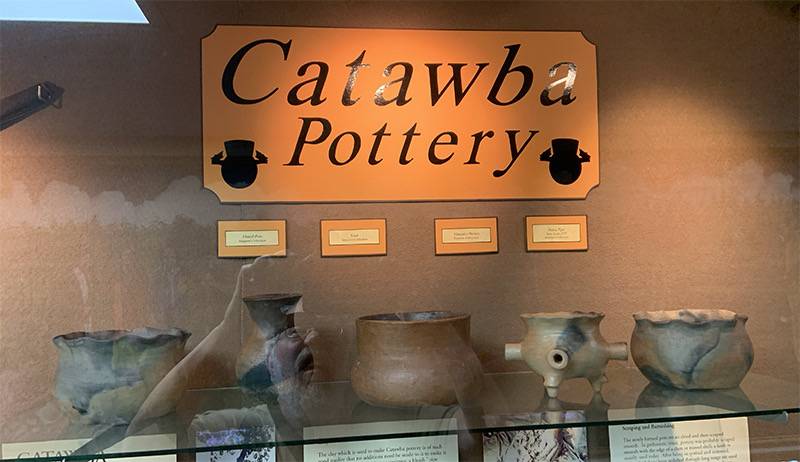
Display case with an orange sign reading "Catawba Pottery" above several clay pots and vessels on glass shelves, with small printed labels below.


Taxidermied wild cat lying on a sandy mound beside tall dried grasses, with a cardboard sign reading "hapke surii" and "(hap-kong soo-ree-ee) wild cat" in front.


Museum display case showing a folded turquoise dress shirt with a patterned blue tie, a black-and-white portrait of a smiling woman holding a mug, a printed biography panel, and a plaque reading Chief Bill Harris 2011-Present.


A trail leads down to the nearby Catawba River, about a mile, but I didn't try it because of heat and humidity. I'll keep it in mind for next fall, when I may be passing that way again.

.
 
  • Like
  • Informative
Likes   Reactions: Astronuc, pinball1970, mcastillo356 and 2 others
Hi, @jtbell, I've enjoyed specially this mini road trip.

The fourth pot in the photo, the one with the four tubes on the sides, I suppose, how is it ment to use?
Wild cat depicted reminds me of the Iberian lynx. Is it also among the endangered felines, in America?

Greetings!
 
mcastillo356 said:
The fourth pot in the photo, the one with the four tubes on the sides, I suppose, how is it ment to use?
Luckily I remember some of the description from the display. :smile: it's a "peace pipe", intended to be smoked by the participants to a peace treaty (maybe other agreements also). Each person uses a different mouthpiece (tube).
mcastillo356 said:
Wild cat depicted reminds me of the Iberian lynx. Is it also among the endangered felines, in America?
Here we have the bobcat (red lynx or lynx rufus). It appears not to be endangered, except maybe in some local areas, as with other wildlife near urban areas.

I'll post more pictures from other stops over the next few days. I had long driving days to and from Raleigh (Friday and Sunday).
 
  • Like
  • Love
Likes   Reactions: berkeman and mcastillo356
jtbell said:
it's a "peace pipe", intended to be smoked by the participants to a peace treaty (maybe other agreements also). Each person uses a different mouthpiece (tube).
Yes, they were a very careful and sanitary people, especially during the Covid pandemic.

Oh wait... :wink:
 
  • Like
  • Sad
Likes   Reactions: hutchphd and mcastillo356
berkeman said:
Yes, they were a very careful and sanitary people,
Or maybe the idea was for everybody to smoke at the same time, getting up close and personal!
 
  • Haha
  • Like
Likes   Reactions: hutchphd and berkeman
My second stop on Friday was at the train station in Hamlet NC. This was once a major junction of the Seaboard Air Line, which is now part of CSX. Amtrak's Silver Star stops here on its way between New York and Miami, via Raleigh NC and Columbia SC.

Road and railroad map of the Carolinas and Georgia, showing Charlotte, Columbia and Greenwood, with railroad lines drawn in orange, black and gray.


Two-story brick-red and tan wooden railway station with a steep gabled roof and dormer window, bunting on the facade, and a parked silver car in the front lot.


Historic brick-red roofed railway station with a turret and bunting on its porch, a paved platform with lamp posts and benches, and a single-track railway line with a signal box on the right.


Hamlet, NC railroad station, a large two-storey wooden building with a steep copper-roofed conical tower, red bunting on the facade and an American flag on a pole at left.


The track next to us is the N/S route used by Amtrak. The E/W track crossing in front of us runs from the coast at Wilmington NC to Atlanta GA and Birmingham AL, passing a couple hundred meters from my house along the way. Also note on the map, the station at Catawba SC, not far from the reservation that I visited earlier in the day.

Railway tracks at Hamlet station on a sunny day, with a grey metal cabinet labeled HAMLET CROSSING and a satellite dish on its roof beside the rails.


The Amtrak station wasn't open because its trains stop here late at night and very early in the morning. One wing of the building houses a museum which was open.

Interior of a railway station museum with a glass display case holding a uniform on a mannequin, a wooden desk with a typewriter and an Explosives sign, a life-size cutout of a porter, and a panel titled Passengers, Porters, People.


It has a large model of the station and yard/shop areas in the SAL's heyday during the early to mid 1900s. It shows four N/S and two E/W tracks passing the station.

Large model railroad layout in a museum showing a station with a red-roofed building, several tracks with trains, and small buildings and trees, with a sign reading HAMLET, N.C.


There's another railroad museum a couple of blocks away, the "National Railroad Museum and Hall of Fame", but it closed at 4pm, right about the time I arrived in town. Next trip, maybe.
 
jtbell said:
The track next to us is the N/S route used by Amtrak. The E/W track crossing in front of us
How do crossing tracks like that work? It looks like there's a discontinuity in the left-right track...?
 
The rails need to have gaps to accommodate the flanges of wheels crossing them perpendicularly. A Google search led me to a closeup of this exact crossing:

Close-up photo of a steel railway diamond crossing, where two sets of rails intersect at right angles, with ballast stones between the rails and bolted clamp plates along the edges.


There's a lot of extra steel to withstand the pounding these crossings get.
 
  • Informative
  • Like
Likes   Reactions: berkeman and Astronuc
Heading north from Hamlet, highway US-1 parallels the CSX/Amtrak line. About 30 miles along, I came to Aberdeen.

Small wood-frame railroad station with a hip roof and two brick chimneys, painted grey with red trim, beside a red caboose on a track and a crossbuck signal at left.


Amtrak doesn't stop here. The station is now a museum which is currently open only by appointment. A few years ago, i.e. before Covid, it had regular opening hours and I was able to visit it then.

Two shortline railroads meet CSX here: the Aberdeen & Rockfish which runs east to Fayetteville, and the Aberdeen Carolina & Western which runs west to Charlotte.

Red caboose labelled ABERDEEN & ROCKFISH R.R.Co. and numbered 309, standing on track beside a cream-coloured station building with a hipped roof and red-trimmed windows.


This was my last stop before Raleigh.
 
On Saturday I drove over to the North Carolina state fairgrounds in Raleigh for the main goal of this trip.

This was the Raleigh Coin Club's big annual event, bigger than most stamp shows I've been to, except for the big national one put on by the American Philatelic Society every summer. Here there were also about a half dozen stamp and postcard dealers, some of whom I'm familiar with from stamp shows in the region.

Large indoor hall with rows of tables and folding chairs where many people browse and trade coins, with glass display cases of collectibles at the left.


The "educational exhibits" included coins from the Danish West Indies, which became the US Virgin Islands in 1917.

Silver coin in a plastic holder, reverse side reading XX SKILLING DANSK AMERIKANSK MYNT 1840, with handwritten labels 1840, 20 Skillings and Danish West Indies.


The Reed Gold Mine state historic site near Charlotte, which I showed you all a couple of months ago, had a guy demonstrating how to pan for gold. I suspect this was his vehicle in the parking lot:

Rear of a white Toyota Tundra pickup with a camper shell, its rear window covered in stickers, and a white magnetic sign reading Carolina Prospectors, For All Your Prospecting Needs, 704.450.1639, with a prospector illustration.
 
Last edited:
  • Like
Likes   Reactions: mcastillo356
A couple of weeks ago I showed you a replica of the cabin where President Andrew Johnson was born:

https://www.physicsforums.com/threads/mini-road-trip-top-of-the-east.1052935/post-6902954

After I left the coin show on Saturday, I drove into Raleigh to see the original cabin.

Small two-story wooden cabin with gray clapboard siding, a steep gabled roof with wood shingles, a brick chimney, and a brick foundation with ventilation grates, with a small exterior staircase at the front.


It's in the Mordecai Historic Park, in a residential neighborhood just north of downtown. The park's centerpiece is the Mordecai House, originally built in 1785 and enlarged in the 1820s. Its original owner sold part of his 5000-acre plantation for founding the city of Raleigh.

Two-story yellow clapboard house with white columns and a balcony on the right side, dark shutters on the windows, and a lamp post in the foreground beside a gravel drive.


The park also contains several smaller buildings including the Johnson birthplace, moved there from other sites in Raleigh, to form a sort of historical village.

Small historic buildings at a park: a green-trimmed wooden structure on the left, a white clapboard chapel with a steeple behind a large tree trunk, and a white clapboard cabin with green shutters and a porch on the right, linked by a brick path.


One can enter the buildings only on a guided tour. I arrived too late for that. Even the visitor center and its exhibits were closing up just as I arrived.

So I walked around the park a bit and then left for my last stop of the day.
 
Now you'll see the inspiration for the thread title. :smile:

I drove to a dot on the map, outside Raleigh, because of its name and some Googling.

Green street sign reading Lizard Lick on a pole at a road intersection, with traffic signal heads hanging on wires and a two-storey brick and siding house with dormers behind.


Storefront of a Swift Mart convenience store with a sign reading LIZARD LICK SWIFT MART beside a cashpoints ATM kiosk topped by a large white lizard sculpture on a blue roof.


A local business has gained some fame because of a cable TV series: Lizard Lick Towing (2011-2014):

Photo of a towing company lot with a grey metal building bearing a Lizard Lick Towing & Recovery sign, and a row of pickup trucks parked in front, including a white Toyota Tacoma and a red one.