Molecular Mechanism for Bacterial Sliding

Click For Summary

Discussion Overview

The discussion centers on the molecular mechanism of bacterial sliding, specifically the role of a rotary motor and associated structures in bacterial mobility. Participants explore the implications of this mechanism for bacterial behavior and energy expenditure, touching on theoretical and conceptual aspects of microbiology.

Discussion Character

  • Exploratory
  • Conceptual clarification
  • Debate/contested

Main Points Raised

  • One participant describes a rotary motor in the bacterial cell membrane that drives a mechanism for movement, involving a tread and adhesin molecules that facilitate adhesion to substrates.
  • Another participant expresses fascination with the complexity of these molecular machines, indicating a general interest in the topic.
  • A question is raised regarding the purpose of bacterial mobility, suggesting that energy is expended for a specific reason, potentially related to sensing gradients of various types.
  • One participant proposes that bacteria can navigate toward or away from chemical concentrations, light, and gravitational or magnetic fields, arguing that such abilities would be evolutionarily advantageous.
  • There is a suggestion that the benefits of energy expenditure for movement should outweigh its costs, although the prevention of death might take precedence over energy considerations.

Areas of Agreement / Disagreement

Participants express varying viewpoints on the purpose and benefits of bacterial mobility, with some agreeing on the evolutionary advantages while others question the mechanisms and energy implications. The discussion remains unresolved regarding the specifics of these mechanisms and their evolutionary significance.

Contextual Notes

Participants have not fully explored the underlying mechanisms of the rotary motor or the exact nature of the gradients that bacteria might sense. There are assumptions about energy expenditure and evolutionary advantages that have not been definitively established.

BillTre
Science Advisor
Gold Member
Messages
2,766
Reaction score
12,161
TL;DR
A molecular mechanism by which a bacteria can slide along a substrate has been described.
This article from Science Advances (probably not open access, an AAAS publication) has described a complex and interesting molecular mechanism (a nano-bio-molecular machine).
A rotary motor in the cell membrane (driving mechanisms unknown) spins a gear that pushes a "tread" along a track imbeded between the cell's inner and outer membranes in a peptidoglycan layer. The tread poke through the outer membrane topped off with an adhesin molecule which binds things in the substrate. Adhesin molecules are proteins that bind particular extracellular molecules, underlying cell to cell adhesion. This gives the mechanism resistance to move forward with. Since the track spirls around the cell, the cell rotates on its long axis as it moves forward along its access.

Picture of their hypothesized mechanism:
https://www.physicsforums.com/attachments/258274
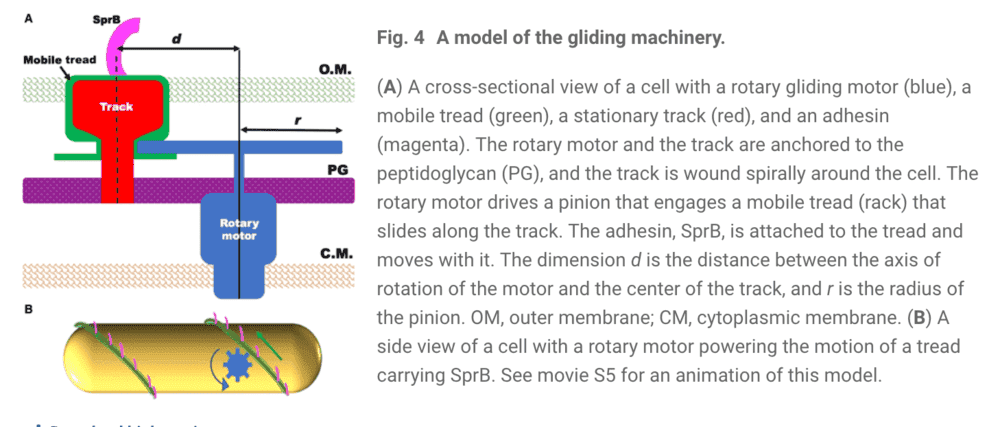
Screen Shot 2020-03-06 at 6.27.31 PM.png


Here is their cartoon movie (click on movie S5) of how it works can be found here (may not be behind paywall since it is supplemental material).

I find these evolved complex molecular machines that cells make use of to be fascinating.
 
Last edited:
  • Informative
  • Wow
Likes   Reactions: 256bits, pinball1970 and berkeman
Biology news on Phys.org
Pretty amazing. Thanks Bill. :smile:

From the S5 movie:

1583588934964.png


1583588977336.png
 
  • Like
Likes   Reactions: BillTre
Thanks for posting that @berkeman.
Not sure what happened to the figure that was in my post, but the video pictures show most of it.
I'll try adding it back.
 
  • Like
Likes   Reactions: berkeman
So what is the point of bacterial mobility?
They would be using energy for some purpose.
Do they sense a gradient of some sort ( chemical, photo, electrical )?
At on um per second they don't get to far quickly.
 
I think that bacteria can go towards or away from increasing concentrations of chemicals (either foods or bad stuff) and can go toward or away from light or up or down in a gravitational field and follow magnetic field lines.
Any of these, appropriately used, can be beneficial to the organism, and would thereore be expected to be selected for.
In the long run, the energy expenditure should normally be expected provide greater energy benefits than its costs.
However, a prevention of death would over-rule that.
 
Last edited:
  • Like
Likes   Reactions: berkeman

Similar threads

  • · Replies 4 ·
Replies
4
Views
3K
  • · Replies 15 ·
Replies
15
Views
6K