Python What is the Winning Probability in Monte Carlo Spinner Game?

  • Thread starter Thread starter Arman777
  • Start date Start date
  • Tags Tags
    Monte carlo Spin
Click For Summary
SUMMARY

The discussion centers on calculating the winning probability in a Monte Carlo Spinner Game using Python. The game involves two spinner disks, where the player spins according to defined probabilities: p11 = 0.2, p12 = 0.4, p21 = 0.3, and p22 = 0.35. The initial code provided yielded an incorrect winning probability of 0.655, while the correct answer is 0.65 after adjustments were made to the code. The solution involves understanding the conditional probabilities and the Markov process inherent in the game's mechanics.

PREREQUISITES
  • Understanding of Monte Carlo simulations
  • Familiarity with Python programming
  • Knowledge of probability theory, particularly conditional probabilities
  • Basic understanding of Markov processes
NEXT STEPS
  • Implement and analyze the Monte Carlo simulation for different probability values
  • Explore advanced techniques in Python for optimizing Monte Carlo simulations
  • Study Markov decision processes and their applications in game theory
  • Learn about statistical validation methods for Monte Carlo results
USEFUL FOR

Game developers, data scientists, and anyone interested in probability simulations and game theory will benefit from this discussion.

Arman777
Insights Author
Gold Member
Messages
2,163
Reaction score
191
Problem:
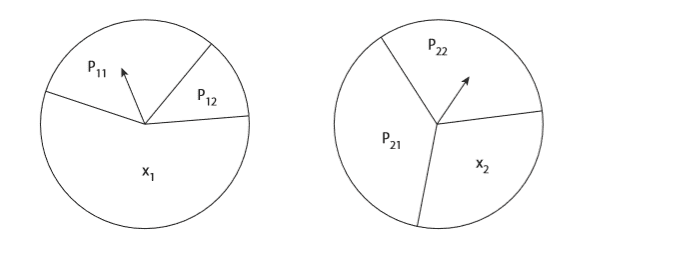
Here’s a little Monte Carlo challenge problem, Consider the following game, which uses the two spinner disks. Suppose a player spins one or the other of the pointers on the disks according to the following rules: (1) if the player spins pointer ##i## and it stops in the region with area ##p_{ij}##, he moves from disk ##i## to disk ##j## (i and j are either 1 or 2); (2) if a pointer stops in the region with area ##x_i##, the game ends; (3) if the game ends in the region with area ##x_1##, the player wins, but if the pointer stops in the region with area ##x_2## the player loses. What is the probability the player, starting with disk 1, wins? Assume the area of each disk is one, so that ##x_1+p_{11}+p_{12} =1##, as well as that ##x_2+p_{21}+p_{22} =1##

Run your code for the case of ##p_{11} =0.2, p_{12} =0.4, p_{21} =0.3##, and ##p_{22} =0.35##.
Mentor note: Changed ICODE tags to code=python
243941

Python:
import random
    p_11 = 0.2
    p_12 = 0.4 #0.2+0.4
    p_21 = 0.3
    p_22 = 0.35    P_1 = p_11+p_12
    P_2 = p_21+p_22    #from starting 1:

    wins = 0
    num = 0
    for i in range(10**7):
        while num < P_1:
            num = random.uniform(0,1)
            if P_1 < num < 1:  #area corresponding to x_1
                wins += 1  #wins
                num = 0
                break
            else:
                num2 = random.uniform(0,1)
                if P_2 < num2 < 1:  #area corresponding to x_2
                    break  #loses
    print(wins/10**7)
The correct answer is 0.5821 however I am getting 0.655.. Where am I doing wrong ?
 
Last edited:
Technology news on Phys.org
Arman777 said:
**Problem:** Here’s a little Monte Carlo challenge problem, Consider the following game, which uses the two spinner disks. Suppose a player spins one or the other of the pointers on the disks according to the following rules: (1) if the player spins pointer i and it stops in the region with area pij, he moves from disk i to disk j (i and j are either 1 or 2); (2) if a pointer stops in the region with area xi, the game ends; (3) if the game ends in the region with area x1, the player wins, but if the pointer stops in the region with area x2 the player loses. What is the probability the player, starting with disk 1, wins? Assume the area of each disk is one, so that x1+p11+p12 =1, as well as that x2+p21+p22 =1

Run your code for the case of p11 =0.2, p12 =0.4, p21 =0.3, and p22 =0.35.
Mentor note: Changed ICODE tags to code=python
Python:
import random
    p_11 = 0.2
    p_12 = 0.4 #0.2+0.4
    p_21 = 0.3
    p_22 = 0.35    P_1 = p_11+p_12
    P_2 = p_21+p_22    #from starting 1:

    wins = 0
    num = 0
    for i in range(10**7):
        while num < P_1:
            num = random.uniform(0,1)
            if P_1 < num < 1:  #area corresponding to x_1
                wins += 1  #wins
                num = 0
                break
            else:
                num2 = random.uniform(0,1)
                if P_2 < num2 < 1:  #area corresponding to x_2
                    break  #loses
    print(wins/10**7)
The correct answer is 0.5821 however I am getting 0.655.. Where am I doing wrong ?
How do you know what the correct answer is? Also, it's a good idea to use random.seed() to seed the random number generator, but it doesn't seem to make much difference here.
 
I don't think your code captures what's supposed to happen here due to it being too simplistic. Based on your description, the pointer on the first disk can land on ##x_1## or ##p_{11}## or ##p_{12}##. If it lands on ##x_1##, that's a win for that turn. If it lands on ##p_{11}##, nothing happens for that spin. If it lands on##p_{12}##, you spin the pointer on the second disk.

If the second pointer lands on ##x_2##, that's a loss for that turn. If it lands on ##p_{22}## nothing happens, but if it lands on ##p_{21}##, the turn continues on the first disk.

I haven't seen how the game is defined, but I would bet it's something like I have described. If so, you need to take into account conditional probabilities, and all possible paths to a win for a given turn. The game makes me think of it as being a Markov process.
 
Last edited:
Mark44 said:
I don't think your code captures what's supposed to happen here due to it being too simplistic. Based on your description, the pointer on the first disk can land on ##x_1## or ##p_{11}## or ##p_{12}##. If it lands on ##x_1##, that's a win for that turn. If it lands on ##p_{11}##, nothing happens for that spin. If it lands on##p_{12}##, you spin the pointer on the second disk.

If the second pointer lands on ##x_2##, that's a loss for that turn. If it lands on ##p_{22}## nothing happens, but if it lands on ##p_{21}##, the turn continues on the first disk.

I haven't seen how the game is defined, but I would bet it's something like I have described. If so, you need to take into account conditional probabilities, and all possible paths to a win for a given turn. The game makes me think of it as being a Markov process.
Python:
import random
p_11 = 0.2
p_12 = 0.4 #0.2+0.4
p_21 = 0.3
p_22 = 0.35wins = 0
pointer = 0
pointer2 = 0
for i in range(10**6):
    while pointer < p_11:
        pointer2 = 0    #resetting pointer2
        pointer = random.uniform(0,1)
        if p_11+p_21  < pointer < 1:  #area corresponding to x_1
            wins += 1  #wins
            pointer = 0 
            break
        else:
            pointer = 0  #resetting pointer1
            lost = False
            while pointer2 < p_22:
                pointer2 = random.uniform(0,1)
                if p_22+p_21 < pointer2 < 1:  #area corresponding to x_2
                    pointer2 = 0
                    lost = True
                    break  #loses
            if lost:
                break

print(wins/10**6)

I noticed that there is an error in the book. The real answer is 0.65 and I edited my code like this which it works now. So problem is solved.
 
I tried a web search "the loss of programming ", and found an article saying that all aspects of writing, developing, and testing software programs will one day all be handled through artificial intelligence. One must wonder then, who is responsible. WHO is responsible for any problems, bugs, deficiencies, or whatever malfunctions which the programs make their users endure? Things may work wrong however the "wrong" happens. AI needs to fix the problems for the users. Any way to...

Similar threads

  • · Replies 1 ·
Replies
1
Views
2K