Need advice for this Adaptor remover (home plumbing)

  • Thread starter Thread starter Ephant
  • Start date Start date
Click For Summary

Discussion Overview

The discussion revolves around the challenges of removing a yellow plastic adaptor in home plumbing, specifically regarding the compatibility of threads and the effectiveness of various tools for the task. Participants explore different methods and tools for gripping and turning the adaptor, as well as the implications of using certain tools on plastic components.

Discussion Character

  • Technical explanation
  • Debate/contested
  • Experimental/applied

Main Points Raised

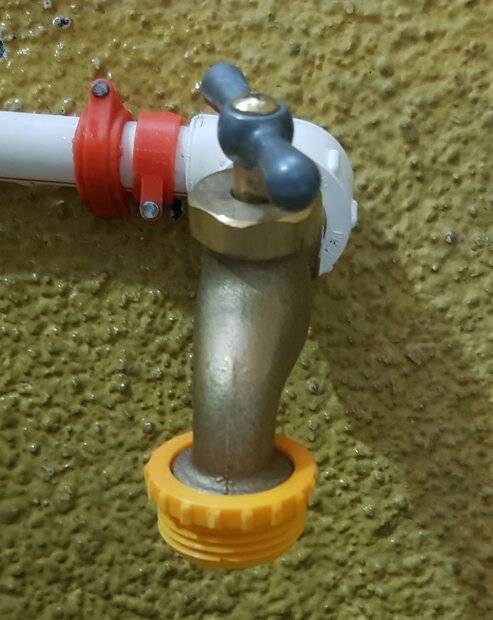
  • One participant inquires about tools that can grip the yellow threads of the adaptor, questioning whether the issue lies in thread compatibility or the rubber gasket causing tightness.
  • Another participant suggests using a pipe wrench, noting its ability to tighten jaws when turned correctly.
  • Some participants express concerns about the spacing of the wrench teeth and suggest alternatives like a strap wrench.
  • One participant mentions cutting the adaptor with a saw to remove it, indicating frustration with the removal process.
  • There is a discussion about the potential for a pipe wrench to damage plastic threads, with differing opinions on the severity of this risk.
  • A participant proposes using grippy gloves to enhance grip and torque, alongside a pipe wrench for stubborn cases.
  • Another participant shares their experience with a leaking tap adaptor, attributing the issue to incompatibility between NPT and GHT threads.
  • Questions arise regarding terminology for parts of the adaptor and the appropriateness of various tools for the job.
  • One suggestion includes pouring hot water on the connection to aid in loosening it.

Areas of Agreement / Disagreement

Participants express a range of opinions on the best tools and methods for removing the adaptor, with no clear consensus on the most effective approach. There are conflicting views on the risks associated with using a pipe wrench on plastic threads.

Contextual Notes

Participants discuss various tools and their potential effects on plastic components, highlighting the need for careful consideration of compatibility and damage risk. The discussion also touches on specific plumbing terms and the nuances of different fittings.

Who May Find This Useful

This discussion may be useful for individuals facing similar plumbing challenges, particularly those dealing with plastic fittings and seeking advice on appropriate tools and methods for removal.
Ephant
Messages
147
Reaction score
2
Is there any tool that can grip the yellow threads and turn it? I use pliers but they are very small. I even used vise grips but the teeth are very small. There is a rubber gasket inside the yellow plastic adaptor which has female thread on top (the male thread at bottom is for 1/2" conversion). The faucet is 3/4" and has male thread. I tightened the 3/4" plastic adaptor with my hands but can't remove it. For this situation. Mechanically, Is it because the faucet thread and adaptor threads are not compatible or more about the gasket causing it to tighten?

Or if the description above is vague. Just please tell me what kind of tool that can engage the threads. Pliers and vise grip have small close teeth.

adaptor remover.jpg
 
Engineering news on Phys.org
The teeth of wrench are very closedly space. Is there other tool that can do it?

I just used saw to cut the adaptor and destroy it just to remove it.

adaptor removed.jpg
 
Get a strap wrench. . . :cool:


.
 
  • Like
Likes   Reactions: russ_watters
Ephant said:
The teeth of wrench are very closedly space. Is there other tool that can do it?
Who cares?! Use a pipe wrench. That is what they are good at.

"Use the right tool for the job".
 
Ephant said:
The teeth of wrench are very closedly space.
The teeth of the wrench don't have to mesh with the adapter teeth. All you have to ...

Ephant said:
I just used saw to cut the adaptor and destroy it just to remove it.
never mind... :sorry:
 
  • Haha
  • Like
Likes   Reactions: jack action, russ_watters and berkeman
DaveC426913 said:
The teeth of the wrench don't have to mesh with the adapter teeth. All you have to ...never mind... :sorry:

I have 5 pieces more like it.. used it in washing machine and water filters.

The problem with pipe wrench is it's pure iron and can damage the plastic threads.

So I'm looking for something like the following close wrench in pic but adjustable. Is there anything like an adjustable close wrench that is also plastic? Iron is ok, at least the force wouldn't be concentrated on a few plastic threads on the adaptor only.

If there is none yet a market. Can you design an adjustable close wrench?

Also it made me think. Do all the tools in the International Space Station already in the market or do they made it custom a round close adjustable wrench?

close wrench.jpg
 
Ephant said:
The problem with pipe wrench is it's pure iron and can damage the plastic threads.
That is nonsense. The pipe wrench may leave some small scars on the outer part of the plastic assembly, but it will not do anything to the threads on the inner part of the assembly.
 
  • Like
Likes   Reactions: phinds
My preferred solution, at least for a first attempt, is a pair of grippy gloves. I keep a pair in the kitchen, and a second pair in my shop. They both get plenty of use. They do two things - shield my delicate fingers from sharp edges so I can grip harder, and increase friction so I can get more torque from the same clamping gripping force.
Grippy Gloves.jpg

I also have a pipe wrench for the really stubborn cases.
 
Last edited:
  • Like
Likes   Reactions: berkeman
  • #10
OCR said:
Get a strap wrench. . . :cool:


.

Get a strap wrench.
 
  • Like
Likes   Reactions: OCR
  • #11
berkeman said:
That is nonsense. The pipe wrench may leave some small scars on the outer part of the plastic assembly, but it will not do anything to the threads on the inner part of the assembly.

I meant I didn't want to leave some small scars on the outer part of the plastic assembly. How do you call those outer part? In wheels in cars/vehicles, the outer part of tire is called threads so I mention threads. What is the right term then?

Why did you give picture of 18" pipe wrench? Does the 18" mean it is the opening of the wrench? If i'd buy one, maybe a 2" is enough? The heavier one may be so heavy it may pull the entire faucet off the PPR piping when turning it.
 
  • #12
Ephant said:
I meant I didn't want to leave some small scars on the outer part of the plastic assembly. How do you call those outer part?
Why not? You were willing to destroy one of them.

The wrench is meant to be applied to this part, not the threads.
1702089587276.png


Ephant said:
In wheels in cars/vehicles, the outer part of tire is called threads so I mention threads.
Tires have treads.

Pipe fittings have threads.

Ephant said:
Why did you give picture of 18" pipe wrench? Does the 18" mean it is the opening of the wrench? If i'd buy one, maybe a 2" is enough? The heavier one may be so heavy it may pull the entire faucet off the PPR piping when turning it.
I think a pipe wrench is overkill.

I use channel locks:

1702089668235.png
 
  • Like
Likes   Reactions: Baluncore
  • #13
I borrowed a pipe wrench as well as ordered both the channel lock and a pipe wrench.

However, even if I used a pipe wrench, the tap adaptor still leaked! Then I realized why, it's because the NPT in the faucet is not compatible with the GHT of the tap adaptor. See:

https://homeandgardentalk.com/ght-vs-npt-compatability/

I used the faucet to the sediment filter connected to the clothes washing machine.

sediment filter setup.jpg


garden hose tap.jpg


Has anyone used this kind of setup? First, some terms we should agree with first.

1. Do you also call it as faucet tap adaptor (the yellow one I sawed earlier)? It's GHT which is not compatible with the faucet NPT so either I'll get a converter or replace the faucet (which is connected to the PPR female NPT thread).

2. Do you also call the hose connector as Water Hose connector quick release? What else do you call it? Or haven't you seen anything like it?

3. The sediment filter is GHT. I connected the washing machine water hose directly to the sediment filter via a 3/4" male to male adaptor.

4. Ok. What other ways to do it? How did you set up yours? The washing machine could another output like a plain kitchen sink faucet, etc.

Appreciated all your help. Thank you!
 
  • #14
It seems that no one has yet suggested pouring a kettle full of hot water on the connection.It could very well be undone by hand after that treatment.
 
  • Like
Likes   Reactions: Tom.G

Similar threads

  • · Replies 14 ·
Replies
14
Views
1K
  • · Replies 19 ·
Replies
19
Views
9K
  • · Replies 1 ·
Replies
1
Views
10K