Need help finding Diagonals of a Rhombus

  • Context:
  • Thread starter Thread starter thatbluegsx90
  • Start date Start date
Join the discussion
Registration is free. Ask a follow-up in this thread, or start your own.
2 replies · 2K views
thatbluegsx90
Messages
1
Reaction score
0
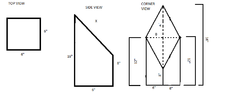
Not sure where exactly to post this but I think it fits in this category...I recently got interested in making a Terrarium and plan to make the glass enclosure myself.. for the life of me without having the physical thing in front of me I can't figure out one of the diagonal measurements of the top cover.. I apologize for the rough drawing but I'm looking for what A and B are(didn't mean to put the X in there)... I'm about 60% confident that B is 8 1/2 but I has been a while since I've done anything related to this
 

Attachments

  • Capture.PNG
    Capture.PNG
    3.9 KB · Views: 158
Mathematics news on Phys.org
From your middle, side view, the back height of the terrarium is 16", the front is 8", and the base is 6". If you draw a line from the top of the front perpendicular to the back (so parallel to the base) you have a right triangle with height 16- 8= 8" and base 8". By the Pythagorean theorem, your distance "A" satisfies [tex]A^2= 8^2+ 8^2= 64+ 64= 120[/tex]. So [tex]A= \sqrt{120}= 2\sqrt{15}[/tex] or about 11" (10.954...). Your distance "B" is just the distance across which is 6+ 6= 12".
 
thatbluegsx90 said:
Not sure where exactly to post this but I think it fits in this category...I recently got interested in making a Terrarium and plan to make the glass enclosure myself.. for the life of me without having the physical thing in front of me I can't figure out one of the diagonal measurements of the top cover.. I apologize for the rough drawing but I'm looking for what A and B are(didn't mean to put the X in there)... I'm about 60% confident that B is 8 1/2 but I has been a while since I've done anything related to this
[TIKZ][scale=0.5]
\coordinate (A) at (-5,2) ;
\coordinate (B) at (1,3) ;
\coordinate (C) at (6,1) ;
\coordinate (D) at (0,0) ;
\coordinate [label=left: $B_1$] (E) at (-5,14) ;
\coordinate [label=above right: $A_1$] (F) at (1,19) ;
\coordinate [label=right: $B_2$] (G) at (6,13) ;
\coordinate [label=left: $A_2$] (H) at (0,8) ;
\draw [very thick] (G) --node
{$12$} (C) --node[below] {$6$} (D) --node[below] {$6$} (A) --node
{$12$} (E) -- (H) ;
\draw [very thick] (E) -- (F) -- (G) -- (H) --node
{$8$} (D) ;
\draw [dashed] (A) -- (B) -- (C) ;
\draw [dashed] (B) --node
{$16$} (F) ;
[/TIKZ]​

In my picture, the distance between $A_1$ and $A_2$ is your distance $A$, and the distance between $B_1$ and $B_2$ is your distance $B$.

Both of the points $B_1$, $B_2$ are $12$ inches above diagonally opposite points of the base of the terrarium. So the distance between them is $6\sqrt2$, which is approximately $8.485$ (close to your estimate of 8 1/2, but a bit less).

The horizontal distance between $A_1$ and $A_2$ is again $6\sqrt2$, but there is also a vertical separation of $16 - 8 = 8$ between them. It follows from Pythagoras's theorem that $A = \sqrt{72 + 64} = \sqrt{136}$, which is approximately $11.66$.

If it helps you in cutting the glass, the sides of the rhombus are approximately $7.2$ inches. The angles at $A_1$ and $A_2$ are almost exactly $72^\circ$ (and the angles at $B_1$ and $B_2$ are almost exactly $108^\circ$).​