Need help with this Vector Question +rep

  • Thread starter Thread starter simpleas123
  • Start date Start date
  • Tags Tags
    Vector
Click For Summary
SUMMARY

This discussion focuses on solving vector-related problems, specifically addressing the proof of vector equations and properties. The participants discuss the implications of the dot product and cross product, emphasizing the need for justifications in proofs. Key equations mentioned include the vector norm ||a|| and the relationship ||a - b|| = ||a|| ||b|| - 2(a · b). The conversation highlights the importance of understanding vector properties and providing clear justifications for mathematical statements.

PREREQUISITES
  • Understanding of vector operations, including dot product and cross product.
  • Familiarity with vector norms and their properties.
  • Knowledge of mathematical proof techniques and justifications.
  • Basic proficiency in LaTeX for typesetting mathematical expressions.
NEXT STEPS
  • Study the properties of vector norms and their applications in proofs.
  • Learn about the implications of the dot product being zero and its geometric interpretations.
  • Explore the properties of the cross product and its significance in vector equations.
  • Practice writing mathematical proofs involving vectors, focusing on clarity and justification.
USEFUL FOR

Students studying linear algebra, mathematicians interested in vector calculus, and educators teaching vector properties and proofs.

simpleas123
Messages
7
Reaction score
0
Alright all I am on this vector question and I am having problems with this question. Part (i) i have no idea what to start with / how i possibly prove the question.

This is the question, help will be deeply appriciated. Thanks, David. Also note that
|| a || = (a_1 + a_2 + ... + 1_n)^1/2 .

|| a - b || = || a || || b || - 2 (a \cdot b).

I have done part (i) :) Its the rest I am struggling with.
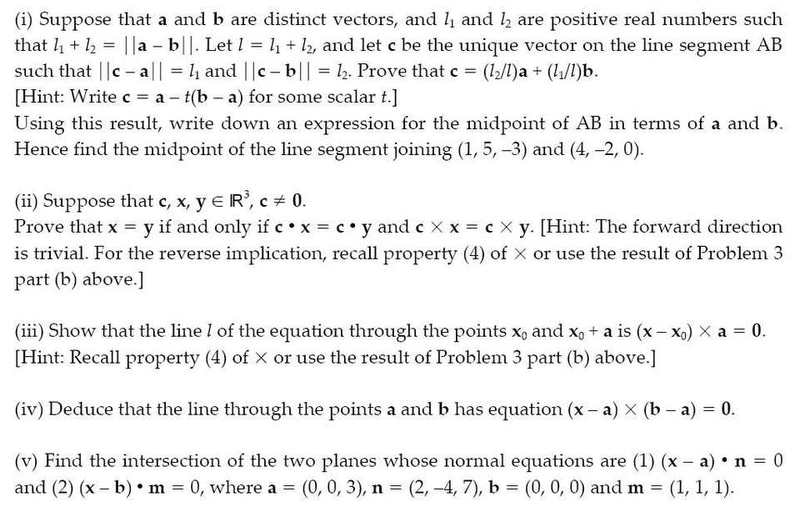
2jwopw.jpg
 
Last edited:
Physics news on Phys.org
Could you show us how you solved part (i)?
 
berkeman said:
Could you show us how you solved part (i)?

c = a + t(b-a), take t = l1 / l
c = a + (l1 / l)(b-a), Expand
c = a -a(l1 / l) + b(l1 / l) Collect terms with a.
c = a(1 - (l1 / l)) + b(l1 / l) 1 = l / l
c = a(l/l - (l1 / l)) + b(l1 / l)
c = a(l - l1)/l + b(l1 / l) l - l1 = l2
c = a(l2 / l) + b(l1 / l)

Its the rest I am stuck on :(
Any ideas?
 
Hi simpleas123, welcome to PF!:smile:

simpleas123 said:
c = a + t(b-a), take t = l1 / l

You should probably use boldface type to distinguish vectors from scalars, just to make things clear (Clicking on the "go advanced" button will give you all kinds of typesetting options, including using \LaTeX)

Also, although t=\frac{l_1}{l} is correct, you need to provide a justification of this for your proof to be complete (A justification of the hint given is also necessary).

Its the rest I am stuck on :(
Any ideas?

For problem (ii), proving the statement "If \textbf{x}=\textbf{y}, then \textbf{c}\cdot\textbf{x}=\textbf{c}\cdot\textbf{y} and \textbf{c}\times\textbf{x}=\textbf{c}\times\textbf{y}" should be easy enough...as for proving the opposite direction if-then statement; what is the result of problem 3 (b) they mention?...What is property (4) of the cross product?
 
Property 4 is the same as result of problem 3 (b).
It states that;

Where a,b are vectors

a x b = 0, if and only if there exist two scalars \mu,\lambda one of which is non-zero such that a\lambda = b\mu

I have done part ii) now too.
 
Okay, and what was your solution for (ii)?

Problem (iii) appears to contain a typo...I am fairly certain it's suppose to say:

"Show that the equation of the line l through the points \textbf{x}_0 and \textbf{x}_0+\textbf{a} is (\textbf{x}-\textbf{x}_0)\times\textbf{a}=0"

To do this, just use what property 4 tells you about the equation (\textbf{x}-\textbf{x}_0)\times\textbf{a}=0...
 
gabbagabbahey said:
Okay, and what was your solution for (ii)?

Problem (iii) appears to contain a typo...I am fairly certain it's suppose to say:

"Show that the equation of the line l through the points \textbf{x}_0 and \textbf{x}_0+\textbf{a} is (\textbf{x}-\textbf{x}_0)\times\textbf{a}=0"

To do this, just use what property 4 tells you about the equation (\textbf{x}-\textbf{x}_0)\times\textbf{a}=0...

Part ii)
c \cdot y = c \cdot x
(c \cdot y) - (c \cdot x) = 0
c \cdot (x-y) = 0

\therefore y = x
and it was pretty much the same method for the cross product execpt u had to state a property at the end as x x y could equal something other than 0.
 
simpleas123 said:
Part ii)
c \cdot y = c \cdot x
(c \cdot y) - (c \cdot x) = 0
c \cdot (x-y) = 0

\therefore y = x
and it was pretty much the same method for the cross product execpt u had to state a property at the end as x x y could equal something other than 0.

Careful, \textbf{c}\cdot(\textbf{x}-\textbf{y})=0 doesn't necessarily mean that \textbf{x}-\textbf{y}=0...one of the vectors in a dot product being zero is not the only way for the dot product to be zero...
 
\bold{c} \cdot (\bold{x}-\bold{y}) = \bold{0}
This doesn't necessarily imply that x = y. All it says is that c is orthogonal to x - y.

Counterexample: c = (1, 0, 0), x = (0, 2, 0), y = (0, 1, 0).
\bold{c} \cdot (\bold{x}-\bold{y}) = (1, 0, 0) \cdot (0, 1, 0) = \bold{0}
but x - y isn't 0.
 
  • #10
Mark44 said:
\bold{c} \cdot (\bold{x}-\bold{y}) = \bold{0}
This doesn't necessarily imply that x = y. All it says is that c is orthogonal to x - y.

Counterexample: c = (1, 0, 0), x = (0, 2, 0), y = (0, 1, 0).
\bold{c} \cdot (\bold{x}-\bold{y}) = (1, 0, 0) \cdot (0, 1, 0) = \bold{0}
but x - y isn't 0.

Oh snap that's right, well then how would i prove it?
 
  • #11
simpleas123 said:
Oh snap that's right, well then how would i prove it?

Well, \textbf{c}\cdot(\textbf{x}-\textbf{y})=0 tells you either \textbf{x}-\textbf{y}=0 or \textbf{x}-\textbf{y} is orthogonal to \textbf{c}...right?

What can you say about \textbf{c}\times(\textbf{x}-\textbf{y}) if \textbf{x}-\textbf{y} is orthogonal to \textbf{c}?
 

Similar threads

Replies
9
Views
2K
Replies
21
Views
2K
Replies
1
Views
1K
Replies
5
Views
1K
  • · Replies 9 ·
Replies
9
Views
2K
  • · Replies 9 ·
Replies
9
Views
2K
  • · Replies 4 ·
Replies
4
Views
3K
Replies
5
Views
2K
  • · Replies 13 ·
Replies
13
Views
2K
  • · Replies 4 ·
Replies
4
Views
1K