New Hybrid Model for the Origin of Indo-European Languages

  • Context: Lingusitics 
  • Thread starter Thread starter BillTre
  • Start date Start date
Click For Summary
SUMMARY

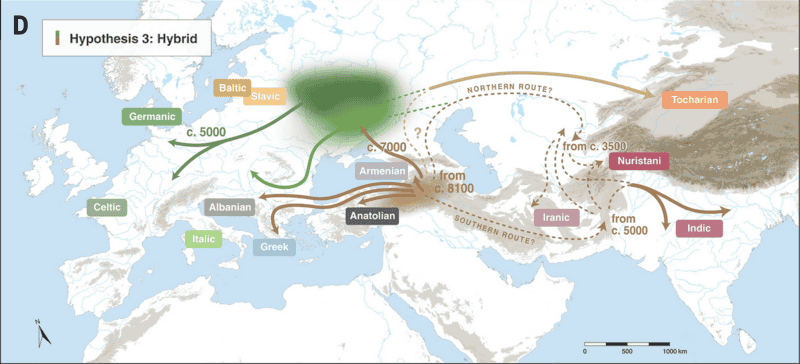
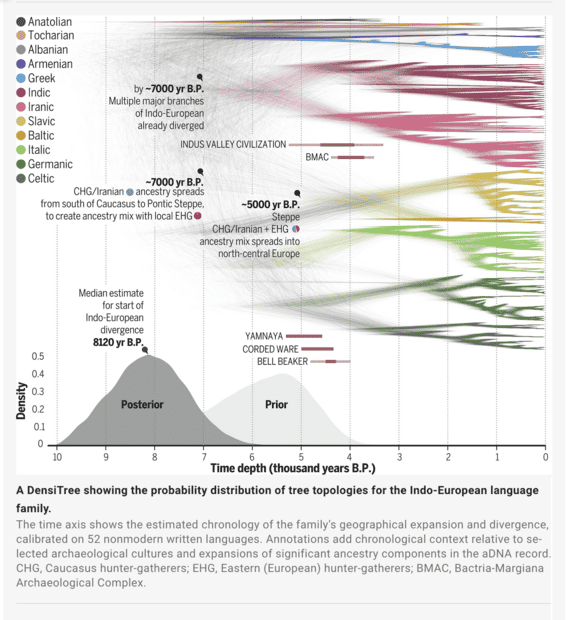
The discussion presents a new hybrid model for the origin of Indo-European languages, integrating both the Steppe and Anatolian hypotheses. The research utilizes Bayesian phylogenetic methods on a dataset of core vocabulary from 161 Indo-European languages, revealing that the Anatolian branch likely originated south of the Caucasus rather than from the Steppe. Additionally, while the Yamnaya culture shows some genetic influence, its timeline does not align with the divergence of languages such as Sanskrit. This study suggests that the resolution to the Indo-European language enigma lies in a combination of both farming and Steppe expansion theories.

PREREQUISITES
  • Understanding of Bayesian phylogenetic methods
  • Familiarity with ancient DNA (aDNA) analysis
  • Knowledge of the Indo-European language family
  • Awareness of historical linguistics and language divergence
NEXT STEPS
  • Research Bayesian phylogenetic methods in linguistics
  • Explore ancient DNA analysis techniques and their applications
  • Study the historical context of the Yamnaya culture and its impact on European languages
  • Investigate the implications of the hybrid model on Indo-European language studies
USEFUL FOR

Researchers in historical linguistics, geneticists studying ancient populations, and anyone interested in the origins and evolution of the Indo-European language family.

BillTre
Science Advisor
Gold Member
Messages
2,734
Reaction score
11,950
From Science (paywalled AAAS journal):
INTRODUCTION​

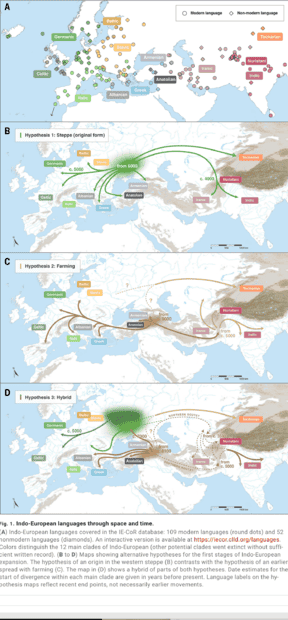
Almost half the world’s population speaks a language of the Indo-European language family. It remains unclear, however, where this family’s common ancestral language (Proto-Indo-European) was initially spoken and when and why it spread through Eurasia. The “Steppe” hypothesis posits an expansion out of the Pontic-Caspian Steppe, no earlier than 6500 years before present (yr B.P.), and mostly with horse-based pastoralism from ~5000 yr B.P. An alternative “Anatolian” or “farming” hypothesis posits that Indo-European dispersed with agriculture out of parts of the Fertile Crescent, beginning as early as ~9500 to 8500 yr B.P. Ancient DNA (aDNA) is now bringing valuable new perspectives, but these remain only indirect interpretations of language prehistory. In this study, we tested between the time-depth predictions of the Anatolian and Steppe hypotheses, directly from language data. We report a new framework for the chronology and divergence sequence of Indo-European, using Bayesian phylogenetic methods applied to an extensive new dataset of core vocabulary across 161 Indo-European languages.
2023-07-27_21-58-41.png


Screenshot 2023-07-27 at 10.09.33 PM.png


CONCLUSION​

Our results are not entirely consistent with either the Steppe hypothesis or the farming hypothesis. Recent aDNA evidence suggests that the Anatolian branch cannot be sourced to the steppe but rather to south of the Caucasus. For other branches, potential candidate expansion(s) out of the Yamnaya culture are detectable in aDNA, but some had only limited genetic impact. Our results reveal that these expansions from ~5000 yr B.P. onward also came too late for the language chronology of Indo-European divergence. They are consistent, however, with an ultimate homeland south of the Caucasus and a subsequent branch northward onto the steppe, as a secondary homeland for some branches of Indo-European entering Europe with the later Corded Ware–associated expansions. Language phylogenetics and aDNA thus combine to suggest that the resolution to the 200-year-old Indo-European enigma lies in a hybrid of the farming and Steppe hypotheses.
2023-07-27_21-59-54.png
 

Attachments

  • 2023-07-27_21-59-54.png
    2023-07-27_21-59-54.png
    53.6 KB · Views: 122
  • Informative
  • Like
Likes   Reactions: BWV and DennisN
Science news on Phys.org
Although some one should cite the author for chart abuse, there has to be a much clearer way to present that data, but if I read it right, the Yamnaya - a common candidate for the original PIE speakers, could be a primary source of European languages but the chronology does not work for Sanskrit and other Asian IE languages?
 

Similar threads

  • · Replies 4 ·
Replies
4
Views
2K