Noetherian Modules and Submodules

  • Context: Undergrad 
  • Thread starter Thread starter Math Amateur
  • Start date Start date
  • Tags Tags
    Modules
Click For Summary

Discussion Overview

The discussion revolves around Proposition 2.4.5 from J A Beachy's "Introductory Lectures on Rings and Modules," specifically focusing on the proof related to Noetherian modules and their submodules. Participants are examining the implications of certain conditions on submodules and exploring the necessary steps to establish that a submodule is finitely generated.

Discussion Character

  • Technical explanation
  • Conceptual clarification
  • Debate/contested
  • Mathematical reasoning

Main Points Raised

  • Peter expresses uncertainty about how the proof shows that if ##N## and ##M/N## are Noetherian, then ##M_0 \cap N## and ##M_0 / (M_0 \cap N)## are finitely generated, leading to ##M_0## being finitely generated.
  • One participant suggests reconsidering the nature of cosets and introduces an example with integers to illustrate the concept of quotient modules.
  • Another participant raises the question of whether the axiom of choice (AC) is required for the proof, noting that some equivalences in this area may depend on it.
  • A different viewpoint asserts that if ##N## is Noetherian, then ##M_0 \cap N## is finitely generated, as well as the quotient module, thus supporting the conclusion that ##M_0## is finitely generated.
  • There is a discussion about the necessity of AC in proving certain implications related to Noetherian modules, with participants speculating on which direction of the implications requires it.
  • Peter revisits the proof steps and questions how to utilize the finitely generated nature of ##M_0 \cap N## and the quotient module to demonstrate that ##M_0## is finitely generated.
  • Another participant challenges the assumption that a submodule of a finitely generated module is finitely generated, emphasizing the need for additional arguments if that result is not already established.

Areas of Agreement / Disagreement

Participants express differing views on the necessity of the axiom of choice in the proof and the implications of Noetherian conditions on submodules. There is no consensus on the specific steps required to conclude that ##M_0## is finitely generated, indicating that the discussion remains unresolved.

Contextual Notes

Some participants note that the relationship between finitely generated modules and Noetherian modules may not hold without additional assumptions, highlighting the complexity of the proof and the potential need for the axiom of choice in certain arguments.

Math Amateur
Gold Member
MHB
Messages
3,920
Reaction score
48
I am reading J A Beachy's Book, Introductory Lectures on Rings and Modules"... ...

I am currently focused on Chapter 2: Modules ... and in particular Section 2.4: Chain Conditions ...

I need help with the proof of Proposition 2.4.5 ...

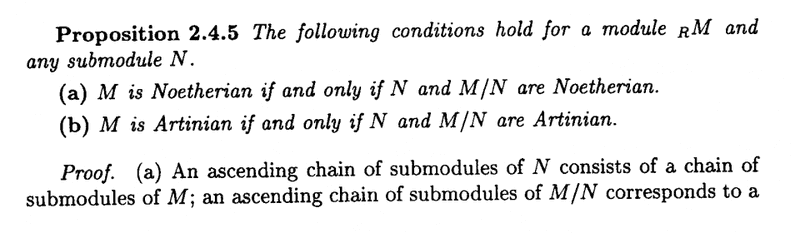
Proposition 2.4.5 reads as follows:
?temp_hash=ada091c612c1b1797f4b1f983463f835.png

?temp_hash=ada091c612c1b1797f4b1f983463f835.png

In the above text by Beachy ... in the proof of part (a) ... we read the following:

"... ... ... Conversely, assume that ##N## and ##M/N## are Noetherian, and let ##M_0## be a submodule of ##M##. Then ##M_0 \cap N## and ##M_0 / ( M_0 \cap N ) \cong (M_0 + N) / N## are both finitely generated, so ##M_0## is finitely generated ... ... ...
I am very unsure of this part of the proof ... but overall Beachy seems to be trying to prove that an arbitrary submodule of ##M##, namely ##M_0##, is finitely generated ... ... and this means that ##M## is Noetherian ...

(Beachy, in his Proposition 2.4.3 has shown that every submodule of ##M## being finitely generated is equivalent to ##M## being Noetherian ... ... )

BUT ... I do not see how it follows in the above that ... ... ##M_0 \cap N## and ##M_0 / ( M_0 \cap N ) \cong (M_0 + N) / N## are both finitely generated ... ... AND ... exactly why it then follows that ##M_0## is finitely generated ... ...

Hope someone can help ...

Peter
 

Attachments

  • J A Beachy - 1 - Proposition 2.4.5 - PART 1 ... ... .png
    J A Beachy - 1 - Proposition 2.4.5 - PART 1 ... ... .png
    18.6 KB · Views: 966
  • J A Beachy - 2 - Proposition 2.4.5 - PART 2.png
    J A Beachy - 2 - Proposition 2.4.5 - PART 2.png
    42.3 KB · Views: 1,111
Physics news on Phys.org
You might reconsider what those cosets are.

Let me start with an example with the integers again, i.e. ##R=\mathbb{Z}##.
Then ##M=6\mathbb{Z}## is a submodule. Now we can write ##\mathbb{Z} = 6\mathbb{Z}\cup(1+6\mathbb{Z})\cup(2+6\mathbb{Z})\cup(3+6\mathbb{Z})\cup(4+6\mathbb{Z})\cup(5+6\mathbb{Z})##, that is every integer is exactly in one of those six sets. They are called cosets with respect to ##M##, which itself corresponds to ##0+6\mathbb{Z}##.

The representatives ## \{0_M,1_M,2_M,3_M,4_M,5_M\}## of these cosets form again a module. Not a submodule! Its elements are (co-)sets which are only represented by these six numbers ##n_M##. For short we write ##R / M = \mathbb{Z}/ 6\mathbb{Z} \cong \mathbb{Z}_6## because they behave like the remainders of integer division by ##6##.

Those modules are called quotient modules (and sometimes also factor modules - a matter of taste).

What is useful to bear in mind for the proof above, is the correspondence theorem (if I remember its name correctly) and the isomorphism theorems in connection with the short exact sequence ##N \rightarrowtail M \twoheadrightarrow M/N\, ##.

To practice you could think about the submodules in the example above, that is the submodules of ##M=6\mathbb{Z}## and the submodules of the quotient module ##R / M = \mathbb{Z}/6 \mathbb{Z}##. Why must the latter contain ##M##?

With respect to your question:

Math Amateur said:
Conversely, assume that ##N## and ##M/N## are Noetherian

##M_0## is a submodule of ##M \;##, ##M_0 / (M_0 \cap N)## a quotient module of ##M_0##.

Math Amateur said:
(Beachy, in his Proposition 2.4.3 has shown that every submodule of ##M## being finitely generated is equivalent to ##M## being Noetherian ... ... )
 
I wonder whether this one requires using the axiom of choice (AC). I note that certain equivalences in this area do require using AC.

I had a go at proving the ##M_0\cap N## one and came up against an apparent need to make an infinite number of choices.

But there may be some result obtained earlier in the text, that has used AC, that can be used in this problem to prove the result, and thereby avoid having to deploy the AC afresh.

@fresh_42
, do you know whether AC is required to prove the ##M_0\cap N## version?
 
Assuming N is noetherian, means all submodules are fin gen so the submodule M0meetN is trivially fin gen. same for the quotient, since he uses the basic isomorphism law to equate it with a submodule of the quotien M/N which is assumed noetherian. then knowing that the quotient and the sub are fin gen gives the result since combining generators of the two (actually representatives of generators of the quotient) gives generators of the module M0.
 
andrewkirk said:
I wonder whether this one requires using the axiom of choice (AC). I note that certain equivalences in this area do require using AC.

I had a go at proving the ##M_0\cap N## one and came up against an apparent need to make an infinite number of choices.

But there may be some result obtained earlier in the text, that has used AC, that can be used in this problem to prove the result, and thereby avoid having to deploy the AC afresh.

@fresh_42
, do you know whether AC is required to prove the ##M_0\cap N## version?
Not by heart. AC appears as Zorn's Lemma in these contexts and is needed, e.g. to prove the existence of maximal ideals in arbitrary rings. And also in Peter's book the author uses it to guarantee the existence of maximal elements. IMO most authors don't care a lot about it which makes it difficult to detect where it might be hidden.

In the case of Noetherian Rings / Modules to be equivalent to finite generation I think it is needed. At least Peter's book uses it as well as my Atiyah / MacDonald does. In the case above I don't think it's needed. The stationary chains should do.

Edit: It's so common to "algebraic" thinking people, that they usually don't care much. As I read your post I first thought you meant ACC instead of AC.
 
Last edited:
mathwonk said:
Assuming N is noetherian, means all submodules are fin gen
I couldn't get a clear sense from the OP whether that theorem has been proved yet, and hence can be used, or whether alternatively the above Proposition is a step on the way towards proving that theorem.

Looking at the last bit of (a), it appears to be taking as previously proven that:

. (all submods of ##M## are fin gen) ##\Rightarrow## (##M## is Noetherian)

But we'd need the converse implication here.

BTW I would guess that only one of those directions requires AC. If so, which is it?
 
andrewkirk said:
BTW I would guess that only one of those directions requires AC. If so, which is it?
finitely generated ##\Rightarrow## ACC / Noetherian
Noetherian + AC ##\Rightarrow## finitely generated
 
Thanks to fresh_42, Andrew and mathwonk for help and guidance ...

Current thinking is as follows:Assume that ##N## and ##M/N## are Noetherian ... and let ##M_0## be a submodule of ##M## ...... ... need to show that ##M## is Noetherian ... ...Follow J A Beachy and consider ##M_0 \cap N##

All elements of ##M_0 \cap N## belong to ##N## ... and ##N## is finitely generated ...

Therefore some subset of the generating set for ##N## will generate ##M_0 \cap N## ... ...

so, then ... ##M_0 \cap N## is finitely generated ... BUT ... what can we usefully conclude from this ...?

... or more precisely ... how do we use this in proving that ##M_0## is finitely generated ...?Now, again following J A Beachy's proof ... consider ##M_0 / ( M_0 \cap N )##

Beachy claims that ##M_0 / ( M_0 \cap N )## is finitely generated ... BUT ... how do we show this ...

... and further ... how do we use this fact to show that ##M_0## is finitely generated?

Now ... Beachy points out that ##M_0 / ( M_0 \cap N ) \cong ( M + N ) / N## ...

So presumably we need to show ##( M + N ) / N## is finitely generated ...

... and then conclude ##M_0 / ( M_0 \cap N )## is finitely generated ...

But how do we do this ... and further ... how do we use this to prove ##M_0## is finitely generated ...?

Hope someone can help ...

Peter
 
Math Amateur said:
All elements of ##M_0 \cap N## belong to ##N## ... and ##N## is finitely generated ...

Therefore some subset of the generating set for ##N## will generate ##M_0 \cap N## ... ...
That assumes that a submodule of a finitely-generated module is finitely-generated, which is not in general true.

If we already have the result that all submodules of a Noetherian module are FG then we can immediately conclude that ##M_0\cap N## is, since it is a submodule of ##N##, which we are told is Noetherian. But if we don't already have that result, we cannot take that step without additional argument (the nature of which is not immediately apparent to me, other than that it's probably going to have to involve some strictly ascending chains).

Has it been proven in the text, prior to the Proposition being discussed, that all submodules of a Noetherian module are FG?
 
  • #10
Math Amateur said:
Thanks to fresh_42, Andrew and mathwonk for help and guidance ...

Current thinking is as follows:Assume that ##N## and ##M/N## are Noetherian ... and let ##M_0## be a submodule of ##M## ...... ... need to show that ##M## is Noetherian ... ...Follow J A Beachy and consider ##M_0 \cap N##

All elements of ##M_0 \cap N## belong to ##N## ... and ##N## is finitely generated ...

Therefore some subset of the generating set for ##N## will generate ##M_0 \cap N## ... ...

so, then ... ##M_0 \cap N## is finitely generated ... BUT ... what can we usefully conclude from this ...?

... or more precisely ... how do we use this in proving that ##M_0## is finitely generated ...?

Now, again following J A Beachy's proof ... consider ##M_0 / ( M_0 \cap N )##

Beachy claims that ##M_0 / ( M_0 \cap N )## is finitely generated ... BUT ... how do we show this ...

... and further ... how do we use this fact to show that ##M_0## is finitely generated?

Now ... Beachy points out that ##M_0 / ( M_0 \cap N ) \cong ( M + N ) / N## ...

So presumably we need to show ##( M + N ) / N## is finitely generated ...

... and then conclude ##M_0 / ( M_0 \cap N )## is finitely generated ...

But how do we do this ... and further ... how do we use this to prove ##M_0## is finitely generated ...?

Hope someone can help ...

Peter

By the isomorphism theorem ##M_0 / ( M_0 \cap N ) \cong (M_0 +N / N) \subseteq M / N## is a submodule.

Submodules of finitely generated modules are finitely generated.

Therefore not only ##M_0 \cap N## is finitely generated, but also ##M_0 / (M_0 \cap N)## since ##M/N## is.

Now I assume that there has been a proposition that says:

If ##A \rightarrowtail B \twoheadrightarrow C## is short exact and ##A## and ##C## are finitely generated, so is ##B##.
Applied to ##A=M_0 \cap N\, , \, B=M_0 \, , \, C= M_0 / ( M_0 \cap N )## it means ##M_0## is finitely generated.

As a personal remark, I don't understand, why we need a submodule ##M_0## of ##M## instead of ##M## in the first place.
I would have expected an induction on the number of generators though (starting with ##\{0\}##).
In addition and having the discussion above about Zorn's Lemma in mind, I think a proof using only chains and the ascending chain conditions on ##N## and ##M/N## instead of generators would have been better in this case. (You might try this as an exercise.)

@andrewkirk He already has the equivalence of Noetherian and FG (Prop. 2.4.3). So only "submodules and quotient modules of FG modules are FG and vice versa" is needed. But I don't understand the role of ##M_0## either.

Edit: However, if you already have
"Given the exact sequence ##\{0\} \rightarrow A \rightarrow B \rightarrow C \rightarrow \{0\}## then ##B## is finitely generated if and only if ##A## and ##C## are finitely generated." (*)
which Beachy apparently uses, then together with the equivalence from Proposition 2.4.3 there is nothing left to show, since (*) is the exact same (equivalent) statement as Prop. 2.4.5 (a).
 
Last edited:
  • Like
Likes   Reactions: Math Amateur
  • #11
fresh_42 said:
Submodules of finitely generated modules are finitely generated
For Noetherian modules, yes.
For modules in general, no. See for instance here. There's a better example in my Hartley and Hawkes, but that's at home and I'm at work.
fresh_42 said:
@andrewkirk He already has the equivalence of Noetherian and FG (Prop. 2.4.3).
Ah, so he has. I didn't notice that comment in the OP. Given that, the FG-ness of ##M_0\cap N## is immediate.
 
  • #12
andrewkirk said:
For Noetherian modules, yes.
For modules in general, no. See for instance here. There's a better example in my Hartley and Hawkes, but that's at home and I'm at work.
Interesting, thanks.
 
  • #13
fresh_42 said:
By the isomorphism theorem ##M_0 / ( M_0 \cap N ) \cong (M_0 +N / N) \subseteq M / N## is a submodule.

Submodules of finitely generated modules are finitely generated.

Therefore not only ##M_0 \cap N## is finitely generated, but also ##M_0 / (M_0 \cap N)## since ##M/N## is.

Now I assume that there has been a proposition that says:

If ##A \rightarrowtail B \twoheadrightarrow C## is short exact and ##A## and ##C## are finitely generated, so is ##B##.
Applied to ##A=M_0 \cap N\, , \, B=M_0 \, , \, C= M_0 / ( M_0 \cap N )## it means ##M_0## is finitely generated.

As a personal remark, I don't understand, why we need a submodule ##M_0## of ##M## instead of ##M## in the first place.
I would have expected an induction on the number of generators though (starting with ##\{0\}##).
In addition and having the discussion above about Zorn's Lemma in mind, I think a proof using only chains and the ascending chain conditions on ##N## and ##M/N## instead of generators would have been better in this case. (You might try this as an exercise.)

@andrewkirk He already has the equivalence of Noetherian and FG (Prop. 2.4.3). So only "submodules and quotient modules of FG modules are FG and vice versa" is needed. But I don't understand the role of ##M_0## either.

Edit: However, if you already have
"Given the exact sequence ##\{0\} \rightarrow A \rightarrow B \rightarrow C \rightarrow \{0\}## then ##B## is finitely generated if and only if ##A## and ##C## are finitely generated." (*)
which Beachy apparently uses, then together with the equivalence from Proposition 2.4.3 there is nothing left to show, since (*) is the exact same (equivalent) statement as Prop. 2.4.5 (a).
Thanks for the above post fresh_42 ...

You write:

"... ... By the isomorphism theorem ##M_0 / ( M_0 \cap N ) \cong (M_0 +N / N) \subseteq M / N## is a submodule. ... .. "

How do we know that ##(M_0 +N / N)## is a submodule of ##M / N## ... ... ?

Peter
 
  • #14
Math Amateur said:
Thanks for the above post fresh_42 ...

You write:

"... ... By the isomorphism theorem ##M_0 / ( M_0 \cap N ) \cong (M_0 +N / N) \subseteq M / N## is a submodule. ... .. "

How do we know that ##(M_0 +N / N)## is a submodule of ##M / N## ... ... ?

Peter
There is a small parenthesis sloppyness from my side. It better would have been written ##(M_0 +N) / N##.
##M_0 +N## is a submodule of ##M## that contains ##N##. So ##(M_0 +N) / N## is a submodule of ##M/N##.
I think it has been called correspondence principle in your books, but I'm not sure.

You can simply write down the arithmetic in ##(M_0 +N) / N##:

##(a+N)+(b+N)=(a+b)+N\, , \,(a,b \in M_0+N)##
##r(a+N)=ra+rN=ra+N\, , \,(a \in M_0+N\, , \,r\in R)##

What has to be shown is the well-definition of them, i.e. that one gets the same result for different representatives.
That is ##(a+N)+(b+N)=(a'+N)+(b'+N)## for ##a'=a+n_a\, , \,b'=b+n_b## and ##r(a+N)=ra'+N##. Because we are dealing with cosets here, which are sets, their representatives may vary. In ##(M_0+N)/N## (and all other quotient objects), ##a+N## and ##a'+N## is the same element iff ##a-a' \in N##.
 
  • Like
Likes   Reactions: Math Amateur
  • #15
1) ##N## is noetherian and ##M_0 \cap N \leq N##, so ##M_0 \cap N## is fingen (finitely generated).

2) ##M/N## is noetherian and ##(M_0 + N)/N \leq M/N##, so ##(M_0 + N)/N## is fingen.

3) ##M_0/(M_0 \cap N) \cong (M_0 + N)/N##, so ##M_0/(M_0 \cap N## is fingen.

4) ##M_0 \cap N## is fingen and ##M_0/(M_0 \cap N)## is fingen, thus ##M_0## is fingen, by a remark of Beachy on page.70.
 
  • #16
I am kind of worried about the fact that anyone would ask why the non existence of an infinite ascending chain of submodules implies all submodules are finitely generated. That is about the most automatic self proving statement I can think of. I guess you do have to have the reflex to prove something by negation, but please just try this, if you think this is a problem. some day a chick has to fly.
 

Similar threads

Replies
4
Views
2K
  • · Replies 13 ·
Replies
13
Views
3K
Replies
1
Views
2K
Replies
2
Views
2K
Replies
2
Views
2K
Replies
21
Views
3K
  • · Replies 2 ·
Replies
2
Views
2K
  • · Replies 3 ·
Replies
3
Views
2K
  • · Replies 10 ·
Replies
10
Views
3K
  • · Replies 1 ·
Replies
1
Views
1K