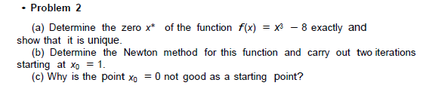
"Newton's method" is a numerical method for solving an equation that basically replaces the function at a given value of x by the tangent function at that point. Here the function is [tex]f(x)= x^3- 8[/tex] which has derivative [tex]f'(x)= 3x^2[/tex], the derivative at [tex]x_0[/tex] [tex]f(x_0)= 3x_0^2[/tex] while the value of the function is [tex]x_0^3- 8[/tex]. So the tangent function at [tex]x= x_0[/tex] is [tex]y= 3x_0^2(x- x_0)+ x_0^3- 8[/tex]. Setting that equal to 0, [tex]3x_0^2(x- x_0)+ x_0^3- 8= 0[/tex], [tex]3x_0^2(x- x_0)= 8- x_0^3[/tex], [tex]x- x_0= \frac{8- x_0^3}{3x_0^2}[/tex], and [tex]x= x_0+ \frac{8- x_0^3}{3x_0^2}[/tex].
Start with some reasonable value for [tex]x_0[/tex] and calculate the next value for x: with, say, [tex]x_0= 1[/tex], [tex]x= 1+ \frac{8- 1}{3}= 1+ \frac{7}{3}= \frac{10}{3}[/tex]. Now take [tex]x_0= \frac{10}{3}[/tex] and calculate the next value for x. Repeat until you get two consecutive values for x that are closer together than your allowable error.
[tex]x_0= 0[/tex] is not a "good" starting value (in fact, it is impossible) because the denominator, [tex]3x_0^2[/tex], would be 0.