Operations regarding tensor-product states

  • Context: Undergrad 
  • Thread starter Thread starter WWCY
  • Start date Start date
  • Tags Tags
    Operations States
Click For Summary
SUMMARY

The discussion focuses on tensor-product states in quantum field theory (QFT), specifically the inner product of basis vectors for two-particle states represented as ##|\mu_i \rangle |\nu_j \rangle##. The inner product for discrete states is confirmed as ##\langle \mu_{i'}|\langle \nu_{j'}|\mu_i \rangle |\nu_j \rangle = \delta_{i,i'} \delta_{j,j'}##, while for continuous degrees of freedom, the identity ##\langle p',q' |p,q \rangle = \delta(p-p') \delta(q-q')## holds true. The discussion emphasizes the necessity of symmetrization for identical particles and the inclusion of spin indices for fermions, which is often overlooked in literature, particularly in Blundell's QFT book.

PREREQUISITES
  • Understanding of tensor-product states in quantum mechanics
  • Familiarity with quantum field theory (QFT) concepts
  • Knowledge of creation and annihilation operators
  • Basic principles of symmetrization and antisymmetrization in quantum systems
NEXT STEPS
  • Study the role of creation and annihilation operators in QFT
  • Learn about the symmetrization and antisymmetrization processes for identical particles
  • Explore the implications of spin degrees of freedom in quantum states
  • Read Blundell's book on QFT with a focus on the treatment of identical particles
USEFUL FOR

Quantum physicists, students of quantum mechanics, and researchers in quantum field theory seeking to deepen their understanding of tensor-product states and the treatment of identical particles.

WWCY
Messages
476
Reaction score
15
TL;DR
Confusion regarding the inner product of tensor-product states
I have a question on tensor-product states that I'd like to ask, thanks in advance!

1. The basis vector of a two-particle state can be written as ##|\mu_i \rangle |\nu_j \rangle## for orthonormal vectors ##|\mu_i \rangle, |\nu_j \rangle## spanning their single-particle Hilbert spaces. The inner product of basis vectors can be written as ##\langle \mu_{i'}|\langle \nu_{j'}|\mu_i \rangle |\nu_j \rangle = \delta_{i,i'} \delta_{j,j'}##

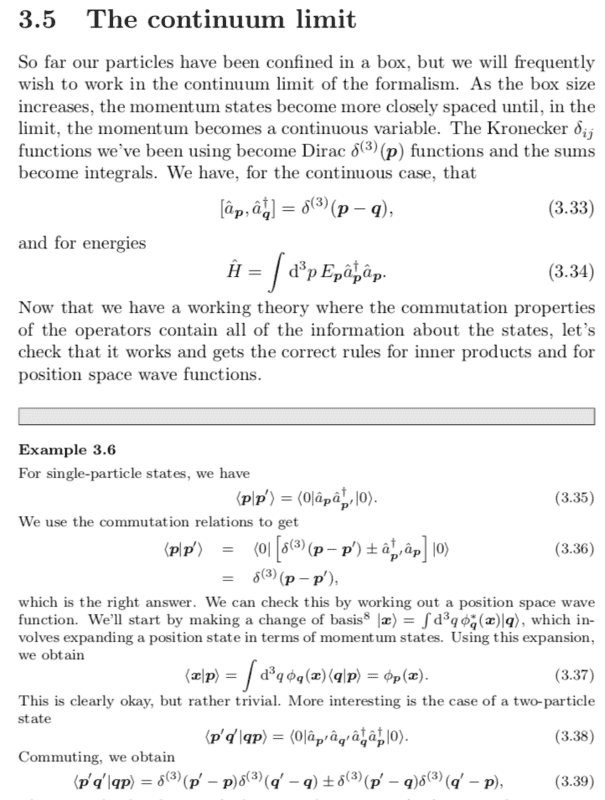
Does this hold for kets with continuous degrees of freedom? Eg momentum ##\langle p',q' |p,q \rangle = \delta(p-p') \delta(q-q')##. After reading Blundell's book on QFT however (screenshot provided below), I attempted to use creation and annihilation operators to obtain the above identity, but what I kept obtaining was ##\langle p',q' |p,q \rangle = \langle 0|\hat{a_{p'}}\hat{a_{q'}}\hat{a_{p}}^\dagger\hat{a_{q}}^\dagger|0\rangle = \delta(p-p') \delta(q-q') + \delta(q-p')\delta(p-q')##.
Screenshot 2019-06-19 at 5.44.00 AM.png
 
Physics news on Phys.org
It's all consistent! The point is that in your example from the book you deal with identical particles, and the QFT formalism includes the appropriate symmetrization (bosons) or antisymmetrization (fermions), i.e., you do not deal with the full product space but only with the totally symmetrized/antisymmetrized Fock states for bosons and fermions. A convenient basis for the Fock space are the occupation-number states, which is very natural, because you cannot know in any way which particle is which due to the indistinguishability of identical particles (with identical I mean that the particles carry exactly the same instrinsic quantum numbers, mass and various conserved charges of the Standard Model).

What's wrong in the book is to omit the spin indices. Only for scalar bosons there are of course none. Fermions necessarily have half-integer spin and thus you must include the spin degree of freedom in you single-particle basis.
 
  • Like
Likes   Reactions: WWCY
Ah yes, I completely forgot about the need to satisfy exchange symmetry, thanks for pointing that out!
 

Similar threads

  • · Replies 15 ·
Replies
15
Views
3K
  • · Replies 1 ·
Replies
1
Views
1K
  • · Replies 1 ·
Replies
1
Views
2K
  • · Replies 2 ·
Replies
2
Views
1K
  • · Replies 1 ·
Replies
1
Views
1K
  • · Replies 4 ·
Replies
4
Views
1K
  • · Replies 4 ·
Replies
4
Views
3K
  • · Replies 8 ·
Replies
8
Views
4K
Replies
2
Views
1K
  • · Replies 18 ·
Replies
18
Views
2K