Optimal Mounting Arrangement for Reinforcement Brackets in Structural Beams?

  • Thread starter Thread starter gmartine
  • Start date Start date
  • Tags Tags
    Bracket
Click For Summary

Discussion Overview

The discussion revolves around the optimal mounting arrangement for reinforcement brackets in structural beams, specifically focusing on the implications for stiffness and structural integrity. Participants explore different configurations and their effects on performance, considering both theoretical and practical aspects.

Discussion Character

  • Exploratory
  • Technical explanation
  • Debate/contested

Main Points Raised

  • One participant questions the preferred arrangement of reinforcement brackets, comparing a specific mounting method to another suggested in an article, considering factors like stiffness and moment of inertia.
  • Another participant notes that the orientation of the brackets may be influenced by accessibility to the joists, suggesting that practical considerations might dictate the chosen method.
  • A different participant raises concerns about maintaining a level surface on the beam if it is used in flooring applications, indicating that unevenness could be a factor in the decision-making process.
  • One participant expresses skepticism about the necessity of horizontal stiffness provided by one mounting method, suggesting that vertical stiffness may be sufficient.
  • Another participant references the manufacturer's claim that a specific configuration is stronger, but questions whether this strength translates to a significant difference in stiffness without bonding.
  • One participant proposes that a particular arrangement might allow for the installation of two braces on either side of the beam, though they express uncertainty about the necessity of this approach.

Areas of Agreement / Disagreement

Participants do not reach a consensus on the optimal mounting arrangement, with multiple competing views and uncertainties remaining regarding the implications of different configurations on stiffness and structural performance.

Contextual Notes

Participants express varying assumptions about the importance of vertical versus horizontal stiffness, the impact of accessibility on mounting choices, and the potential effects on the beam's surface level. These factors remain unresolved in the discussion.

Who May Find This Useful

Individuals interested in structural engineering, particularly those involved in the design and reinforcement of beams, may find this discussion relevant.

gmartine
Messages
4
Reaction score
1
Thanks for taking interest but I studied basic statics about three decades ago and I wasn't quite sure what the definitive answer was...can anybody tell me what the preferred arrangement of this reinforcement bracket should be?
Should it be as shown in the picture to achieve maximum stiffness or with the flanges hooked over and under the joist as the article below suggests. I thought initially the increased area moment of inertia by having the flanges mounted away from the beam would have made a difference? Assume the beam is a 12 x 2" and the hole is 8" diameter, bracketry is standard 14 gauge BMS, thanks again.
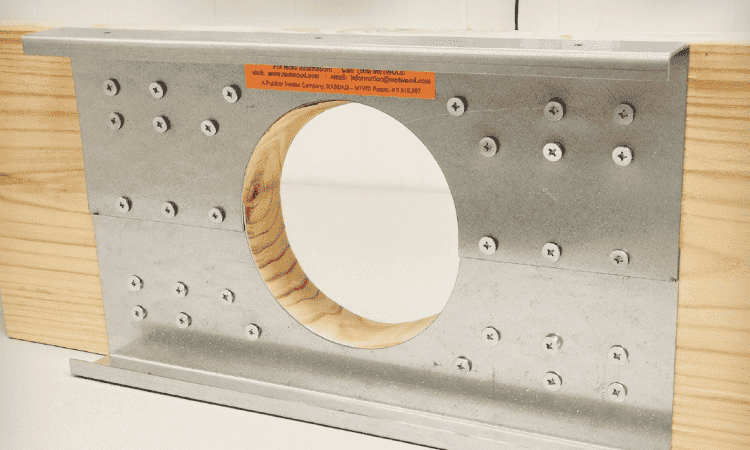
metwood.png


https://www.proremodeler.com/innovative-products-metwood-building-solutions-joist-reinforcements
 

Attachments

  • metwood.png
    metwood.png
    87.3 KB · Views: 595
Engineering news on Phys.org
Welcome to the PF. :smile:

It looks wrong when shown in isolation like that, but all of the pics at the Metwood website seem to show that orientation. I'm guessing it's because you don't always have access to the tops of the joists...? Like this (from Google Images):

upload_2018-10-22_13-48-8.png
 

Attachments

  • upload_2018-10-22_13-48-8.png
    upload_2018-10-22_13-48-8.png
    68.8 KB · Views: 519
  • Like
Likes   Reactions: gmartine
Thank you...also besides access you wouldn't want to create any unevenness to the top surface of the beam if it were being used in flooring for example.
 
  • Like
Likes   Reactions: berkeman
I don't think it matters much. the flange us there for vertical stiffness, which you get either way. Mounting as picture will add horizontal stiffness, which is nice but probably not really required.
 
Good point, the company does say it is stronger with flanges over and under the beam just wondering definitely if that were true (without bonding) or the stiffness remained about the same for both scenarios.
 
One way allow you to fit two braces, one each side of the beam.
 
Could be, not sure if it would be necessary but then that's why I'm here.
 

Similar threads

Replies
33
Views
6K
  • · Replies 17 ·
Replies
17
Views
17K
  • · Replies 4 ·
Replies
4
Views
4K