Oscillation of a particle inside water caused by a sound wave

Join the discussion
Registration is free. Start your own thread to ask a follow-up.
1 reply · 2K views
bubble-flow
Messages
2
Reaction score
1
Homework Statement
Under water, a flat, sinusoidal sound wave with 1 MHz frequency and 1000 kW/m² intensity hits a round particle with a diameter of 10 microns and a density of 5 kg/m³. It is stimulated to oscillate in the longitudinal direction. How big is the amplitude of this movement?
Relevant Equations
No equations given
I don't really know where to start as this is not exactly my homework and I finished school some 15 years ago. I looked into my old high school notes, the last time I ever had anything about mechanical waves and sound. Unfortunately, we never learned anything about sound waves causing oscillation in a 2-phase flow, so I don't even know what to google for an explanation or appropriate equations.
So far this is what I have:
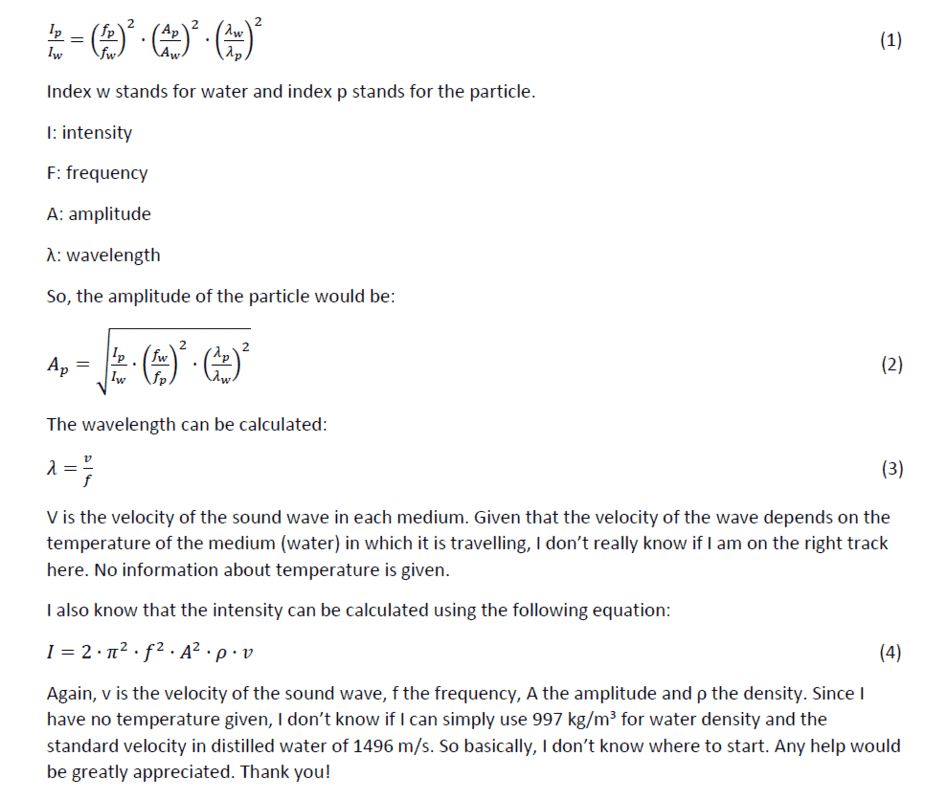
pic.png

​
 
Physics news on Phys.org
Hi.

I just estimate order of the amplitude.
Mass of the particle is
[tex]\frac{3}{4}\pi (10\times10^{-6})^3\ m^3 \times 5\ kg/m^3\ \equiv M[/tex]
The area that particle receives energy is
[tex]\pi(10/2\times 10^{-5})^2\ m^2[/tex]
So energy the particle get is
[tex]\pi(10/2\times 10^{-5})^2\ \times 10^6\ W[/tex]
During a pair of push pull time of ##10^{-6}## seconds input energy is
[tex]\pi(10/2\times 10^{-5})^2\ \times 10^6\times 10^{-6} \ Joule\ \equiv E[/tex]

In stationary case where input energy dissipates, we may estimate the above energy is average Kinetic Energy whose formula is
[tex]E=\frac{1}{2}Mv^2[/tex]
average absolute value of velocity is
[tex]|v|=\sqrt{2E/M}[/tex]
We get order of displacement amplitude as
[tex]|v|\times 10^{-6} \ m[/tex]
it is calculated order of ##m\ m##.
 
  • Like
Likes   Reactions: Delta2 and bubble-flow