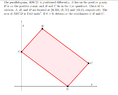
Ilikebugs Messages 94 Reaction score 0 Thread starter Jan 28, 2017 #1 View attachment 6377 Is there a way to do this other than guess and check? Attachments tri 2.png 13.7 KB · Views: 151
Prove It Gold Member MHB Messages 1,434 Reaction score 20 Jan 28, 2017 #2 Ilikebugs said: Is there a way to do this other than guess and check? The length of segment AD is $\displaystyle \begin{align*} \sqrt{ \left( 40 - 0 \right) ^2 + \left( 0 - 30 \right) ^2 } = \sqrt{1600 + 900} = \sqrt{2500} = 50 \end{align*}$. The length of segment AB is $\displaystyle \begin{align*} \sqrt{ \left( k - 0 \right) ^2 + \left( 50 - 30 \right) ^2 } = \sqrt{ k^2 + 400 } \end{align*}$. The length of segment BD is $\displaystyle \begin{align*} \sqrt{ \left( 40 - k \right) ^2 + \left( 0 - 50 \right) ^2 } = \sqrt{ 1600 - 80\,k + k^2 + 2500 } = \sqrt{ k^2 - 80\,k + 4100 } \end{align*}$. Thus the area of triangle ABD can be found using Heron's Formula and the length of the parallelogram is double that. Then you can set this quantity equal to 1340 and solve for k.
Ilikebugs said: Is there a way to do this other than guess and check? The length of segment AD is $\displaystyle \begin{align*} \sqrt{ \left( 40 - 0 \right) ^2 + \left( 0 - 30 \right) ^2 } = \sqrt{1600 + 900} = \sqrt{2500} = 50 \end{align*}$. The length of segment AB is $\displaystyle \begin{align*} \sqrt{ \left( k - 0 \right) ^2 + \left( 50 - 30 \right) ^2 } = \sqrt{ k^2 + 400 } \end{align*}$. The length of segment BD is $\displaystyle \begin{align*} \sqrt{ \left( 40 - k \right) ^2 + \left( 0 - 50 \right) ^2 } = \sqrt{ 1600 - 80\,k + k^2 + 2500 } = \sqrt{ k^2 - 80\,k + 4100 } \end{align*}$. Thus the area of triangle ABD can be found using Heron's Formula and the length of the parallelogram is double that. Then you can set this quantity equal to 1340 and solve for k.
Greg Gold Member MHB Messages 1,377 Reaction score 0 Jan 29, 2017 #3 $$\left|\vec{AB}\times\vec{AD}\right|=1340\implies k=18,\quad B(x,y)=(18,50)$$ $$\vec{AB}+\vec{AD}=\vec{AC}\implies C(x,y)=(58,20)$$
$$\left|\vec{AB}\times\vec{AD}\right|=1340\implies k=18,\quad B(x,y)=(18,50)$$ $$\vec{AB}+\vec{AD}=\vec{AC}\implies C(x,y)=(58,20)$$