MHB Parameterization for a Straight Line

  • Thread starter Thread starter nacho-man
  • Start date Start date
Click For Summary
Parameterization of a straight line between points z1 and z2 is crucial, as it determines the direction of the curve. The formulas (1-t)z1 + z2t and z1 + t(z2 - z1) can be used interchangeably, but the choice of z1 and z2 affects the orientation of the line. The parameter t can range from negative to positive values depending on the direction of the line; for a line going from right to left, negative values may be appropriate. It is important to ensure that the chosen parameterization accurately represents the curve's direction. Understanding that parameterizations can vary while still representing the same line is key to resolving confusion.
nacho-man
Messages
166
Reaction score
0
Hi,

Just wanted to clarify with parameterising.

So for a straight line, connected from the point $z_1$ to $z_2$
We can use the formula

$ (1-t)z_{1} + z_{2}t$ or
$ z_{1} + t[(z_1 - z_2)]$

I am just wondering, does it matter which end points you allocate to be z1 and z2?

if so, in which manner do we go about assigning the points?

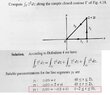
So if you could look at the attached image, for the line $y_3$
could someone please give me what the correct $z_1$ and $z_2$ would be? I've tried both, but can't seem to get the answer.
I did also notice that the direction of the line is going from right to left, so what does that change for us, is it a negative direction?

I am confused why the parameter is ranging from -2<t< 0, although i suspect it may be because the arrow is pointing from right to left.

Any help is very much appreciated.
 

Attachments

  • Parameterize.jpg
    Parameterize.jpg
    18.5 KB · Views: 107
Physics news on Phys.org
Re: parameterization question

nacho said:
Hi,

Just wanted to clarify with parameterising.

So for a straight line, connected from the point $z_1$ to $z_2$
We can use the formula

$ (1-t)z_{1} + z_{2}t$ or
$ z_{1} + t[(z_1 - z_2)]$

I am just wondering, does it matter which end points you allocate to be z1 and z2?

Yes, because the curve has a direction it matters which direction you choose actually the two curves will differ by a negative sign.

If you let the following $$\gamma(t) = (1-t)z_1 +z_2 t = z_1+t(z_2-z_1)$$

if you plug $$t=0$$ in the first equation you get $$\gamma(0) = z_1$$ so the starting point is $$z_1$$ and if you plug $$t=1$$ you get $$\gamma(1) = z_2$$ so the final point is $z_2$ hence the parmatrization of the curve is

$$\int_{\gamma}f(z)\, dz = \int^1_0 f(\gamma(t)) \gamma'(t)\, dt$$
if so, in which manner do we go about assigning the points?

For straight lines it is quite easy $z_1$ is the starting point and $z_2$ is the final point, most of the time it is by trial and error so test it first .

So if you could look at the attached image, for the line $y_3$
could someone please give me what the correct $z_1$ and $z_2$ would be? I've tried both, but can't seem to get the answer.
I did also notice that the direction of the line is going from right to left, so what does that change for us, is it a negative direction?

I am confused why the parameter is ranging from -2<t< 0, although i suspect it may be because the arrow is pointing from right to left.

Any help is very much appreciated.

I understand your confusion because parametrization is not unique so you can get many parametrizations for the same curve but they are actually the same.

In $$\gamma_3$$ what is the starting point $z_1$ and what is $z_2$ ? and just plug them in the formula above.

To check that the formula the book used is correct note that $z_3(t) = -t(1+i)$ so we must have $z_3(-2) = 2+2i $ and $z_3(0) =0$ which is indeed correct. since the paratmerization represents the right coordinates on the curve. But that is not enough we have to prove that $$z_3$$ is an equation of a line and since a line between two point is unique the parametrization is correct.

Note that another valid parametrizations is $z_3(t) = t(1+i)$ where $2 \leq t \leq 0$ since the starting point and the end points coincide with the curve it is correct.
 
Last edited:
Re: parameterization question

Thanks a tonne zaid, that clears up a lot.

i also just remembered that i forgot paramterizations need not be unique
 
Re: parameterization question

nacho said:
Thanks a tonne zaid, that clears up a lot.

i also just remembered that i forgot paramterizations need not be unique

Note that direction IS important. Regardless of what parametrization you use it should EXACTLY represents the same curve with the correct direction.
 
We all know the definition of n-dimensional topological manifold uses open sets and homeomorphisms onto the image as open set in ##\mathbb R^n##. It should be possible to reformulate the definition of n-dimensional topological manifold using closed sets on the manifold's topology and on ##\mathbb R^n## ? I'm positive for this. Perhaps the definition of smooth manifold would be problematic, though.

Similar threads

Replies
1
Views
2K
  • · Replies 7 ·
Replies
7
Views
2K
  • · Replies 3 ·
Replies
3
Views
2K
Replies
3
Views
2K
  • · Replies 2 ·
Replies
2
Views
2K
  • · Replies 16 ·
Replies
16
Views
2K
  • · Replies 1 ·
Replies
1
Views
1K
Replies
1
Views
2K
Replies
3
Views
2K
  • · Replies 22 ·
Replies
22
Views
2K