Partial Order - Reconciling Definitions by Garling and Goldrei

  • Context: Undergrad 
  • Thread starter Thread starter Math Amateur
  • Start date Start date
  • Tags Tags
    Definitions Partial
Click For Summary
SUMMARY

The discussion centers on the definitions of partial orders as presented by D. J. H. Garling in "A Course in Mathematical Analysis" and Derek Goldrei in "Classic Set Theory for Guided Independent Study." Garling's definition does not explicitly include reflexivity, while Goldrei's does. Participants clarify that Garling's condition (ii) implies reflexivity through anti-symmetry, leading to confusion regarding the distinction between weak and strict partial orders. The consensus suggests that Goldrei's terminology may mislead by conflating weak and strict partial orders.

PREREQUISITES
  • Understanding of partial orders and their properties
  • Familiarity with anti-symmetry and transitivity in mathematical relations
  • Knowledge of reflexivity in set theory
  • Basic concepts of equivalence relations
NEXT STEPS
  • Study the implications of reflexivity in partial orders
  • Examine the differences between weak and strict partial orders
  • Learn about equivalence relations and their definitions
  • Explore additional resources on mathematical analysis and set theory
USEFUL FOR

Mathematicians, students of mathematical analysis, and educators seeking clarity on the definitions and properties of partial orders in set theory.

Math Amateur
Gold Member
MHB
Messages
3,920
Reaction score
48
I am reading D. J. H. Garling: "A Course in Mathematical Analysis: Volume I Foundations and Elementary Real Analysis ... ... and I am also referencing concepts in Derek Goldrei's book, "Classic Set Theory for Guided Independent Study" ...

I am currently focused on Garling's Section 1.3 Relations and Partial Orders ... ...

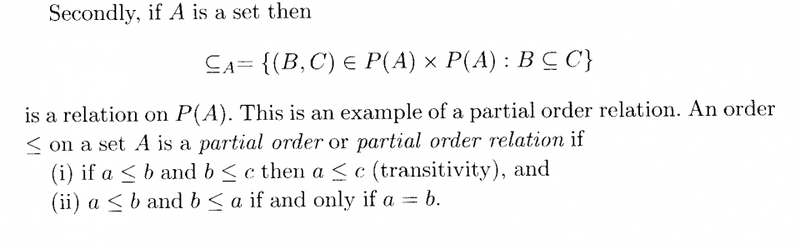
Garling defines a partial order as follows:
?temp_hash=bde0420746728c796c40c6980af783e4.png

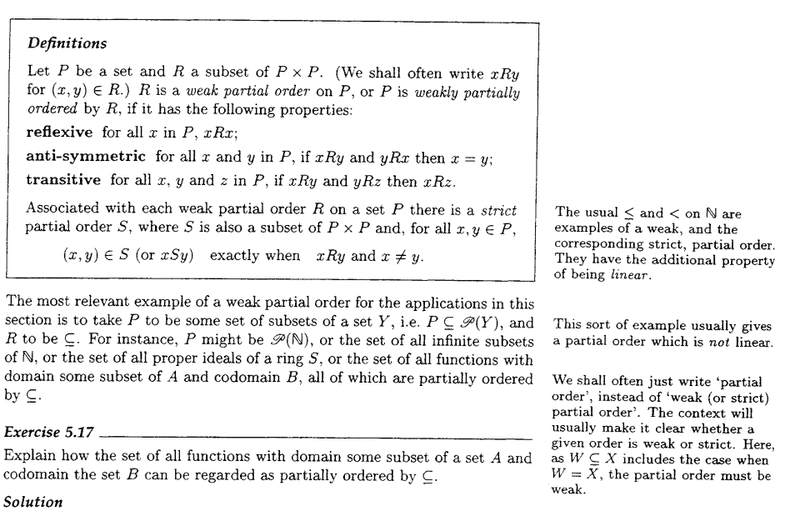
... ... BUT Goldrei's definition is (apparently) slightly different ... as follows:
?temp_hash=bde0420746728c796c40c6980af783e4.png


Can anyone explain why Goldrei includes reflexivity but Garling doesn't ... ... ?

Is it because reflexivity can be derived somehow from Garling's condition (ii) ... which appears to simply be anti-symmetry ... ?

Can someone please clarify this issue ...

Help will be appreciated ...

Peter
 

Attachments

  • Garling - Defn of a Partial Order ... ....png
    Garling - Defn of a Partial Order ... ....png
    39.7 KB · Views: 904
  • Goldrei - Definition of a Partial Order ... ....png
    Goldrei - Definition of a Partial Order ... ....png
    48.8 KB · Views: 966
Physics news on Phys.org
Math Amateur said:
Is it because reflexivity can be derived somehow from Garling's condition (ii)

Yes. Condition (ii) says "if and only if". So if we take the case ##a = b = x ## , condition (ii) implies ##a \le b##, which is equivalent to "##x \le x##".

(An interesting technical question is whether this a consequence of the definition of "##=##" for some particular equivalence relation, or whether it is a consequence of the "common language" definition of the relation "##=##", which , in common mathematical speech implies "You can substitute one of a pair of "equal" symbols for another in any symbolic expression in a proof.")
 
Last edited:
  • Like
Likes   Reactions: Math Amateur
Math Amateur said:
Can anyone explain why Goldrei includes reflexivity but Garling doesn't ... ... ?
I read it as:

Garling (1) = Goldrei (3) = transitivity
Garling (2) = Goldrei (2) = anti-symmetry
Garling automatically satisfies Goldrei (1).

Garling doesn't distinguish between a strict inclusion (##\subsetneq##) and one that allows equality as well (##\subseteq##).
So Garling calls Goldrei's weak partial order simply a partial order whereas Goldrei also speaks of a strict partial order.

Now starts my confusion alike. My reading is, that a strict partial order (## \subsetneq##) cannot be reflexive (Goldrei (1).)
So Goldrei's formulation of a strict partial order which involves a weak partial order isn't a good one. In my opinion he should have defined a weak partial order to be transitive, anti-symmetric and reflexive, and a strict partial order, one that is not reflexive without to refer to weak partial oders. The usage of the word "strict" indicates this intention, I think. Therefore the definition of a strict partial order to be a weak partial order and ... is very misleading for he contradicts himself on reflexivity. He should have taken it simply as:
  1. weak ##\Longleftrightarrow## reflexive, anti-symmetric and transitive ##\Longleftrightarrow## Garling's partial order
  2. strict ##\Longleftrightarrow## anti-symmetric and transitive and reflexivity excluded, i.e not allowed
I guess he thought a similar confusion may arise here: How does it come, that "weak" satisfies three conditions and "strict" only two of them? Shouldn't this be the other way around? But in this case, strict with conditions (1,2,3) and weak with conditions (2,3), how can we call a strict inclusion (##\subsetneq##) then a weak partial order, but an inclusion that allows equality (##\subseteq##) a strict order in contradiction to our usage on the word strict on inclusions.

Either you follow logical principles and contradict the language used for your main and most important example, or you adapt the definitions according to this example and get into logical trouble for strict satisfies less conditions than weak or to be more exact: explicitly exclude one property of weak. And if you compromise as Goldrei tried to, then a clever student from the end of the world shows up and complaints, as well. :wink: Whatever you do ...

I start to understand why Garling abstained from the distinction. There are already total orders waiting around the corner, Archimedian orders and this ominously well-ordering ...

P.S.: Sorry for the end of the world. :oops:
 
  • Like
Likes   Reactions: Math Amateur
fresh_42 said:
I read it as:

Garling (1) = Goldrei (3) = transitivity
Garling (2) = Goldrei (2) = anti-symmetry
Garling automatically satisfies Goldrei (1).

Garling doesn't distinguish between a strict inclusion (##\subsetneq##) and one that allows equality as well (##\subseteq##).
So Garling calls Goldrei's weak partial order simply a partial order whereas Goldrei also speaks of a strict partial order.

Now starts my confusion alike. My reading is, that a strict partial order (## \subsetneq##) cannot be reflexive (Goldrei (1).)
So Goldrei's formulation of a strict partial order which involves a weak partial order isn't a good one. In my opinion he should have defined a weak partial order to be transitive, anti-symmetric and reflexive, and a strict partial order, one that is not reflexive without to refer to weak partial oders. The usage of the word "strict" indicates this intention, I think. Therefore the definition of a strict partial order to be a weak partial order and ... is very misleading for he contradicts himself on reflexivity. He should have taken it simply as:
  1. weak ##\Longleftrightarrow## reflexive, anti-symmetric and transitive ##\Longleftrightarrow## Garling's partial order
  2. strict ##\Longleftrightarrow## anti-symmetric and transitive and reflexivity excluded, i.e not allowed
I guess he thought a similar confusion may arise here: How does it come, that "weak" satisfies three conditions and "strict" only two of them? Shouldn't this be the other way around? But in this case, strict with conditions (1,2,3) and weak with conditions (2,3), how can we call a strict inclusion (##\subsetneq##) then a weak partial order, but an inclusion that allows equality (##\subseteq##) a strict order in contradiction to our usage on the word strict on inclusions.

Either you follow logical principles and contradict the language used for your main and most important example, or you adapt the definitions according to this example and get into logical trouble for strict satisfies less conditions than weak or to be more exact: explicitly exclude one property of weak. And if you compromise as Goldrei tried to, then a clever student from the end of the world shows up and complaints, as well. :wink: Whatever you do ...

I start to understand why Garling abstained from the distinction. There are already total orders waiting around the corner, Archimedian orders and this ominously well-ordering ...

P.S.: Sorry for the end of the world. :oops:
Thanks for the help and the thoughts fresh_42 ...

My thought ... maybe the definition for a strict partial order could be thought to have 3 conditions ... anti-symmetry, transitivity and anti-reflexivity ... then weak and strict partial orders have 3 conditions each ... not quite your preferred ideal of a strict partial order having more conditions however ...

Peter
 
Stephen Tashi said:
Yes. Condition (ii) says "if and only if". So if we take the case ##a = b = x ## , condition (ii) implies ##a \le b##, which is equivalent to "##x \le x##".

(An interesting technical question is whether this a consequence of the definition of "##=##" for some particular equivalence relation, or whether it is a consequence of the "common language" definition of the relation "##=##", which , in common mathematical speech implies "You can substitute one of a pair of "equal" symbols for another in any symbolic expression in a proof.")
Thanks so much for that help Stephen ... that clarifies the issue .. what a relief ...!

I thought that D. J. H. Garling would be too well informed and experienced to put a non-standard definition in a book for undergraduates ... he is an Emeritus Reader in mathematical analysis at the University of Cambridge and he has 50 years of experience teaching undergraduates ... ...

Thanks again ... it all makes sense now ...

Peter
 
Math Amateur said:
Thanks for the help and the thoughts fresh_42 ...

My thought ... maybe the definition for a strict partial order could be thought to have 3 conditions ... anti-symmetry, transitivity and anti-reflexivity ... then weak and strict partial orders have 3 conditions each ... not quite your preferred ideal of a strict partial order having more conditions however ...

Peter
Hi Peter,
I agree, although I would not call it anti-reflexive, because it is a forbidden reflexivity, while the "anti" in the anti-symmetry has actually to do with symmetry. Let's leave it to linguists ... To be honest I got confused myself each time I read my own statement for linguistic corrections.
For some time I even thought Goldrei wanted to distinguish between sets like ##\{1,2,3, \dots\}## and ##\{\frac{2}{2}\frac{4}{4}\frac{6}{6}, \dots \}## but that's too absurd for obvious reasons. I prefer Garling's definition and reserve "strict" as a property of possible inclusions as examples of a partial order, or for progression, comparisons in size and so on. It's fine enough to have partial orders in Garling's sense and distinguish between ##\subseteq## and ##\subsetneq## as examples, if needed.
 

Similar threads

  • · Replies 4 ·
Replies
4
Views
2K
  • · Replies 2 ·
Replies
2
Views
3K
Replies
4
Views
2K
  • · Replies 2 ·
Replies
2
Views
2K
  • · Replies 1 ·
Replies
1
Views
2K
Replies
1
Views
2K
  • · Replies 4 ·
Replies
4
Views
2K
Replies
2
Views
2K
  • · Replies 2 ·
Replies
2
Views
2K
  • · Replies 5 ·
Replies
5
Views
2K