Discussion Overview
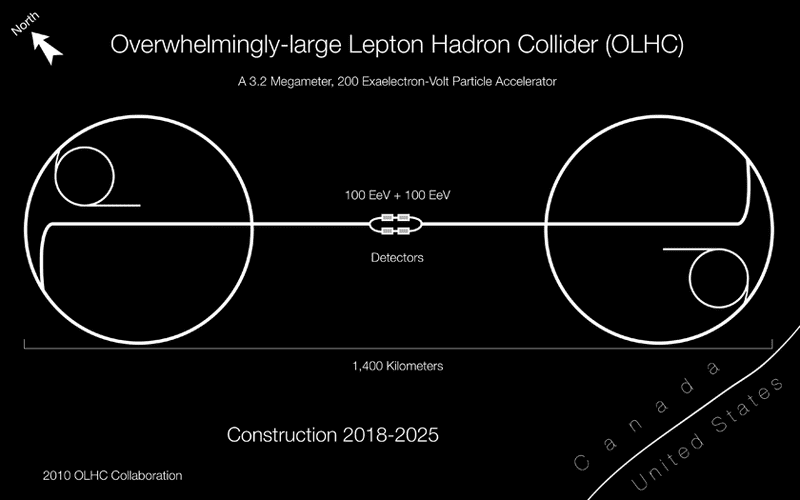
The discussion revolves around the future of high-energy particle physics experiments that may succeed current facilities like the LHC. Participants explore potential advancements in understanding fundamental theories such as the electroweak theory, the Standard Model, supersymmetry, and other concepts at ultra-high energies ranging from 1 TeV to 200,000,000 TeV. The conversation includes considerations of experimental designs, challenges, and the implications of discoveries in this field.
Discussion Character
- Exploratory
- Technical explanation
- Debate/contested
- Mathematical reasoning
- Experimental/applied
Main Points Raised
- Some participants propose that future experiments could complete the electroweak theory and the Standard Model with high precision, potentially revealing insights into supersymmetry, extra dimensions, dark matter, dark energy, and grand unification theory.
- Concerns are raised about the design of circular accelerators, particularly regarding synchrotron radiation for electrons and the challenges of radiation damage and vacuum maintenance in proton synchrotrons.
- There is speculation about the potential for ultra-high energy machines to discover limits on particle mass, the possibility of super-symmetry, or even new fundamental forces.
- Some participants highlight the advantages of lepton colliders over hadron colliders, noting that lepton collisions yield cleaner data due to the simplicity of the resulting products.
- Discussion includes the potential for muon colliders, which could combine the benefits of lepton collisions with the ability to be accelerated in circular rings due to the greater mass of muons.
- There is a mention of the Higgs boson as a critical point of observation that could influence future experimental directions.
Areas of Agreement / Disagreement
Participants express a range of views on the design and feasibility of future accelerators, with some favoring linear colliders for their cleaner data and others discussing the limitations of circular designs. There is no consensus on the best approach or the implications of potential discoveries.
Contextual Notes
Participants acknowledge various challenges in high-energy physics experiments, including the limitations of current accelerator designs, the need for precision in measurements, and the complexities involved in data analysis from different types of collisions.