bobby2k
- 126
- 2
Hi, I have a question about the definition of the poisson process. Check out the definition here:
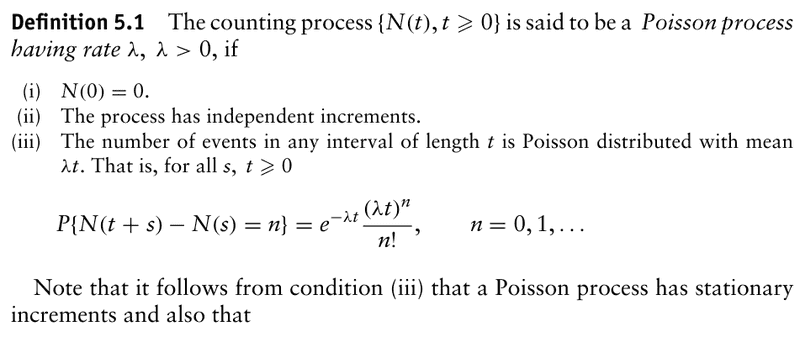 Would you say that one can prove point (2) from point (3)?
The reason I have some discomfort about this is that something seems to be hidden in the poisson distribution to make it all work?
For instance, from point (3) I am able to prove independent increments if we are looking at the probability of 0 events.
For instance, let's say you have two disjoint intervals [itex]\Delta t[/itex] and [itex]\Delta s[/itex].
Then from point (3) we get that probability of 0 events in the union of these two intervals is [itex]e^{-\lambda(\Delta t + \Delta s)}[/itex], but this can be written as [itex]e^{-\lambda\Delta t}*e^{-\lambda \Delta s}[/itex]. So since we are able to multiplicate each marginal probability, in this case we got independence directly from 3.
What is it I am not seeing?
EDIT: Also look at this fact for 1 event in the interval.
From (3) the probability of 1 event in the interval [itex]\Delta t + \Delta s[/itex] is: [itex]e^{-\lambda (\Delta t + \Delta s)}*(\lambda(\Delta t + \Delta s))[/itex].
But if we assume independce and (3) we get that this probability can also be calculated as the probability for 1 in the first interval and 0 in the last, plus the probability of 0 in the first interval and 1 in the last:
[itex]e^{-\lambda \Delta t}*e^{-\lambda \Delta s}*(\lambda \Delta s)+e^{-\lambda \Delta s}*e^{-\lambda \Delta t}*(\lambda \Delta t)=e^{-\lambda(\Delta t + \Delta s)}*(\lambda(\Delta t + \Delta s))[/itex].
We get the same. And hence it does look like there is something in the poisson distribution that makes this all works? I mean, if we kept point (1) and (2) and changed poisson with geometric(the probability distribution would now be independent of the langth of the interval aswell), we would not get these properties. So it seems like they couldn't just pick a distribution and put it in the definition. Can it be that a distribution would have to have some multiplicative property in regards to time intervals?
The reason I have some discomfort about this is that something seems to be hidden in the poisson distribution to make it all work?
For instance, from point (3) I am able to prove independent increments if we are looking at the probability of 0 events.
For instance, let's say you have two disjoint intervals [itex]\Delta t[/itex] and [itex]\Delta s[/itex].
Then from point (3) we get that probability of 0 events in the union of these two intervals is [itex]e^{-\lambda(\Delta t + \Delta s)}[/itex], but this can be written as [itex]e^{-\lambda\Delta t}*e^{-\lambda \Delta s}[/itex]. So since we are able to multiplicate each marginal probability, in this case we got independence directly from 3.
What is it I am not seeing?
EDIT: Also look at this fact for 1 event in the interval.
From (3) the probability of 1 event in the interval [itex]\Delta t + \Delta s[/itex] is: [itex]e^{-\lambda (\Delta t + \Delta s)}*(\lambda(\Delta t + \Delta s))[/itex].
But if we assume independce and (3) we get that this probability can also be calculated as the probability for 1 in the first interval and 0 in the last, plus the probability of 0 in the first interval and 1 in the last:
[itex]e^{-\lambda \Delta t}*e^{-\lambda \Delta s}*(\lambda \Delta s)+e^{-\lambda \Delta s}*e^{-\lambda \Delta t}*(\lambda \Delta t)=e^{-\lambda(\Delta t + \Delta s)}*(\lambda(\Delta t + \Delta s))[/itex].
We get the same. And hence it does look like there is something in the poisson distribution that makes this all works? I mean, if we kept point (1) and (2) and changed poisson with geometric(the probability distribution would now be independent of the langth of the interval aswell), we would not get these properties. So it seems like they couldn't just pick a distribution and put it in the definition. Can it be that a distribution would have to have some multiplicative property in regards to time intervals?
Last edited: