Undergrad Poles in Casimir force as function of frequency & mode

Click For Summary
The discussion centers on the interpretation of the Casimir force between two plates as a function of frequency and mode parameters. It highlights that at a single frequency, the force can vary significantly with mode parameter p, potentially leading to infinite force contributions. This phenomenon is attributed to the lack of boundary conditions and the assumption of perfect conductors, which results in certain modes having an infinite quality factor. The abrupt sign change from attractive to repulsive forces with small variations in p or ω raises questions about the physical interpretation of these results. The conversation suggests that while the authors focus on numerical methods, the underlying physics of these discontinuities and their implications, including potential energy losses, require further exploration.
Swamp Thing
Insights Author
Messages
1,045
Reaction score
775
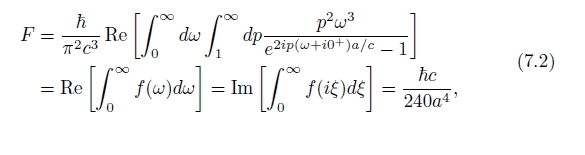
In Numerical methods for computing Casimir interactions, we have this expression for the Casimir force between two plates:
upload_2018-11-30_7-15-57.png


where
p is relatedto the plate-parallel momentum of the contributing modes/fluctuations.

I am trying to interpret this physically on a per-frequency and per-mode basis, before actually looking at the complete integral.

If we focus on a single frequency ##\omega##, it seems that the force contribution as a function of the mode parameter ##p## can vary wildly and become arbitrarily large.

If we consider a narrow-band or even a single-frequency "excitation", the expression is telling us that certain modes will produce an infinite force. This infinite force would change sign abruptly from attractive to repulsive if we make small changes to ##p## or ##\omega## around those critical values.

How are we to interpret this physically? The authors focus more on how to tame this numerical headache, but not on why the force should behave this way.
 

Attachments

  • upload_2018-11-30_7-15-57.png
    upload_2018-11-30_7-15-57.png
    5.4 KB · Views: 759
Last edited:
Physics news on Phys.org
I think this discontinuity happens because your integrals are not including boundary conditions for the edges of plates or finite conductivity of plates. Reference you cited seems specifically treat the perfect conductor. With infinite plate size and infinite conductivity no wonder certain (resonant) modes will have infinite quality factor and therefore eventually all zero-point energy between infinite perfectly conductive plates will convert to these modes, draining energy from non-resonant modes. This can be contradiction too - frequency conversion is generally lossy, therefore process which will allow "Casimir force resonance" as you described will likely introduce losses in form of (thermal) radiation.
Actually a-4 law have the same power-law slope as radiative loss for electrically small antenna
 
  • Like
Likes Swamp Thing
Thank you!
 
Time reversal invariant Hamiltonians must satisfy ##[H,\Theta]=0## where ##\Theta## is time reversal operator. However, in some texts (for example see Many-body Quantum Theory in Condensed Matter Physics an introduction, HENRIK BRUUS and KARSTEN FLENSBERG, Corrected version: 14 January 2016, section 7.1.4) the time reversal invariant condition is introduced as ##H=H^*##. How these two conditions are identical?

Similar threads

  • · Replies 1 ·
Replies
1
Views
1K
  • · Replies 1 ·
Replies
1
Views
1K
  • · Replies 46 ·
2
Replies
46
Views
5K
  • · Replies 7 ·
Replies
7
Views
1K
  • · Replies 3 ·
Replies
3
Views
2K
  • · Replies 1 ·
Replies
1
Views
5K
  • · Replies 1 ·
Replies
1
Views
2K
  • · Replies 3 ·
Replies
3
Views
3K
  • · Replies 1 ·
Replies
1
Views
2K
  • · Replies 1 ·
Replies
1
Views
2K