Postage stamp sells for $9.5 million

  • Context: News 
  • Thread starter Thread starter jtbell
  • Start date Start date
  • Tags Tags
    Photoshop
Click For Summary
SUMMARY

The British Guiana one-cent magenta postage stamp of 1856 sold for $9.5 million at auction, reclaiming its title as the world's most valuable stamp from the Sweden three-skilling yellow of 1855. This unique stamp's value is primarily attributed to its rarity, as only one exists. Previously owned by John E. du Pont, who purchased it for $935,000 in 1980, the stamp's sale highlights the extreme market for unique philatelic items. The discussion emphasizes the significance of rarity in determining stamp value, particularly in the context of British Guiana's early and scarce stamps.

PREREQUISITES
  • Understanding of philately and stamp collecting
  • Knowledge of historical context regarding British Guiana stamps
  • Familiarity with auction processes and valuation of collectibles
  • Awareness of the impact of rarity on collectible markets
NEXT STEPS
  • Research the historical significance of the British Guiana one-cent magenta postage stamp
  • Explore the auction history and market trends for rare stamps
  • Learn about the Treskilling Yellow and its place in philatelic history
  • Investigate the psychology behind high-value collectibles and the "collecting disease"
USEFUL FOR

Stamp collectors, investors in collectibles, historians of philately, and anyone interested in the economics of rare items will benefit from this discussion.

jtbell
Staff Emeritus
Science Advisor
Homework Helper
2025 Award
Messages
16,028
Reaction score
7,867
Yesterday, the British Guiana one-cent magenta postage stamp of 1856 sold at auction for $9.5 million:

http://money.cnn.com/2014/06/18/luxury/stamp-auction/index.html?hpt=hp_t2

http://en.wikipedia.org/wiki/British_Guiana_1c_magenta

It thereby reclaimed its position as the world’s most valuable stamp from the Sweden three-skilling yellow of 1855:

http://en.wikipedia.org/wiki/Treskilling_Yellow

Its most recent previous owner was John E. du Pont, who bought it in 1980 for $935,000. He was convicted of murder in 1997, and died in prison in 2010. His estate was the seller in yesterday’s sale.

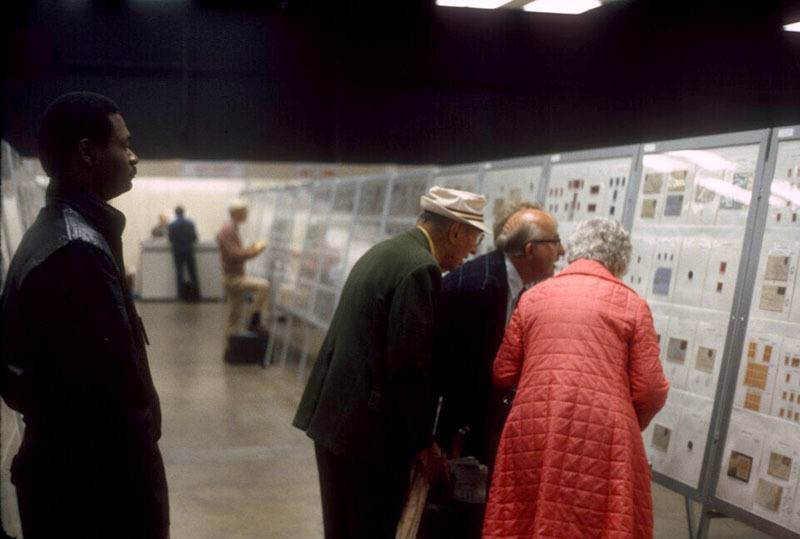
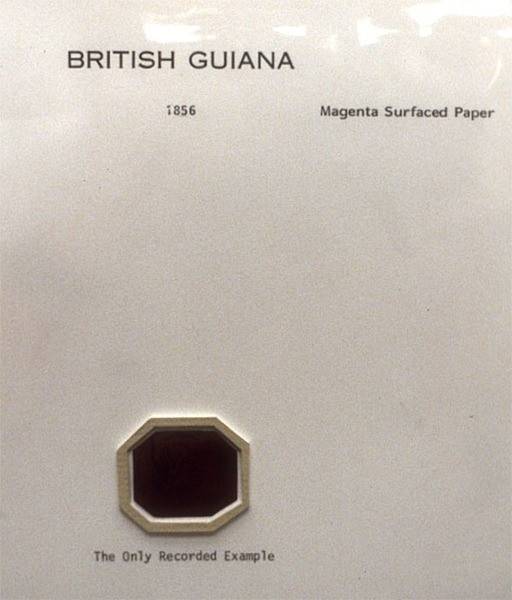
I’ve seen it on probably two occasions: the big international stamp shows in Philadelphia in 1976, and in Chicago in 1986. During the shows in San Francisco in 1997 and Washington DC in 2006, du Pont was in prison; maybe the new owner will show it in New York in 2016. In Philadelphia, it was displayed by itself in a “court of honor” along with several other famous philatelic items; but in Chicago it was among the “normal” exhibits as part of du Pont’s comprehensive collection of British Guiana, with a guard standing nearby:
attachment.php?attachmentid=70687&stc=1&d=1403104549.jpg


attachment.php?attachmentid=70688&stc=1&d=1403104549.jpg


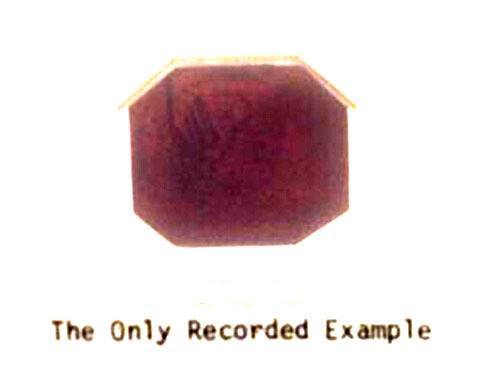
Thanks to Photoshop, I can pull out some details from the apparently featureless blob in the scanned slide above:
attachment.php?attachmentid=70689&stc=1&d=1403104549.jpg
 

Attachments

  • bg1.jpg
    bg1.jpg
    40.6 KB · Views: 672
  • bg2.jpg
    bg2.jpg
    26.9 KB · Views: 631
  • bg3.jpg
    bg3.jpg
    8.7 KB · Views: 630
Physics news on Phys.org
jtbell said:
Yesterday, the British Guiana one-cent magenta postage stamp of 1856 sold at auction for $9.5 million:
What's so special about it? Why would someone buy an old stamp for 9.5 million?
 
You have got to be kidding me. Paying $9.5M for that is a crime against humanity.
 
adjacent said:
What's so special about it?
The only thing that is special about it is that there's only one of them. It is unique.

One of the driving factors in the value of a stamp is how many others just like it are out there in stamp collections. The value of a stamp escalates exponentially with rarity. The greatest rarity is one and only one. For this stamp, along with the Treskilling Yellow mentioned by JT, there is only one.
 
adjacent said:
Why would someone buy an old stamp for 9.5 million?

The "collecting disease" does strange things to people. :rolleyes: I have a mild case of it myself, so I can see where du Pont and Philipp von Ferrary and Bill Gross and others like them come from. (If any of you all invest your savings in one of the PIMCO bond funds, you're helping Bill with his stamp collection.)

There aren't many truly unique stamps. I think the British Guiana stamp takes the prize because it's from a British colony, it started to issue stamps early on, and the British were among the first to take up stamp collecting seriously in the 1840s and 1850s. Think of those eccentric rich Britons of the Victorian era.

British Guiana is small, and most of its early stamps are scarce to begin with. They're among the "blue chips" of philately, so to speak. A collection of British Guiana is manageable in size (number of stamps), but nevertheless expensive to do well, even without the one-cent magenta. With the one-cent magenta, only one person at a time can have a complete collection. It doesn't take many millionaires who collect British Guiana to drive the price up.
 

Similar threads

  • · Replies 4 ·
Replies
4
Views
2K