Probability of winning dice game

Join the discussion
Ask a follow-up here, or get your own question answered by working scientists, mathematicians and engineers — people, not an autocomplete.
Real named experts · corrections over time · the nuance an AI answer skips
3 replies · 2K views
TheFallen018
Messages
52
Reaction score
0
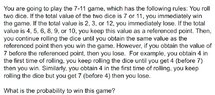
Hey, so I've got this problem that I'm trying to figure out. I've worked out something that I think is probably right through simulation, but I'm not really sure how to tackle it from a purely mathematical probability perspective. So, would anyone know how I should approach this? I've tried a few different things, but my two answers tend to conflict a little. Thanks,

View attachment 8168
 

Attachments

  • Screenshot_12.jpg
    Screenshot_12.jpg
    75.3 KB · Views: 172
Physics news on Phys.org
The starting point (which I guess you already know) is to make a list of the probabilities $p(x)$ of rolling a total of $x$ with the two dice, where $x$ goes from $2$ to $12$. These are $$\begin{array}{r|ccccccccccc}x& 2&3&4&5&6 &7&8&9&10 &11&12\\ \hline p(x) & \frac1{36} & \frac2{36} & \frac3{36} & \frac4{36} & \frac5{36} & \frac6{36} & \frac5{36} & \frac4{36} & \frac3{36} & \frac2{36} & \frac1{36} \end{array}.$$

The probability of an immediate win on the first roll is $p(7)+p(11)$. To win at a later stage, you first need to roll an $x$ (where $x$ is $4,5,6,8,9$ or $10$). You then need to roll another $x$ before rolling a $7$. The probability of those two things happening is $p(x)\dfrac{p(x)}{p(x)+p(7)}$. Putting in the numbers, and adding the various probabilities, I get the overall probability of a win to be $\dfrac{244}{495} \approx 0.49292929\ldots$.
 
Opalg said:
The starting point (which I guess you already know) is to make a list of the probabilities $p(x)$ of rolling a total of $x$ with the two dice, where $x$ goes from $2$ to $12$. These are $$\begin{array}{r|ccccccccccc}x& 2&3&4&5&6 &7&8&9&10 &11&12\\ \hline p(x) & \frac1{36} & \frac2{36} & \frac3{36} & \frac4{36} & \frac5{36} & \frac6{36} & \frac5{36} & \frac4{36} & \frac3{36} & \frac2{36} & \frac1{36} \end{array}.$$

The probability of an immediate win on the first roll is $p(7)+p(11)$. To win at a later stage, you first need to roll an $x$ (where $x$ is $4,5,6,8,9$ or $10$). You then need to roll another $x$ before rolling a $7$. The probability of those two things happening is $p(x)\dfrac{p(x)}{p(x)+p(7)}$. Putting in the numbers, and adding the various probabilities, I get the overall probability of a win to be $\dfrac{244}{495} \approx 0.49292929\ldots$.

Wow, that works really well. I thought it was going to be much more complicated and messy than that, which is a beautiful solution. I'm curious though, is that equation $p(x)\dfrac{p(x)}{p(x)+p(7)}$ something that you derived for this, or is this a standard formula for similar problems.If it's something that you derived, would you be able to explain how you came up with it? If it's a standard equation, would you happen to know it's name? I'd love to understand better how and why it works. Thanks
 
TheFallen018 said:
Wow, that works really well. I thought it was going to be much more complicated and messy than that, which is a beautiful solution. I'm curious though, is that equation $p(x)\dfrac{p(x)}{p(x)+p(7)}$ something that you derived for this, or is this a standard formula for similar problems.If it's something that you derived, would you be able to explain how you came up with it? If it's a standard equation, would you happen to know it's name? I'd love to understand better how and why it works. Thanks
In the expression ${\color {red} p(x)}{\color {green}\dfrac{p(x)}{p(x)+p(7)}}$, the red $\color {red} p(x)$ gives the probability that the first roll of the dice gives the value $x$. The green fraction represents the probability of rolling $x$ again before rolling a $7$. My argument for that is that after rolling the first $x$, you can completely disregard any subsequent rolls until either an $x$ or a $7$ turns up. The only question is, which one of those will appear first. The relative probabilities of $x$ and $7$ are in the proportion $p(x)$ to $p(7)$. So out of a combined probability of $p(x) + p(7)$, the probability of an $x$ is $\dfrac{p(x)}{p(x)+p(7)}$, and the probability of a $7$ is $\dfrac{p(7)}{p(x)+p(7)}$.

I hope that makes sense.