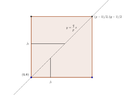
Sure. The proof I know of is by counting lattice points of a square. I thought it was pretty standard, but giving it here in case anyone who reads does not know :
Theorem : $$\left(\frac{a}{p}\right) = (-1)^{\sum_{j = 1}^{(p-1)/2} \left \lfloor \frac{a \cdot j}{p} \right \rfloor}$$
There is a pretty standard proof of this and can be found in any introductory NT text, so I am omitting this here; but do not think that this result is trivial! It's actually the key to the proof of QR.
Now, consider this
View attachment 2160
There are exactly $\left \lfloor \frac{q \cdot j_1}{p} \right \rfloor$ and $\left \lfloor \frac{p\cdot j_2}{q} \right \rfloor$ integer points on the boldfaced straightlines, respectively. And there are $(p-1)/2$ and $(q-1)/2$ integer points on the x and y-axis respectively, so let $j_1$ and $j_2$ run through those. Hence the number of lattice points are
$$\sum_{j_1 = 1}^{(p-1)/2} \left \lfloor \frac{q \cdot j_1}{p} \right \rfloor + \sum_{j_2 = 1}^{(q-1)/2} \left \lfloor \frac{p \cdot j_2}{q} \right \rfloor$$
But then simply counting the lattices gives $(p-1)/2\cdot (q-1)/2$ lattice points in the square. Hence exponentiating both sides to $-1$ gives
$$\left(\frac{p}{q}\right) \left(\frac{q}{p}\right) = (-1)^{(p-1)/2\cdot (q-1)/2}$$