Properties of Thiazole: Balancing Reactions, Yields & Mass Ratios

  • Thread starter Thread starter Eva Brain
  • Start date Start date
  • Tags Tags
    Properties
Click For Summary

Discussion Overview

The discussion revolves around the combustion properties of thiazole, including the balanced reaction equation, yields of various products, and the implications of the combustion process. Participants explore theoretical aspects, chemical reactions, and the interpretation of the original question posed by a learner.

Discussion Character

  • Exploratory
  • Debate/contested
  • Technical explanation

Main Points Raised

  • Some participants question the phrasing of the original question regarding the "balanced reaction of thiazole," suggesting that a reaction must involve multiple substances.
  • There is a debate about the relevance of water in the context of thiazole's combustion, with some arguing it is irrelevant while others suggest it might be an example of a reaction.
  • One participant proposes a balanced combustion equation for thiazole, indicating that it produces carbon dioxide, water, hydrogen sulfide, and nitrogen.
  • Another participant challenges the inclusion of hydrogen sulfide in the combustion products, asserting that it will not be present.
  • There are discussions about the need for clarity in the original question, with suggestions that it might be asking about either the synthesis or combustion of thiazole.

Areas of Agreement / Disagreement

Participants do not reach a consensus on the balanced reaction or the products of thiazole combustion. There are competing views on the relevance of water and the correctness of the proposed balanced equation.

Contextual Notes

Participants express uncertainty regarding the original question's intent and the specifics of the combustion process. The discussion highlights the need for clarity in chemical reactions and the definitions of terms used.

Eva Brain
Messages
22
Reaction score
0
I am learning Chemistry from one book and I have bumped onto a following image with given tasks:
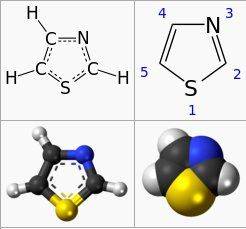
IOQo7.jpg


What is the balanced reaction?
What is the RMM of thiazole?
What is the fuel-air mass ratio?
What is the oxygen depletion?
What is the yield of CO2?
What is the yield of H2O?
What is the yield of N2?
For ideal combustion, what is the yield of carbon-monoxide?

Now, aformentioned product is Thiazole( checked on wiki ) and products of combustion are carbon dioxide, water, hydrogen sulphide (H2S) and nitrogen. Now how can I solve this matter having in mind following data that air is consisted of 21% O2 and 79% of N2.
 
Physics news on Phys.org
Eva Brain said:
What is the balanced reaction?

Of what?
 
Borek said:
Of what?

Of Thiazole.
 
There is no such thing as "balanced reaction of thiazole". Reaction equation describes a process (reaction), not the substance.

What is the reaction of water?
 
So is it more appropriate to say "the balanced equation" then?
 
Last edited:
No, you must name the PROCESS, not the substance.

What is the balanced reaction equation of water?
 
Borek said:
No, you must name the PROCESS, not the substance.

What is the balanced reaction equation of water?

Of Thiamin 1?

H_2 + 20_2 --> 2H_2O
 
Last edited:
This is not "reaction of water", this is reaction of SYNTHESIS of water. Or of hydrogen burning in oxygen.

It is not balanced, but let's not be that nitpicky.
 
Borek said:
This is not "reaction of water", this is reaction of SYNTHESIS of water. Or of hydrogen burning in oxygen.

It is not balanced, but let's not be that nitpicky.

OK, can you give me balanced reaction then? Of water and thiazole? I can see you know a lot about this thing.
 
  • #10
While thiazole does react with water, it is most likely irrelevant to the question.
 
  • #11
Borek said:
While thiazole does react with water, it is most likely irrelevant to the question.

Thiazole doesn't react with a water. Yes, I agree it is completely irrelevant to Q1.
 
  • #12
It is a weak Bronsted-Lowry base, it reacts with water producing slightly alkaline solutions.

I am less and less convinced you are interested in solving the original question.
 
  • #13
Borek said:
It is a weak Bronsted-Lowry base, it reacts with water producing slightly alkaline solutions.

I am less and less convinced you are interested in solving the original question.

More and more I am convinced you are trying to detour me on my path of learning! Why do you mention water at all?
 
  • #14
It looks like the book did not ask the questions properly, or perhaps you left something out when you posted your questions.

A reaction must involve more than one substance, so asking for "the balanced reaction of thiazole" makes no sense. There must be other substances involved in order for there to be any reaction.

Here are some guesses: the question might be asking about the reaction for the synthesis of thiazole (involving other substances used to make it), OR it might be asking about the combustion reaction for thiazole (where it reacts with oxygen to form other substances as products), OR it might be about something else entirely.

Since the question, as you posted it, did not specify a reaction, people are trying to figure out what is really being asked. If you can check the book again, and see if the question provides any other information that is missing from your posts, you are more likely to get help in answering your question.

Eva Brain said:
Why do you mention water at all?
I think he meant it as an example; your answer to his question might have helped us figure out what the question is really supposed to be. Your answer was about the synthesis of water, which is a hint that the book's question might be asking about the synthesis of thiazole. BUT -- the book's question also mentioned combustion, which is a hint that the question might really be asking about thiazole combustion (reacting with oxygen).

So, respectfully, we are simply confused as to how to help you based on the limited information (so far) given in these posts.
 
  • Like
Likes   Reactions: 1 person
  • #15
The question is: Thiazole combusts in air to give carbon dioxide, water, hydrogen sulphide and nitrogen. Write the balanced equation:

Answer:

4C3H3NS + 13O2 →12CO2+2H2 O+4H2S+2N2

Just that!

NB: combustion takes place with Oxygen only! other compounds in air are thus 'useless' in the combustion.
 
Last edited:
  • #16
You won't get H2S in the combustion products.
 
  • #17
Haha. You will! Alternatively, give me the ideal combustion equation of thiazole in air... Such a reply would be more helpful than simply saying what will not be.
 

Similar threads

  • · Replies 4 ·
Replies
4
Views
3K
  • · Replies 16 ·
Replies
16
Views
4K
  • · Replies 13 ·
Replies
13
Views
3K
  • · Replies 2 ·
Replies
2
Views
2K
  • · Replies 6 ·
Replies
6
Views
5K
Replies
5
Views
2K
  • · Replies 1 ·
Replies
1
Views
3K
  • · Replies 10 ·
Replies
10
Views
18K
  • · Replies 1 ·
Replies
1
Views
2K
  • · Replies 1 ·
Replies
1
Views
3K