Prove an nth-degree polynomial has exactly n roots

  • Context: Undergrad 
  • Thread starter Thread starter Happiness
  • Start date Start date
  • Tags Tags
    Polynomial Roots
Click For Summary

Discussion Overview

The discussion centers around the proof that an nth-degree polynomial has exactly n roots, exploring the implications of the fundamental theorem of algebra and the conditions necessary for certain algebraic proofs. Participants examine the validity of specific steps in the proof and the assumptions underlying them.

Discussion Character

  • Debate/contested
  • Technical explanation
  • Mathematical reasoning

Main Points Raised

  • One participant outlines a proof using the factor theorem and the second fundamental result in algebra (SFRA), suggesting that if a polynomial can be expressed in a certain form, it implies it has n roots.
  • Another participant challenges the proof by questioning the applicability of SFRA, arguing that the condition for equality of coefficients is not satisfied since the equality holds only for r roots, not all values of x.
  • Some participants discuss whether establishing that a polynomial can be written in a specific form implies equality for all x, raising questions about the completeness of the proof.
  • A reference to Wikipedia is made, noting that there is no purely algebraic proof of the fundamental theorem of algebra, which relies on the completeness of the reals.
  • Another participant mentions that while the fundamental theorem of algebra does not have an elementary proof, it can be shown that a polynomial can be expressed in a specific factorized form if the theorem is assumed, providing an inductive argument for this claim.

Areas of Agreement / Disagreement

Participants express disagreement regarding the validity of the proof and the assumptions made, particularly concerning the application of SFRA and the implications of the fundamental theorem of algebra. No consensus is reached on the correctness of the proof or the existence of an elementary proof.

Contextual Notes

Limitations include the reliance on the completeness of the reals for the fundamental theorem of algebra and the unresolved nature of the assumptions regarding the equality of polynomials at all values of x.

Happiness
Messages
686
Reaction score
30
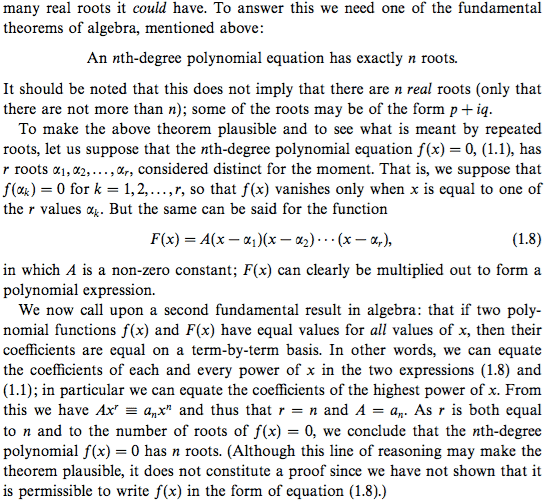
The attachment below proves that an nth-degree polynomial has exactly ##n## roots.

The outline of the proof is as follows:
Suppose (1.1) has ##r## roots. Then it can be written in the form of (1.8) by factor theorem.
Next use the second fundamental result in algebra (SFRA): if ##f(x)=F(x)## for all values of ##x##, then their coefficients ##a_i##'s in (1.1) are the same. So we have [after expanding (1.8)] ##Ax^r=a_nx^n##. Thus ##r=n##.

The last sentence suggests that if ##f(x)## can be written in the form (1.8) then the proof is complete. And it can be by factor theorem.

My issue with the proof is that the condition for SFRA is not satisfied and hence we cannot compare the coefficients ##a_i##'s. We do not know that ##f(x)=F(x)## for all values of ##x##; we only know ##f(x)=F(x)## for ##r## values of ##x##, for those ##r## roots ##\alpha_i##'s.

So how could we justify the use of SFRA?

Screen Shot 2016-05-29 at 2.50.54 am.png

Screen Shot 2016-05-29 at 2.51.27 am.png
 
Last edited:
Physics news on Phys.org
Happiness said:
The last sentence suggests that if ##f(x)## can be written in the form (1.8) then the proof is complete. And it can be by factor theorem.
If you have established that ##f(x)## can be written in the form (1.8), then doesn't that mean precisely that ##f(x) = F(x)## for all ##x##? If not, then what does it mean?
 
jbunniii said:
If you have established that ##f(x)## can be written in the form (1.8), then doesn't that mean precisely that ##f(x) = F(x)## for all ##x##? If not, then what does it mean?

Oh, this is a good point!

Then I've not established that ##f(x)## can be written in the form (1.8) with ##A## being a constant, but only that ##f(x)=g(x)(x-\alpha_1)(x-\alpha_2)...(x-\alpha_r)## where ##g(x)## is a polynomial.

Wikipedia: "In spite of its name, there is no purely algebraic proof of the theorem, since any proof must use the completeness of the reals (or some other equivalent formulation of completeness), which is not an algebraic concept." https://en.wikipedia.org/wiki/Fundamental_theorem_of_algebra

Does it mean there is no elementary proof for this theorem?
 
Last edited:
Happiness said:
Wikipedia: "In spite of its name, there is no purely algebraic proof of the theorem, since any proof must use the completeness of the reals (or some other equivalent formulation of completeness), which is not an algebraic concept." https://en.wikipedia.org/wiki/Fundamental_theorem_of_algebra

Does it mean there is no elementary proof for this theorem?
The fundamental theorem of algebra has no really elementary proof. It says that any nonconstant polynomial (with real or complex coefficients) has at least one complex root. So it is really a statement involving complex analysis, and indeed the most straightforward proof uses complex analysis. However, there are many other ways to prove it. Here is a book which proves the theorem six different ways and is intended as a semester-long course at the senior undergraduate level: https://www.amazon.com/dp/0387946578/?tag=pfamazon01-20 by Benjamin Fine and Gerhard Rosenberger. So that gives you some idea of the level of mathematics required for a rigorous proof.

However, note that if we assume the fundamental theorem of algebra, then it is not hard to show that your ##f(x)## can be written in the form ##A(x-x_1)(x-x_2)\cdots(x-x_n)##. We can do this by induction on ##n##, the degree of ##f(x)##. First, it is clear that if ##n=0## or ##n=1## then ##f(x)## is already in that form. So suppose that ##n \geq 2## and that the result is true for all polynomials of degree smaller than ##n##, and that ##f(x)## has degree ##n##. By the fundamental theorem of algebra, ##f(x)## has at least one complex root, call it ##x_1##. By the division algorithm, we may write ##f(x) = g(x)(x-x_1) + r(x)##, where ##g(x)## is a polynomial and ##r(x)## is zero or a polynomial of degree less than ##1##, i.e., ##r(x)## is a constant, so just write it as ##r##. Thus ##f(x) = g(x)(x-x_1) + r##. Plugging in ##x=x_1## shows that ##r=0##. Consequently, ##f(x) = g(x)(x-x_1)##. Comparing degrees, we see that ##g(x)## must have degree ##n-1##, so the induction hypothesis applies, and we can write ##g(x) = A(x-x_2)(x-x_3)\cdots(x-x_n)##, and therefore ##f(x) = A(x-x_1)(x-x_2)\cdots(x-x_n)## as desired.
 
Last edited by a moderator:
  • Like
Likes   Reactions: Happiness

Similar threads

  • · Replies 24 ·
Replies
24
Views
1K
  • · Replies 43 ·
2
Replies
43
Views
7K
  • · Replies 0 ·
Replies
0
Views
3K
  • · Replies 3 ·
Replies
3
Views
2K
  • · Replies 8 ·
Replies
8
Views
2K
  • · Replies 14 ·
Replies
14
Views
4K
  • · Replies 5 ·
Replies
5
Views
2K
Replies
48
Views
6K
  • · Replies 9 ·
Replies
9
Views
2K
  • · Replies 2 ·
Replies
2
Views
2K