If we let $0<k<2$,
[TABLE="class: grid, width: 700"]
[TR]
[TD]We have $k(k-2)<0$.[/TD]
[TD]Besides, we also have $k^3(k-2)<0$[/TD]
[/TR]
[TR]
[TD]Adding 1 to the inequality $0<k<2$ we get $1<k+1<3$.
Or simply $k+1>0$.
Thus,
$k(k-2)(k+1)<0$
$k^3-k^2-2k<0$
$k^3<k^2+2k$
$2k^3<2k^2+4k$ (*)[/TD]
[TD]Expanding the inequality we get
$k^4-2k^3<0$
$k^4<2k^3$(**)[/TD]
[/TR]
[/TABLE]
Merging these two inequalities (*) and (**) yields
$k^4<2k^2+4k$
$k^4-3k^2+k-10<-k^2+5k-10$
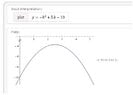
View attachment 1753
From the graph, we can tell $-k^2+5k-10<0$ for $0<k<2$, hence, $k^4-3k^2+k-10<0$ for $0<k<2$ and we can conclude there is no root exists in the interval $(0,2)$ for a quartic function $k^4-10+k-3k^2$.