Prove $x>2y$ Given $e^y=\dfrac{x}{1-e^{-x}}$

  • Context: MHB 
  • Thread starter Thread starter anemone
  • Start date Start date
Click For Summary
SUMMARY

The discussion centers on proving the inequality $x > 2y$ given the relationship $e^y = \frac{x}{1 - e^{-x}}$. Participants explore various mathematical approaches, including expressing $y$ in terms of $x$ and utilizing the hyperbolic sine function. The key conclusion is that demonstrating $\sinh\left(\frac{x}{2}\right) > \frac{x}{2}$ effectively proves the original inequality. Additionally, the McLaurin expansion of $y$ around $x = 0$ is discussed as a method to analyze the behavior of $y$ in relation to $x$.

PREREQUISITES
  • Understanding of exponential functions and their properties.
  • Familiarity with hyperbolic functions, specifically $\sinh$.
  • Knowledge of logarithmic functions and their manipulations.
  • Basic calculus concepts, including limits and derivatives.
NEXT STEPS
  • Study the properties of hyperbolic functions, particularly $\sinh$ and its applications.
  • Learn about the McLaurin series and its use in approximating functions.
  • Explore the Mean Value Theorem and its implications in calculus.
  • Investigate inequality proofs in calculus, focusing on techniques for manipulating exponential and logarithmic expressions.
USEFUL FOR

Mathematicians, calculus students, and anyone interested in advanced inequality proofs and the properties of exponential and logarithmic functions.

anemone
Gold Member
MHB
POTW Director
Messages
3,851
Reaction score
115
Hi MHB,

Problem:

Assume $x>0$, and $y$ satisfy that $e^y=\dfrac{x}{1-e^{-x}}$, prove that $x>2y$.

Attempt:

I first tried to express $y$ in terms of $x$ and get:

$y=x+\ln x- \ln (e^x-1)$

and I am aware that one of the method to prove the intended result is to rewrite the equation above as

$y-\dfrac{x}{2}=\dfrac{x}{2}+\ln x- \ln (e^x-1)$

and if I can prove $\dfrac{x}{2}+\ln x- \ln (e^x-1)<0$, which also implies $y-\dfrac{x}{2}<0$, then the result is proved.

Now, I see it that no inequality theorems that I know of could be applied to the expression $\dfrac{x}{2}+\ln x- \ln (e^x-1)$ and hence I get stuck, so stuck that I wish to drop this problem behind my mind!

But, I hope to solve it nonetheless and that's why I posted it here and hope someone can chime into help me out.

Thanks in advance.
 
Physics news on Phys.org
Re: Prove x>2y

Can you show that the given definition of $y$ and the inequality implies:

$$\sinh\left(\frac{x}{2} \right)>\frac{x}{2}$$ ?

After that, a bit of calculus is all you need to demonstrate this is true. :D
 
Re: Prove x>2y

MarkFL said:
Can you show that the given definition of $y$ and the inequality implies:

$$\sinh\left(\frac{x}{2} \right)>\frac{x}{2}$$ ?

We can simplify the terms of natural logarithm in $\dfrac{x}{2}+\ln x- \ln (e^x-1)$ and get:

$\dfrac{x}{2}+\ln x- \ln (e^x-1)=\dfrac{x}{2}+\ln \dfrac{x}{e^x-1}$

and to be honest with you, I don't understand how to get what you obtained.
 
Re: Prove x>2y

I began with the given inequality:

$$x>2y$$

and this implies:

$$e^x>e^{2y}=\left(e^y \right)^2=\left(\frac{x}{1-e^{-x}} \right)^2=\left(\frac{xe^x}{e^x-1} \right)^2$$

Hence:

$$e^x>\frac{x^2e^{2x}}{\left(e^x-1 \right)^2}$$

Multiplying through by $$\frac{\left(e^x-1 \right)^2}{e^{2x}}>0$$ we obtain:

$$e^{-x}\left(e^x-1 \right)^2>x^2$$

Now this implies:

$$e^{-\frac{x}{2}}\left(e^x-1 \right)>x$$

$$e^{\frac{x}{2}}-e^{-\frac{x}{2}}>x$$

Dividing through by 2:

$$\frac{e^{\frac{x}{2}}-e^{-\frac{x}{2}}}{2}>\frac{x}{2}$$

Using the definition of the hyperbolic sine function, we may now write:

$$\sinh\left(\frac{x}{2} \right)>\frac{x}{2}$$
 
Re: Prove x>2y

Ah, I see...thanks!
 
Re: Prove x>2y

anemone said:
Hi MHB,

Problem:

Assume $x>0$, and $y$ satisfy that $e^y=\dfrac{x}{1-e^{-x}}$, prove that $x>2y$.

Attempt:

I first tried to express $y$ in terms of $x$ and get:

$y=x+\ln x- \ln (e^x-1)$

and I am aware that one of the method to prove the intended result is to rewrite the equation above as

$y-\dfrac{x}{2}=\dfrac{x}{2}+\ln x- \ln (e^x-1)$

and if I can prove $\dfrac{x}{2}+\ln x- \ln (e^x-1)<0$, which also implies $y-\dfrac{x}{2}<0$, then the result is proved.

Now, I see it that no inequality theorems that I know of could be applied to the expression $\dfrac{x}{2}+\ln x- \ln (e^x-1)$ and hence I get stuck, so stuck that I wish to drop this problem behind my mind!

But, I hope to solve it nonetheless and that's why I posted it here and hope someone can chime into help me out.

Thanks in advance.
I'm afraid that You have to try the McLaurin expansion around x = 0 of the logarhitm of the function... $\displaystyle y = \ln x - \ln (1 - e^{-x})\ (1)$Starting from f(0) and using l'Hopital rule You have... $\displaystyle \lim_{x \rightarrow 0} \frac{x}{1 - e^{-x}} = \lim_{x \rightarrow 0} e^{x} = 1 \implies y(0) = 0\ (2)$

The procedure for the derivatives however is much more complex and 'Monster Wolfram' can supply a significative aid...

ln x - ln [1 - e^(- x)] - Wolfram|Alpha

The McLaurin expansion we are interersted for is...

$\displaystyle y(x) = \frac{x}{2} - \frac{x^{2}}{24} + \frac{x^{4}}{2880} + \mathcal {O} (x^{6})\ (3)$

As curiosity y(x) is defined for all value of x [positive as well as negatives...] and is $y(x) \le \frac{x}{2}$. May be that a simpler approach to the problem exists and, if yes, it must be found... Kind regards $\chi$ $\sigma$
 
Re: Prove x>2y

chisigma said:
I'm afraid that You have to try the McLaurin expansion around x = 0 of the logarhitm of the function... $\displaystyle y = \ln x - \ln (1 - e^{-x})\ (1)$Starting from f(0) and using l'Hopital rule You have... $\displaystyle \lim_{x \rightarrow 0} \frac{x}{1 - e^{-x}} = \lim_{x \rightarrow 0} e^{x} = 1 \implies y(0) = 0\ (2)$

The procedure for the derivatives however is much more complex and 'Monster Wolfram' can supply a significative aid...

ln x - ln [1 - e^(- x)] - Wolfram|Alpha

The McLaurin expansion we are interersted for is...

$\displaystyle y(x) = \frac{x}{2} - \frac{x^{2}}{24} + \frac{x^{4}}{2880} + \mathcal {O} (x^{6})\ (3)$

As curiosity y(x) is defined for all value of x [positive as well as negatives...] and is $y(x) \le \frac{x}{2}$.

Hey chisigma, thank you for your reply...and I am happy to learn these two methods to solve the problem!

chisigma said:
May be that a simpler approach to the problem exists and, if yes, it must be found...

I think MarkFL's approach is very straightforward and smart! :):o
 
Re: Prove x>2y

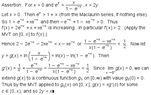
Here's another solution which just uses a careful application of the mean value theorem.

View attachment 1617
 

Attachments

  • MHBcalculus3.png
    MHBcalculus3.png
    8.4 KB · Views: 118

Similar threads

  • · Replies 10 ·
Replies
10
Views
3K
  • · Replies 3 ·
Replies
3
Views
2K
  • · Replies 1 ·
Replies
1
Views
1K
  • · Replies 2 ·
Replies
2
Views
1K
  • · Replies 3 ·
Replies
3
Views
3K
  • · Replies 5 ·
Replies
5
Views
1K
  • · Replies 9 ·
Replies
9
Views
3K
  • · Replies 9 ·
Replies
9
Views
2K
  • · Replies 10 ·
Replies
10
Views
2K
Replies
5
Views
2K