Proving Area Ratio of Equilateral Triangle Divided by Line

anemone
Gold Member
MHB
POTW Director
Messages
3,851
Reaction score
115
A line divides an equilateral triangle into two parts with the same perimeter and having areas $A_1$ and $A_2$ respectively. Prove that $\dfrac{7}{9} \le \dfrac{A_1}{A_2} \le \dfrac{9}{7}$.
 
Mathematics news on Phys.org
anemone said:
A line divides an equilateral triangle into two parts with the same perimeter and having areas $A_1$ and $A_2$ respectively. Prove that $\dfrac{7}{9} \le \dfrac{A_1}{A_2} \le \dfrac{9}{7}$.
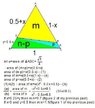
my solution :
View attachment 1735
if DE is not parallel to BC the discussion is similar (x+y=0.5 must hold)
 

Attachments

  • 9 over 7.jpg
    9 over 7.jpg
    23.9 KB · Views: 151
anemone said:
A line divides an equilateral triangle into two parts with the same perimeter and having areas $A_1$ and $A_2$ respectively. Prove that $\dfrac{7}{9} \le \dfrac{A_1}{A_2} \le \dfrac{9}{7}$.
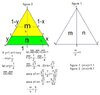
another solution :
 

Attachments

  • ratio of two areas.jpg
    ratio of two areas.jpg
    24.5 KB · Views: 148
Thanks for participating and well done, Albert! For your second method, I recall vaguely seeing you used pretty much quite similar way to target other type of geometry problem.:cool:

Solution proposed by Vishal Lama, Southern Utah University:
Let's name the triangle be triangle ABC. WLOG, let the triangle has the unit side length of 1.The line can divide the triangle into two congruent triangles or into a triangle and a quadrilateral or . If the line cuts the triangle in two congruent triangles, then clearly $\dfrac{A_1}{A_2}=1$.

For the second case, we may assume that the line cuts side $AB$ at $D$ and $AC$ at $E$. Let the area of triangle $ADE=A_1$ and the area of quadrilateral $BDEC=A_2$. Then $A_1+A_2=\dfrac{1}{2}(1)(1)(\sin 60^{\circ})=\dfrac{\sqrt{3}}{4}$.

Let $BD=x$ and $CE=y$. Then $AD=1-x$, $AE=1-y$. Since the regions with areas $A_1$ and $A_2$ have equal perimeter, we must have $BD+BC+CE+AD+AE$.

$\therefore x+1+y=(1-x)+(1-y) \rightarrow x+y=\dfrac{1}{2}$

Now, area of triangle $ADE=A_1=\dfrac{1}{2}(AD)(AE)\sin \angle DAE$,

$A_1=\dfrac{1}{2}(1-x)(1-y)\sin 60^{\circ} \rightarrow A_1=\dfrac{\sqrt{3}}{4}(1-x)(\dfrac{1}{2}+x)$

Denote $k=\dfrac{A_2}{A_1}>0$, we get that

$\dfrac{A_1}{A_1+A_2}=\dfrac{\dfrac{\sqrt{3}}{4}(1-x)(\dfrac{1}{2}+x)}{\dfrac{\sqrt{3}}{4}}=(1-x)(\dfrac{1}{2}+x)=\dfrac{1}{1+k}$

which after simplification yields

$2x^2-x+\dfrac{1-k}{1+k}=0$

The above quadratic equation in $x$ has real roots and the discriminant should be greater than or equal to zero. Thus,

$D=1-4\cdot2\cdot\left( \dfrac{1-k}{1+k} \right)=\dfrac{9k-7}{k+1} \ge 0$

Therefore $k \ge \dfrac{7}{9}$ or $\dfrac{A_2}{A_1} \ge \dfrac{7}{9}$.

Changing the notations, area of triangle $ADE=A_2$ and area of quadrilateral $BDEC=A_1$ we get $\dfrac{A_1}{A_2} \ge \dfrac{7}{9}$.

Thus,

$\dfrac{7}{9} \le \dfrac{A_1}{A_2} \le \dfrac{9}{7}$.
 

Similar threads

  • · Replies 2 ·
Replies
2
Views
2K
  • · Replies 1 ·
Replies
1
Views
1K
  • · Replies 1 ·
Replies
1
Views
1K
Replies
4
Views
2K
  • · Replies 5 ·
Replies
5
Views
2K
  • · Replies 9 ·
Replies
9
Views
3K
  • · Replies 5 ·
Replies
5
Views
3K
  • · Replies 2 ·
Replies
2
Views
2K
  • · Replies 5 ·
Replies
5
Views
2K
  • · Replies 2 ·
Replies
2
Views
2K