Quadratic conformal mapping with parameters in images

  • Level: Graduate 
  • Thread starter benpaulthurston
  • Start date
  • Tags Tags
    conformal mapping
4 replies · 2K views · last reply
benpaulthurston
Messages
5
Reaction score
0
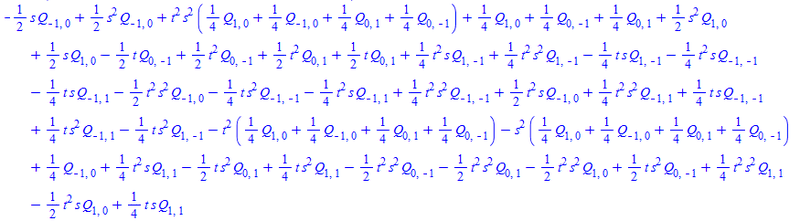
I found this formula for doing a quadratic conformal map with parameters:
Long symbolic expression in blue Mathematica-style typeset, a sum of many terms with coefficients like 1/2, 1/4 and r^2 s^2, involving symbols Q with subscripts such as Q_{-1,0}, Q_{0,1} and Q_{1,1}.

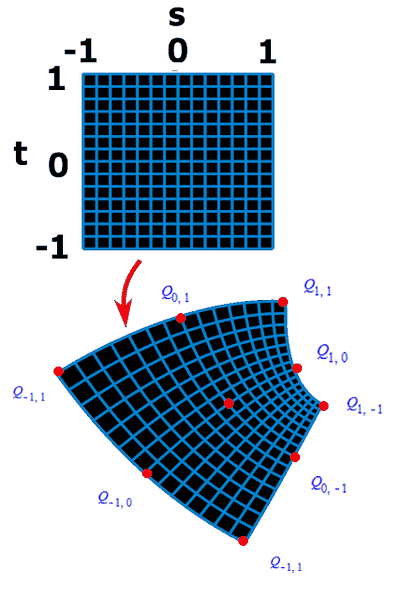
I think there's probably a nice Einstein notation representation of this above but I haven't figured it out yet.. But anyway the mapping is like below:
Top: a square grid on axes s and t, each running from -1 to 1. Red arrow points down to a curved quadrilateral grid with control points labelled Q with subscripts (-1,1), (0,1), (1,1), (1,0), (1,-1), (0,-1), (-1,-1) and (-1,0).


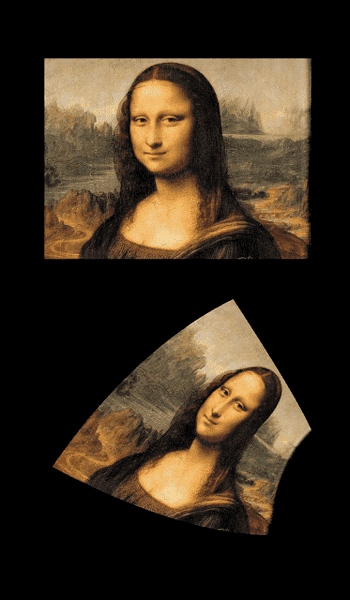
I don't know enough about General Relativity to know how this would fit in exactly, but so far I've written a program in Python to do this with images:
Two copies of a painted portrait of a woman with long dark hair against a landscape background; the lower copy is warped into a curved, wedge-shaped region, showing the image distorted by a nonlinear mapping.


Any comments are appreciated, thanks!
 
I guess I should have explained that Q in the above can be any of the X,Y,Z values it's the same formula for each, I've looked at some of the General Relativity formulas and it looked to me like it's a lot of effort to keep all the coordinate axis straight, this formula is the same for each coordinate axis separately so they can sort of be dealt with individually, but I'm not sure if that would help much or not...
 
If you want to have something you can copy and paste into a math program you can use this:
p = 1.0*((1/4)*b-(1/2)*s*b+(1/2)*s*s*b+(1/2)*t*t*d+(1/2)*t*d+(1/4)*e+(1/4)*g+
t*t*s*s*((1/4)*g+(1/4)*b+(1/4)*d+(1/4)*e)-(1/2)*t*t*s*g+(1/2)*s*s*g+
(1/2)*s*g-s*s*((1/4)*g+(1/4)*b+(1/4)*d+(1/4)*e)-t*t*((1/4)*g+(1/4)*b+
(1/4)*d+(1/4)*e)-(1/2)*t*t*s*s*e+(1/2)*t*s*s*e+(1/4)*t*s*f+(1/4)*t*s*s*f+
(1/4)*t*t*s*f+(1/4)*t*t*s*s*f-(1/4)*t*t*s*c-(1/4)*t*s*s*c+
(1/4)*t*t*s*s*c+(1/4)*t*s*c-(1/2)*t*t*s*s*g-(1/2)*t*e+(1/2)*t*t*e-
(1/2)*t*t*s*s*b+(1/2)*t*t*s*b+(1/4)*d-(1/2)*t*s*s*d-(1/2)*t*t*s*s*d+
(1/4)*t*t*s*s*a-(1/4)*t*s*a-(1/4)*t*t*s*a+(1/4)*t*s*s*a-(1/4)*t*s*s*h+
(1/4)*t*t*s*s*h+(1/4)*t*t*s*h-(1/4)*t*s*h)

The a,b,c,d,e,f,g,h are mapped like this:
conformal2.png


and s and t still range over -1..1
 
Attachments
  • upload_2016-1-2_10-38-21.png
    upload_2016-1-2_10-38-21.png
    4.7 KB · Views: 519
I found this matrix way of writing it, but I'm not entirely happy with it unless maybe someone happens to know if this matrix A is used somewhere else:
Equation M = a column vector of monomials (r^2 s^2, r^2 s, r s^2, r s^2, r^2 s, s^2, r s, r, s, 1) times a row of coefficients Q_{-1,1}, Q_{-1,0}, Q_{-1,-1}, Q_{0,1}, Q_{0,-1}, Q_{1,1}, Q_{1,0}, Q_{1,-1}.

An 8 by 8 matrix A with entries that are multiples of 1/4, including values 1/2, -1/2 and 0, with many zero entries.

Equation Q_{s,t} = sum over i and j of (M_{i,j} · A_{i,j}), written with double summation over indices i and j.
 
Sorry in the above I put 2 t*s^2 in the column vector, I'm now wondering if maybe I make that column vector and the row vector two 3x3 matrices and use the tensor product if that makes A something nicer...