Question concerning density of dark energy

Click For Summary
SUMMARY

The discussion centers on the density of dark energy, which is estimated to constitute approximately 68% of the universe according to data from the WMAP and Planck spacecraft. Participants explore the cosmological coincidence problem, questioning whether the observed similarity in density between dark energy and matter is merely a result of timing. Lawrence Krauss's graphical representation is analyzed, revealing that while the densities of dark energy and matter may appear similar, they evolve differently over time. The conversation concludes that while 50% and 68% densities are of the same order of magnitude, they do not necessarily indicate a true coincidence.

PREREQUISITES
  • Understanding of dark energy and its role in cosmology
  • Familiarity with the WMAP and Planck spacecraft data
  • Knowledge of the cosmological constant and its implications
  • Basic grasp of graph interpretation in scientific contexts
NEXT STEPS
  • Research the implications of the cosmological coincidence problem in modern cosmology
  • Study the differences between dark energy and matter density evolution over time
  • Examine empirical measurements from WMAP and Planck missions
  • Learn about the significance of order of magnitude in cosmological data analysis
USEFUL FOR

Astronomers, cosmologists, physics students, and anyone interested in understanding the complexities of dark energy and its impact on the universe's structure and evolution.

CosmicTheorist
Messages
2
Reaction score
0
Ok this might be quite a stupid question but I can't seem to find a clear answer. The Wikipedia page on dark energy says that work done by WMAP and the Planck spacecraft indicate that the universe is made up of about 68% dark energy. But looking at the Wikipedia page titled List of unsolved problems in physics it says the following:

Why is the energy density of the dark energy component of the same magnitude as the density of matter at present when the two evolve quite differently over time; could it be simply that we are observing at exactly the right time?

Also, in one of the Lawrence Krauss lectures he presents the following graph:
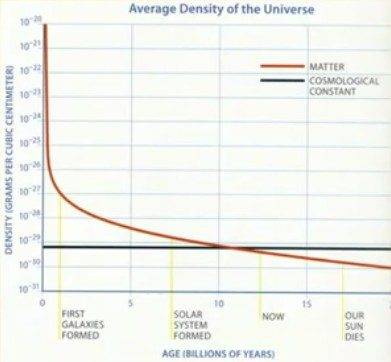
Screen_Hunter_06_Jun_05_07_50.jpg


For those unaware, cosmological constant is another term for dark energy, assuming the density of dark energy never changes (as new space is created new dark energy is created with it they say).

So I think my question at this point should be fairly predictable: doesn't the cosmological coincidence problem tell us that there is essentially 50% dark energy if the densities are the same? Has Krauss placed the "NOW" label slightly after where the two lines intersect in order to match the 68% dark energy estimation? If so doesn't that mean the densities don't match all that well at this point in time and there is no real coincidence?
 
Space news on Phys.org
Welcome to PF;
By "magnitude" I suspect the cosmic coincidence article is referring to "order of magnitude".
There is not enough information to make such statements about absolute magnitudes.
It is fair to say that 50% and 68% have "about the same order of magnitude".
Cosmology is like that.

Krauss has, indeed, placed the "now" label to illustrate the empirical measurements.
This is the data that any model of cosmology has to conform to after all. Reading off the graph, the red and blue lines both have order 10-30 and continue to do so until well after "our sun dies".

Note: Wikipedia articles will disagree with each other when they are not updated, to reflect new discoveries, at the same rate. In general, Wikipedia is not a reliable source for information - though it can be useful as a starting point.
 
Simon Bridge said:
It is fair to say that 50% and 68% have "about the same order of magnitude".
Ah that makes sense, especially considering the y-axis is using powers of 10 as the units.
 

Similar threads

  • · Replies 18 ·
Replies
18
Views
2K
  • · Replies 1 ·
Replies
1
Views
2K
  • · Replies 23 ·
Replies
23
Views
4K
  • · Replies 29 ·
Replies
29
Views
3K
  • · Replies 5 ·
Replies
5
Views
2K
  • · Replies 134 ·
5
Replies
134
Views
11K
  • · Replies 6 ·
Replies
6
Views
2K
  • · Replies 5 ·
Replies
5
Views
3K
  • · Replies 1 ·
Replies
1
Views
2K
  • · Replies 4 ·
Replies
4
Views
2K