Question on multiple rebrightening gamma ray bursts and gravity waves

  • Context: Undergrad 
  • Thread starter Thread starter Sware
  • Start date Start date
  • Tags Tags
    Correlation
Click For Summary
SUMMARY

This discussion focuses on the correlation between gravitational waves and multiple rebrightening gamma-ray bursts (MRGRBs), specifically examining whether gravitational waves are detected within 0-0.25 times the interval between rebrightenings. The participants mention the IPTA (International Pulsar Timing Array) and LIGO (Laser Interferometer Gravitational-Wave Observatory) as key organizations in gravitational wave detection. The discussion highlights the need for low-frequency gravitational wave detection, which LIGO cannot provide, and points to LISA (Laser Interferometer Space Antenna) as a potential future solution, with a planned launch in 2037.

PREREQUISITES
  • Understanding of gravitational wave detection methods, specifically LIGO and LISA.
  • Familiarity with gamma-ray bursts and their characteristics.
  • Knowledge of the frequency ranges of gravitational waves, particularly mHz to nHz.
  • Basic concepts of pulsar timing and its relevance to gravitational wave detection.
NEXT STEPS
  • Research the capabilities and limitations of LIGO in detecting gravitational waves.
  • Explore the design and expected functionalities of LISA for low-frequency gravitational wave detection.
  • Investigate the role of the IPTA in gravitational wave astronomy and its findings.
  • Study the characteristics and implications of multiple rebrightening gamma-ray bursts (MRGRBs).
USEFUL FOR

Astronomers, astrophysicists, and researchers interested in gravitational wave detection, gamma-ray burst phenomena, and the interplay between these two fields will benefit from this discussion.

Sware
Messages
10
Reaction score
0
TL;DR
Has anyone correlated gravity waves with multiple rebrightening gamma ray bursts where the bursts are of constant time separation?
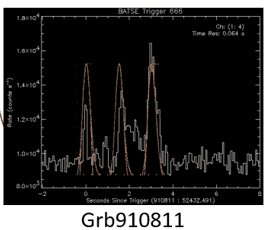
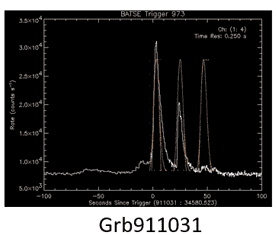
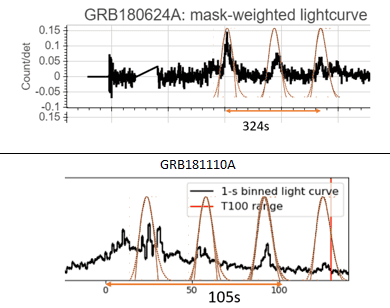
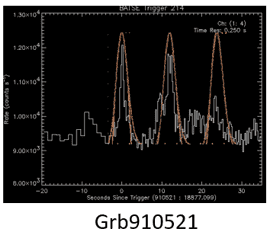
Hi Guys. I am interested to find out if anyone at the IPTA or other relevant organizations have correlated gravity waves with multiple rebrightening gamma ray bursts where there is a constant time (t) between 3 or more rebrightening's? If so, did the detection of the gravity wave occur between 0-0.25t seconds before the first brightening peak. Example gamma ray bursts below - I added the red curves.

I am just an interested amateur and have not done any university math's since 1988 so please be kind!!
1698176480145.png


Here's a couple of older (before the IPTA started measuring) GRB's with 3 peaks for example
1698176818126.png
1698176862842.png
1698176920169.png
 
Last edited by a moderator:
Space news on Phys.org
Sware said:
gravity waves

(gravitational waves) :wink:
 
  • Like
Likes   Reactions: vanhees71
Thanks for the correction berkeman - I shall be more careful with my nomenclature.
It seems though that there are no takers for this very specific question. Guess no one knows at the moment ☹. Would be interesting to know if any gravitational waves do get correlated with MRGRB's and actually lead the first brightening peak (not the rumble before) by <=0.25 x the peak to peak separation.
 
Sware said:
I am interested to find out if anyone at the IPTA or other relevant organizations have correlated gravity waves with multiple rebrightening gamma ray bursts where there is a constant time (t) between 3 or more rebrightening's?
The only way to do this would be if there was a LIGO detection corresponding to these events. At least with a quick web search, it does not appear that that was the case.
 
Hi Peter
Thanks for the reply. I have looked at LIGO but the frequency range of 1-1000Hz is too high.
(Black hole mergers an example). The waves I am looking at would be in the mHz to nHz range - see pic below
1699388947965.png

(https://physics.stackexchange.com/questions/543797/difference-between-gravitational-wave-detectors)

LISA is the best bet to pick up gravitational waves of the mHz range (if any are associated with MRGRB's).
1699389395407.png


It hasn't been been launched yet - 2037 planned launch! Ill be old then!!
(https://www.esa.int/Science_Exploration/Space_Science/LISA_factsheet)
I'm hoping the IPTA has picked up low frequency waves that look like below. X axis is time. Y axis would be flight time of pulses from pulsars relative to c. Looks totally different to LIGO black hole merger waves. Would be nice to know if this type of gravitational wave exists.
1699390327828.png
 
Sware said:
The waves I am looking at would be in the mHz to nHz range
Based on what?
 
Sware said:
I'm hoping the IPTA has picked up low frequency waves that look like below.
Based on what?
 
Sware said:
nHz range
Nanohertz means a period of decades. Are you sure that's what you mean?
 
Hi Guys
Thanks for the responses - been a bit busy.
@PeterDonis - I'm trying to gather evidence for an Idea I have. No good talking about it until I have something to go on - would be a bit foolish as I am just a layman when it comes to Cosmology. It's probably wrong but you never know. Lets see if those waves exist first. Any help with finding if these exist would be gratefully received :)

@Vanadium 50 - If you look at the chart above of the frequency ranges of gravitational waves, the stochastic background is around -nano Hz (you need the IPTA to detect these - https://ipta4gw.org/). The wavelength of MRGRB's would be in the milli Hz range. So there may be waves anywhere in the range of milli to nano Hz. We are talking about space so decades may be plausible?
Thanks for your interest and helpful comments guys.
 
  • #10
Sware said:
I'm trying to gather evidence for an Idea I have.
Personal research is off topic for discussion here.
 

Similar threads

  • · Replies 6 ·
Replies
6
Views
2K
  • · Replies 2 ·
Replies
2
Views
3K
  • · Replies 6 ·
Replies
6
Views
4K
Replies
8
Views
3K
  • · Replies 19 ·
Replies
19
Views
5K
  • · Replies 12 ·
Replies
12
Views
5K
  • · Replies 4 ·
Replies
4
Views
3K
  • · Replies 4 ·
Replies
4
Views
2K
  • · Replies 13 ·
Replies
13
Views
6K
  • · Replies 15 ·
Replies
15
Views
4K