Questions about the learning curve

  • Context: Undergrad 
  • Thread starter Thread starter EvilKermit
  • Start date Start date
  • Tags Tags
    Curve
Click For Summary

Discussion Overview

The discussion revolves around the concept of the learning curve and its implications for individual differences in skill acquisition and intelligence. Participants explore how varying learning curves may affect proficiency in learning skills and the potential relationship between learning curves and intelligence, particularly in the context of mastering complex concepts.

Discussion Character

  • Exploratory
  • Conceptual clarification
  • Debate/contested

Main Points Raised

  • Some participants propose that a steeper learning curve for one individual (person A) compared to another (person B) could lead to significant differences in proficiency, regardless of effort from person B.
  • There is a suggestion that mastering basic concepts may enable faster learning of complex concepts, potentially linking learning curves to differences in intelligence.
  • One participant cautions against overextending the implications of the learning curve graph, noting that it does not clarify how "performance" is measured or the motivations behind continued attempts after reaching a plateau.
  • It is argued that learning is skill-specific and influenced by various factors, including the learner's perception of the skill and their motivation, which may not be captured by a generalized learning curve.
  • Another participant questions the utility of the learning curve graph for generalization, suggesting it lacks differentiation between types of knowledge and reasons for learning.
  • There is a request for specific references to the source of the learning curve image and its context within a psychology textbook.
  • A later reply mentions that the learning curve may primarily apply to procedural memory, indicating a potential area of focus for further discussion.

Areas of Agreement / Disagreement

Participants express differing views on the implications of the learning curve, with some supporting the idea of significant individual differences in learning potential, while others challenge the generalizability of the learning curve concept. The discussion remains unresolved regarding the broader implications of learning curves on intelligence and skill acquisition.

Contextual Notes

The discussion highlights limitations in the understanding of how learning curves apply across different skills and contexts, as well as the need for clearer definitions and measurements of performance and motivation in learning scenarios.

EvilKermit
Messages
22
Reaction score
0
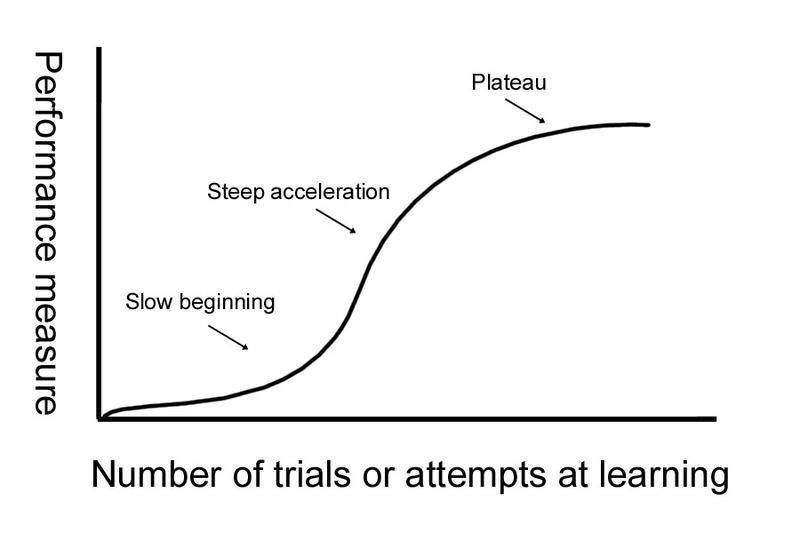
In case you don't know what I'm talking about or haven't seen it, here's the link:
07learningcurve.jpg


Does the learning curve imply that different people have different limits in learning a skill. For example let's say there's two people: person A and person B. If person A has a learning curve that is steeper, and lasts the same time or longer than person B, then he will become much more proficient then him, no matter how much person B tries. It will take person B years to become as proficient person A did in a couple of days, since person's B learning curve plateue out at a much lower performance than B.

Could this also explain the difference in intelligence of people. People who have mastered basic concepts at a better proficiency, can learn many different complex concepts at a faster rate (for example an understanding of Calculus can make one proficient in physics and engineering).
 
Mathematics news on Phys.org
Does the learning curve imply that different people have different limits in learning a skill? For example let's say there's two people: person A and person B. If person A has a learning curve that is steeper, and lasts the same time or longer than person B, then he will become much more proficient then him, no matter how much person B tries. It will take person B years to become as proficient person A did in a couple of days, since person's B learning curve plateue out at a much lower performance than B.

Could this also explain the difference in intelligence of people. People who have mastered basic concepts at a better proficiency, can learn many different complex concepts at a faster rate (for example an understanding of Calculus can make one proficient in physics and engineering).[/QUOTE]

I think you have to be careful overextending what is represented by this graph in terms of theoretical implications. The graph doesn't say how "performance" is measured or why learners would continue to make trials or attempts after reaching a plateau.

I think that learning is skill-specific and the reasons it is relatively easy or difficult for a certain learner to learn a certain skill has to do with a number of factors about how the learner perceives the skill, their attitude toward, their evaluation of what the use of it is, etc.

Some people can be easily motivated to learn skills or information that they perceive as arbitrary or functionless, if there are other social or material rewards involved. A rat can learn to navigate a maze, for example, after a certain number of tried provided there is a piece of cheese to be had as a reward for doing so. The same rat would probably not bother with the maze is there was no reward, but would probably learn other skills that are of immediate relevance, such as nest-building, without a different attitude.

Because this graph doesn't differentiate between different types of knowledge, skills, and reasons for learning, I don't think it is very useful for generalization - and since it probably is only derived from studying certain kids of knowledge-learning, it is vague for not specifying what those were/are.
 
EvilKermit said:
In case you don't know what I'm talking about or haven't seen it, here's the link:

www. psywww.com/intropsych/ch07_cognition/07learningcurve.jpg

Please tell me what section from Psychology: An Introduction by Russell A. Dewey, PhD did you find the link in Chapter 7: Cognition. Was it in Part One: Visual Information Processing, Part Two: Language, Part Three: Motor Activity, or Part Four: Thinking and Problem Solving.
http://www.intropsych.com/ch07_cognition/tofc_for_ch07_cognition.html or
www. intropsych.com/ch07_cognition/tofc_for_ch07_cognition.html (link)


Would you be so kind to also give me the previous page (via a link) prior to the image you presented?
 
Last edited:

Similar threads

  • · Replies 1 ·
Replies
1
Views
2K
Replies
16
Views
3K
  • · Replies 10 ·
Replies
10
Views
3K
Replies
5
Views
3K
  • · Replies 12 ·
Replies
12
Views
2K
  • · Replies 1 ·
Replies
1
Views
3K
  • · Replies 7 ·
Replies
7
Views
5K
  • · Replies 3 ·
Replies
3
Views
1K
  • · Replies 19 ·
Replies
19
Views
3K
  • · Replies 6 ·
Replies
6
Views
3K