Raising and lowering Ricci Tensor

Join the discussion
Registration is free. Ask a follow-up in this thread, or start your own.
9 replies · 3K views
unscientific
Messages
1,728
Reaction score
13
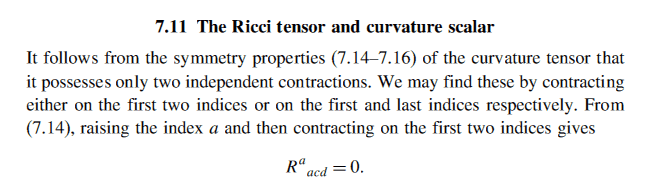
Taken from Hobson's book:

ricci4.png


How is this done? Starting from:

[tex]R_{abcd} = -R_{bacd}[/tex]

Apply ##g^{aa}## followed by ##g^{ab}##

[tex]g^{aa}g^{aa} R_{abcd} = -g^{ab}g^{aa}R_{bacd}[/tex]
[tex]g^{ab}R^a_{bcd} = -g^{ab}g^{aa}R_{bacd}[/tex]
[tex]R^{aa}_{cd} = - g^{ab}g^{aa} R_{bacd}[/tex]

Applying ##g_{aa}## to both sides:
[tex]g_{aa}R^{aa}_{cd} = - g^{ab}g^{aa} g_{aa} R_{bacd}[/tex]
[tex]R^a_{acd} = -g^{ab} R_{bacd}[/tex]
[tex]R^a_{acd} = - R^a_{acd} = 0[/tex]

Is there a quicker way?
 
Last edited:
Physics news on Phys.org
unscientific said:
Taken from Hobson's book:

ricci4.png


How is this done? Starting from:

[tex]R_{abcd} = -R_{bacd}[/tex]

Apply ##g^{aa}## followed by ##g^{ab}##

[tex]g^{aa}g^{aa} R_{abcd} = -g^{ab}g^{aa}R_{bacd}[/tex]
[tex]g^{ab}R^a_{bcd} = -g^{ab}g^{aa}R_{bacd}[/tex]
[tex]R^{aa}_{cd} = - g^{ab}g^{aa} R_{bacd}[/tex]

Applying ##g_{aa}## to both sides:
[tex]g_{aa}R^{aa}_{cd} = - g^{ab}g^{aa} g_{aa} R_{bacd}[/tex]
[tex]R^a_{acd} = -g^{ab} R_{bacd}[/tex]
[tex]R^a_{acd} = - R^a_{acd} = 0[/tex]

Is there a quicker way?
[itex]g^{aa}[/itex] has no meaning. The metric is symmetric tensor, [itex]g^{a b} = g^{b a}[/itex], so when you contract it with some antisymmetric tensor like [itex]R_{a b c d e f g} = - R_{b a c d e f g}[/itex], you get zero:
[tex]g^{ab} R_{a b c d} = - g^{b a} R_{b a c d}, \ \Rightarrow \ R^{b}{}_{b c d} = - R^{a}{}_{a c d} .[/tex]
So, you have something equal to minus itself. It must be zero.
 
samalkhaiat said:
[itex]g^{aa}[/itex] has no meaning. The metric is symmetric tensor, [itex]g^{a b} = g^{b a}[/itex], so when you contract it with some antisymmetric tensor like [itex]R_{a b c d e f g} = - R_{b a c d e f g}[/itex], you get zero:
[tex]g^{ab} R_{a b c d} = - g^{b a} R_{b a c d}, \ \Rightarrow \ R^{b}{}_{b c d} = - R^{a}{}_{a c d} .[/tex]
So, you have something equal to minus itself. It must be zero.

Thanks for replying, I think I almost got the hang of it.
Quick but unrelated question:
Suppose I start off with ##R_{abcd}##, how do I get to ##R_{bc}##?

I'm thinking ##g^{aa}R_{abcd} = R^a _{bcd}## then ##-R^a_{bdc}## then ##-g_{de} g^{ea} R^a_{bdc} = -\delta_d^a R^a_{bdc} =- R^a_{bac} =- R_{bc}##.
 
Last edited:
unscientific said:
Quick but unrelated question:
Suppose I start off with ##R_{abcd}##, how do I get to ##R_{bc}##?
This depends on the book you use. I contract the first with the last index [itex]R_{a b} = g^{c d} R_{c b a d} = R^{d}{}_{b a d}[/itex] others do it between the first and the 3rd.
 
samalkhaiat said:
This depends on the book you use. I contract the first with the last index [itex]R_{a b} = g^{c d} R_{c b a d} = R^{d}{}_{b a d}[/itex] others do it between the first and the 3rd.

I don't understand how you can do that... I'm confused.
 
samalkhaiat said:
This depends on the book you use. I contract the first with the last index [itex]R_{a b} = g^{c d} R_{c b a d} = R^{d}{}_{b a d}[/itex] others do it between the first and the 3rd.

Starting with the Bianchi Identity:

[tex]\nabla_e R_{abcd} + \nabla_c R_{abde} + \nabla_d R_{abec} = 0[/tex]

I raise index ##a## by multiplying ##g^{aa}##:

[tex]\nabla_e R^a_{bcd} + \nabla_c R^a_{bde} + \nabla_d R^a_{bec} = 0[/tex]

I'm trying to understand their steps:

riemann1.png
 
samalkhaiat said:
This depends on the book you use. I contract the first with the last index [itex]R_{a b} = g^{c d} R_{c b a d} = R^{d}{}_{b a d}[/itex] others do it between the first and the 3rd.

It's alright, I got it - It can be done by contracting ##a## with ##c## then multiplying ##g^{be}##.
 
unscientific said:
Starting with the Bianchi Identity:

[tex]\nabla_e R_{abcd} + \nabla_c R_{abde} + \nabla_d R_{abec} = 0[/tex]

I raise index ##a## by multiplying ##g^{aa}##:

[tex]\nabla_e R^a_{bcd} + \nabla_c R^a_{bde} + \nabla_d R^a_{bec} = 0[/tex]
I told you, we don't have an object like [itex]g^{aa}[/itex]. If you have a tensor [itex]T_{abc}[/itex] and you want to raise the first index, you multiply your tensor with [itex]g^{a d}[/itex], i.e. [itex]T^{d}{}_{b c} = g^{a d} T_{a b c}[/itex].
 
Multiply the BI with [itex]g^{ad}[/itex]. Let us do it term by term:
The first term [tex]g^{ad} \nabla_{e} R_{abcd} = \nabla_{e} g^{ad} R_{abcd} = \nabla_{e} R^{d}{}_{bcd} = \nabla_{e} R_{bc} .[/tex] The second term [tex]g^{ad} \nabla_{c} R_{abde} = \nabla_{c} R^{d}{}_{bde} = - \nabla_{c} R_{be} .[/tex] And the third term is easy, just raise the index on the covariant derivative [tex]g^{ad} \nabla_{d} R_{abec} = \nabla^{a} R_{abec} = \nabla_{a} R^{a}{}_{bec} .[/tex]
 
samalkhaiat said:
Multiply the BI with [itex]g^{ad}[/itex]. Let us do it term by term:
The first term [tex]g^{ad} \nabla_{e} R_{abcd} = \nabla_{e} g^{ad} R_{abcd} = \nabla_{e} R^{d}{}_{bcd} = \nabla_{e} R_{bc} .[/tex] The second term [tex]g^{ad} \nabla_{c} R_{abde} = \nabla_{c} R^{d}{}_{bde} = - \nabla_{c} R_{be} .[/tex] And the third term is easy, just raise the index on the covariant derivative [tex]g^{ad} \nabla_{d} R_{abec} = \nabla^{a} R_{abec} = \nabla_{a} R^{a}{}_{bec} .[/tex]

The ricci tensor is defined as ##R_{bc} = R^a_{bac}## in my notes. I'm trying to work with their notation.