Rare Plume on Mars: A Mystery Baffling Scientists

  • Context: Undergrad 
  • Thread starter Thread starter Dotini
  • Start date Start date
  • Tags Tags
    Mars
Click For Summary

Discussion Overview

The discussion centers around the observation of a rare plume on Mars, reported by amateur astronomers in 2012, which rose to an altitude of over 250 km. Participants explore various hypotheses regarding the nature of the plume, including its potential causes and implications for understanding Martian atmospheric phenomena.

Discussion Character

  • Exploratory
  • Debate/contested
  • Technical explanation

Main Points Raised

  • Some participants note the unusual altitude of the plume, which exceeds previous observations of similar features that did not rise above 100 km.
  • There is speculation about the plume being a reflective cloud of water-ice, an auroral emission, or possibly related to an impact event.
  • One participant suggests that highly energetic auroral activity on Mars may be more common than previously thought, although it remains puzzling.
  • Another participant expresses interest in future satellite imagery to further investigate the area where the plume was observed.

Areas of Agreement / Disagreement

Participants do not reach a consensus on the cause of the plume, with multiple competing hypotheses presented and ongoing uncertainty regarding the nature of the observed phenomenon.

Contextual Notes

The discussion highlights the limitations in current understanding of Martian atmospheric dynamics and the need for further observational data to clarify the nature of the plume.

Dotini
Gold Member
Messages
639
Reaction score
230
In the spring of 2012 amateur astronomers spotted a huge plume rising from the Marian surface and captured it on video. They’ve been seen in the past rising to an altitude of 100km, but this one rose to more than 250 km. A reflective cloud of water-ice? An auroral emission of some kind? Or could it be due to an impact?

http://www.esa.int/Our_Activities/Space_Science/Mystery_Mars_plume_baffles_scientists

MYSTERY MARS PLUME BAFFLES SCIENTISTS
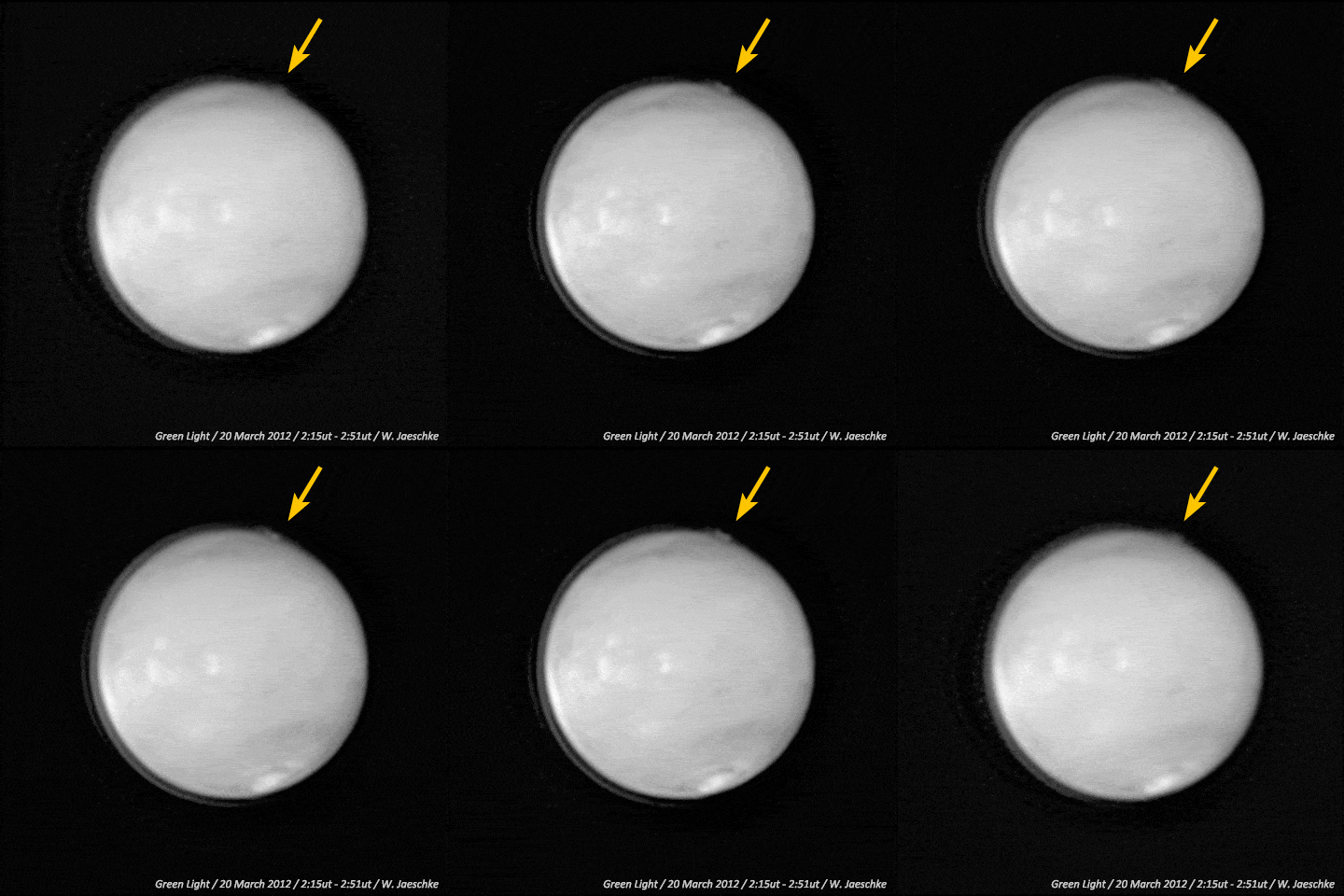
Mystery_plume_on_Mars_medium.gif

Mystery plume on Mars
16 February 2015

Plumes seen reaching high above the surface of Mars are causing a stir among scientists studying the atmosphere on the Red Planet.

On two separate occasions in March and April 2012, amateur astronomers reported definite plume-like features developing on the planet.

The plumes were seen rising to altitudes of over 250 km above the same region of Mars on both occasions. By comparison, similar features seen in the past have not exceeded 100 km.

“At about 250 km, the division between the atmosphere and outer space is very thin, so the reported plumes are extremely unexpected,” says Agustin Sanchez-Lavega of the Universidad del País Vasco in Spain, lead author of the paper reporting the results in the journal Nature.

High-altitude_plume_on_Mars_medium.jpg
 
Last edited:
  • Like
Likes   Reactions: diogenesNY
Astronomy news on Phys.org
cool ... wasn't aware of those ... thanks :)Dave
 
  • Like
Likes   Reactions: Dotini
Neat. Would like to see the followup when they get sat photos of the area.
 
Maybe highly energetic auroral activity on Mars is less rare than thought, though still quite puzzling. This Martian aurora is said to be many times brighter than Earthly aurorae. In 2001, Mars was entirely engulfed in a thick dust storm.

http://www.nature.com/articles/nature14162.epdf?referrer_access_token=QYGOQY2nWe7OxhG_I7gwcNRgN0jAjWel9jnR3ZoTv0PQU3zoghsPsRCu5hOdcH3Cxsj-l2UK7SQYJdUGZ1oqB-bVZpfiulpYIqz-iG65sCobwq0WEGP07uZ1c2pSrPfS0MN9_a-2ktKU2QirDdPCmgsLkLtoJF9l8n8rtvNd4DudcrXsRBfHjbTPgegJyfxnKKv3FfBNjfvxfgHDJDGUfQ==&tracking_referrer=www.nature.com

http://www.nasa.gov/press/2015/marc...sterious-dust-cloud-around-mars/#.VQwHlUt-_8s

ultraviolet%20aurora%20on%20mars%20dec2014%20by%20maven.jpg


A map of IUVS’s auroral detections in December 2014 overlaid on Mars’ surface. The map shows that the aurora was widespread in the northern hemisphere, not tied to any geographic location. The aurora was detected in all observations during a 5-day period. Image credit: University of Colorado.
 
Last edited:

Similar threads

  • · Replies 1 ·
Replies
1
Views
4K
  • · Replies 10 ·
Replies
10
Views
10K