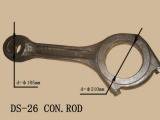
Rationale for big end con-rod design seen here

  • Thread starter Thread starter jellydonut
  • Start date Start date
  • Tags Tags
    Design
Click For Summary

Discussion Overview

The discussion revolves around the design rationale for the angled big end attachment of connecting rods in piston engines, particularly in marine and Subaru boxer diesel engines. Participants explore whether this design is primarily for practical maintenance access or if it also serves to enhance the lifespan of the connecting rods due to the forces involved during operation.

Discussion Character

  • Exploratory
  • Technical explanation
  • Debate/contested

Main Points Raised

  • One participant suggests that the angled design may be advantageous due to reciprocating forces acting on the big end after top dead center (TDC).
  • Another participant proposes that the design is primarily for practical maintenance access, especially in marine engines where maintenance is conducted from the side.
  • A participant acknowledges that while ease of piston removal is a benefit of the design, they question whether this is the sole reason or if it also accommodates better tolerance of reciprocating forces.
  • One participant notes that the Subaru engine's horizontal layout complicates access to the con rod bolt, implying that the design choice may be influenced by this accessibility issue.

Areas of Agreement / Disagreement

Participants express a mix of views, with some suggesting that both maintenance practicality and force tolerance are factors in the design, while others remain uncertain about the primary rationale. The discussion does not reach a consensus.

Contextual Notes

Participants reference specific engine designs and maintenance practices, but there is no detailed exploration of the underlying mechanical principles or empirical evidence supporting their claims.

jellydonut
Messages
2
Reaction score
0
Hey,

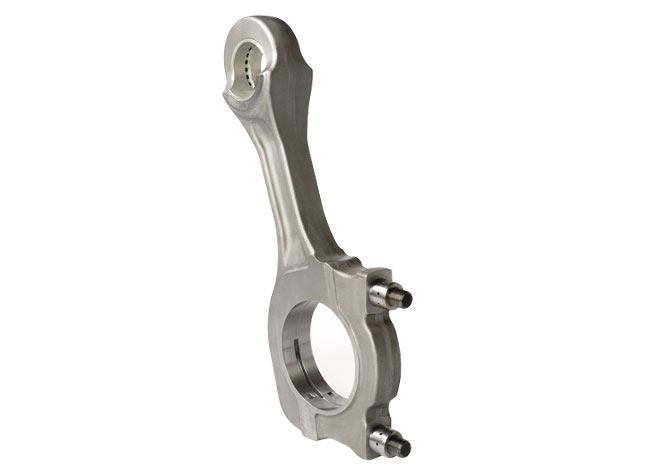
I've wondered about the reasoning behind, or rationale for, the angled big end attachment of the connecting rod in piston engines.

This is from a large Wärtsilä four-stroke marine diesel:
hsCI9.jpg


From a tiny Daihatsu marine diesel:
I7aec.jpg


My first thought was that this was somehow advantageous due to the reciprocating forces, but that's me with my layman eyes.. It was suggested to me that the reason was much simpler: easy access because marine engines are maintained from the side, and not by removing the sump. This made sense and the matter settled.

Then I saw this:
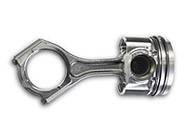
e0qhy.jpg


This is from the new Subaru boxer diesel. I suppose it could make sense that due to the engine shape they made them this way solely for maintenance access here as well, but I just want to ask anyway because this is like an itch I can't scratch.

Do they angle the attachment solely for practicality, or does it increase the lifespan of the con rods?
 
Engineering news on Phys.org
Think about where the forces in the big end are acting just after TDC.
Also think about how you'd go about removing pistons on such an engine.
 
That's what I've been doing :rolleyes:

I mentioned both such thoughts - I'm just wondering if I am right about either, both or none. Certainly it is easier to remove the piston on a marine engine with this design, I was just wondering if this was the sole reason or just a side effect of a design more tolerant of reciprocating forces.
 
Yeah, some of both.
 
First time i was in a marine engine facility was when i saw a piston/ rod combination being lowered into the engine case with an over head crane..huge..access is from the side
Subaru is not a V8,v6, V4 but horizontal engine design and again access to con rod bolt is difficult , hence the design...btw Subaru has all wheel drive and touts the horizontal engine layout for lower CG
 

Similar threads

  • · Replies 2 ·
Replies
2
Views
11K