Recasting/Reducing ODEs of order n to first order

  • Context: MHB 
  • Thread starter Thread starter nacho-man
  • Start date Start date
  • Tags Tags
    First order Odes
Click For Summary
SUMMARY

This discussion focuses on the recasting and reduction of ordinary differential equations (ODEs) of order n to first-order systems. The first example provided is the second-order ODE $y''(x) = x + y'(x) + e^{y(x)}$ with initial conditions $y(0)=0$ and $y'(0)=1$. The second example is a third-order ODE $y'''(x) = y(x)$ with initial conditions $y(1) = 4$, $y'(1)=4$, and $y''(1)=0$. The solution approach involves introducing a state vector ${\bf{Y}}(x)=(y'(x),y(x))$ to transform the second-order ODE into a first-order system, allowing for easier analysis and solution.

PREREQUISITES
  • Understanding of ordinary differential equations (ODEs)
  • Familiarity with initial value problems
  • Knowledge of state-space representation in differential equations
  • Proficiency in solving linear differential equations with constant coefficients
NEXT STEPS
  • Study the method of reducing higher-order ODEs to first-order systems
  • Learn about state-space representation and its applications in differential equations
  • Explore the characteristic equation and its role in solving linear differential equations
  • Investigate numerical methods for solving ODEs, such as the Runge-Kutta method
USEFUL FOR

Students preparing for exams in differential equations, mathematicians, and engineers looking to deepen their understanding of ODEs and their solutions.

nacho-man
Messages
166
Reaction score
0
Could someone please provide a worked solution for me. I think that is the only way I will understand this. It was covered very vaguely in our lectures and my notes start talking about vectors and using co-domain notation which is very frustrating!

1. $y''(x) = x + y'(x) + e^{y(x)}$ with $y(0)=0, y'(0)=1$I know MHB doesn't endorse just handing out solutions, so I will try and attempt the second problem myself if someone may help me with the first. I really need to learn this for my exam in 7 days.

2. $y'''(x) = y(x)$ with $y(1) = 4, y'(1)=4, y''(1)=0$
 
Physics news on Phys.org
The second one is easy if you substitute \displaystyle \begin{align*} u(x) = y'(x) \end{align*}, making a second order linear DE with constant coefficients \displaystyle \begin{align*} u''(x) = u(x) \end{align*}.
 
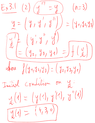
This is my lecturer's solution.

What even man
 

Attachments

  • recast.png
    recast.png
    19.5 KB · Views: 116
The may or may not help you, but if I was going to solve the second one, I would note the characteristic equation is:

$$r^3-1=(r-1)\left(r^2+r+1 \right)=0$$

which has the roots:

$$r=1,\,\frac{-1\pm\sqrt{3}i}{2}$$

Hence, the general solution will take the form:

$$y(x)=c_1e^x+e^{-\frac{1}{2}x}\left(c_2\cos\left(\frac{\sqrt{3}}{2}x \right)+c_3\sin\left(\frac{\sqrt{3}}{2}x \right) \right)$$

Now it is a matter of differentiating to get a 3X3 linear system in the 3 parameters.
 
nacho said:
Could someone please provide a worked solution for me. I think that is the only way I will understand this. It was covered very vaguely in our lectures and my notes start talking about vectors and using co-domain notation which is very frustrating!

1. $y''(x) = x + y'(x) + e^{y(x)}$ with $y(0)=0, y'(0)=1$I know MHB doesn't endorse just handing out solutions, so I will try and attempt the second problem myself if someone may help me with the first. I really need to learn this for my exam in 7 days.

2. $y'''(x) = y(x)$ with $y(1) = 4, y'(1)=4, y''(1)=0$

For a second order ODE that can be written in the form: \(y''(x)=f(y'(x),y(x),x)\) we reduce this to a first order system by introducting the state vector \( {\bf{Y}}(x)=(y'(x),y(x))\). Now if we differentiate this we get:

\[ {\bf{Y}}'(x)=(y''(x),y'(x))\]
Now we may substitute \(y''(x)\) from the original equation into this to get:
\[ {\bf{Y}}'(x)=(f(y'(x),y(x),x),y'(x))\]
Then using \(y'(x)={\bf{Y}}_1\) and \(y(x)={\bf{Y}}_2\) we get:
\[ {\bf{Y}}'(x)=(f({\bf{Y}}_1,{\bf{Y}}_2,x),{\bf{Y}}_1)\]
with inotial condition \({\bf{Y}}(0)=({\bf{Y}}_1(0),{\bf{Y}}_2(0)) =(y'(0),y(0))\)

.
 
Last edited:
Please disregard my last post, I misread the question.
 
For the longest of time, our lecturer made it out to be that recasting and reduction of order were the same thing.

now that I know that they are not, everything is much more clearer.

Thanks for the help guys/gals
 

Similar threads

  • · Replies 3 ·
Replies
3
Views
3K
  • · Replies 2 ·
Replies
2
Views
4K
  • · Replies 3 ·
Replies
3
Views
2K
  • · Replies 7 ·
Replies
7
Views
3K
  • · Replies 2 ·
Replies
2
Views
4K
  • · Replies 2 ·
Replies
2
Views
2K
  • · Replies 1 ·
Replies
1
Views
541
  • · Replies 2 ·
Replies
2
Views
3K
  • · Replies 7 ·
Replies
7
Views
2K
  • · Replies 9 ·
Replies
9
Views
3K