Replacing ATV Trail Bridges: Cat 259D Skid Steer Impact

  • Thread starter Thread starter jrmichler
  • Start date Start date
  • Tags Tags
    Bridges Impact
Click For Summary

Discussion Overview

The discussion revolves around the structural integrity and safety of ATV trail bridges over wetlands, particularly focusing on the impact of a Caterpillar 259D skid steer that may have contributed to the collapse of one such bridge. Participants explore various aspects including design loads, material choices, environmental considerations, and liability issues related to the bridge's failure.

Discussion Character

  • Debate/contested
  • Technical explanation
  • Conceptual clarification
  • Exploratory

Main Points Raised

  • One participant believes that ATV trail bridges have a design load of 5,000 lbs, while the skid steer weighs 9,000 lbs plus additional load, raising concerns about the bridge's capacity.
  • Another participant questions the approval process for the bridges and liability in case of injuries during the collapse.
  • Concerns are raised about the difference between official engineering requirements and real-world conditions, citing examples from highway systems.
  • Some participants discuss the environmental implications of using pressure-treated wood in wetlands, noting that it may not be a good combination.
  • One participant expresses skepticism about the bridge's design, highlighting inadequate support and potential dangers based on visual observations.
  • There is a discussion on the importance of selecting appropriate wood types for durability and lifespan, with suggestions for alternatives that may perform better in wet conditions.
  • Details are provided about the structural failure, indicating that only the deck boards rotted while the main structural components remained solid.
  • A participant shares an anecdote from a skid steer operator who reported that the drop during the collapse was gentle, with no injuries or damage to the equipment.

Areas of Agreement / Disagreement

Participants express multiple competing views regarding the design and safety of the bridges, the environmental impact of materials used, and the implications of the collapse. The discussion remains unresolved with no consensus on the key issues raised.

Contextual Notes

Participants note that the original design had posts that tilted significantly, which contributed to the need for replacement. The new design features longer posts and cross bracing, but concerns about the overall robustness of the design persist.

jrmichler
Mentor
Messages
2,448
Reaction score
3,540
A local ATV (All Terrain Vehicle) trail has some bridges over wetlands. The original supplier of the wood decking did not properly pressure treat the wood, so several of the bridges are being replaced. One bridge had the decking replaced last year. The contractor replacing the other bridges was using this bridge to access the work site.
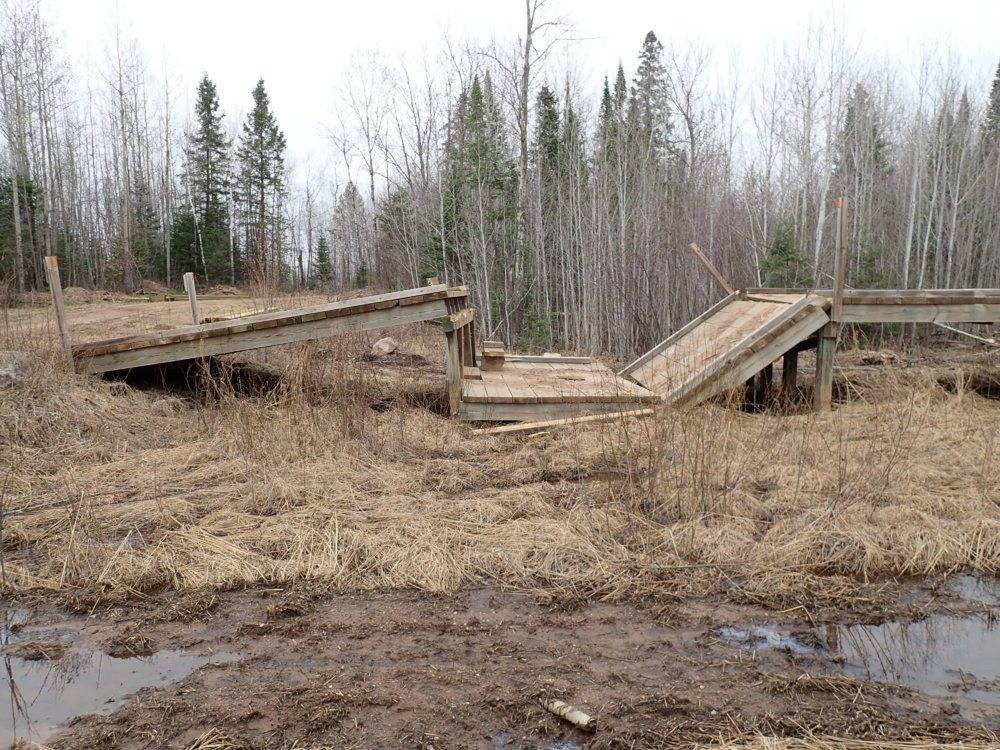
P4270005.JPG

I don't know for a fact, but believe that ATV trail bridges have a design load of 5,000 lbs. This trail is closed to snowmobiles, so does not have trail groomers on it. The Caterpillar 259D tracked skid steer that made many trips over this bridge weighs 9,000 lbs plus the load.

In addition, when traveling from left to right, the skid steer goes up a steep ramp, then tips over the edge to flop down onto the level portion. That's an additional impact load.

The contractor is working on a contract with a firm finish date of soon. They had originally hoped to be done by last week, but still have one bridge to replace yet. I don't know if the contractor will be held liable for the damage to this bridge.
 
Engineering news on Phys.org
Is there a question in there somewhere?
 
phinds said:
Is there a question in there somewhere?
Probably good questions would be: Who signed off on this set of bridges? Who approved the EIR for this construction (related to the previous question)? Who would be liable if there had been injuries during this collapse? Yikes...
 
phinds said:
Is there a question in there somewhere?

Just pointing out that, in the engineering world, there are the official requirements, and there are the real world requirements. And there are unexpected things that come up.

A similar example, but on a larger scale, is the highway system near Chicago, Illinois. The official requirement is that roads and bridges be designed for trucks weighing up to 80,000 lbs. The real world requirement is to deal with trucks, especially trucks carrying steel, weighing up to 120,000 lbs.

Note that the bridge is four feet above the ground. That was the result of a DNR requirement to make the bridge high enough so that vegetation could grow underneath. That did not work, so the replacement bridges are closer to the ground.

In Wisconsin, the laws concerning protection of wetlands are fully enforced. This bridge is in 230 square miles (about 150,000 acres) of County and National Forest in a county that is 38% wetland. Without this bridge, 0.02 acres of wetland would have been filled.
 
jrmichler said:
The original supplier of the wood decking did not properly pressure treat the wood
Wetlands - pressure treated wood - wet lands - environment - not really all that good a combination.
https://www.doi.gov/sites/doi.gov/files/migrated/greening/buildings/upload/EnviromentalConsiderationsTreatedWood.pdf
 
256bits said:
Wetlands - pressure treated wood - wet lands - environment - not really all that good a combination.
https://www.doi.gov/sites/doi.gov/files/migrated/greening/buildings/upload/EnviromentalConsiderationsTreatedWood.pdf
Yeah, but environomental impact is a completely separate issue from the issue of failure possibly due to improper/inadequate treatment, which is what this thread is about. I don't mean it's a bad point, just that it's not what this thread is about.
 
jrmichler said:
I don't know if the contractor will be held liable for the damage to this bridge.
You won't know that without a report from a qualified/licensed engineer.

My humble opinion (based on a picture which only partially shows the structure) is that this construction seems to be dangerous/inadequate: the edges which are actually shouldering the load are just a few cm wide and with the flat elements bending under load this will just get smaller and smaller. Also the most important horizontal beam holding two (!) flat sections seems to have no fix against forward-backward (cross) movements, since it is standing on 'legs' in a single row - this further decreasing that safe 'shoulder' area when the construction is under load.
 
Last edited:
phinds said:
Yeah, but environomental impact is a completely separate issue from the issue of failure possibly due to improper/inadequate treatment, which is what this thread is about. I don't mean it's a bad point, just that it's not what this thread is about.
Treated wood or untreated wood selection has an impact.
If treated or a wood less prone to rot is selected then the bridge and deck lifespan would be longer than that from an improper wood selection. Certain types of say oak with a dense grain or cellular structure absorb less moisture when in contact with the ground. Cedar for the deck might be selected for resistance to weathering effects and rot.
A lesser wood would require a beefier bridge design taking into account decreased performance over the years.

Even then,
If the other bridges that were being replaced were of the same design as timber, board and plank selection, then it would at first hand appear of not a robust enough of a design to withstand continued traffic over the expected lifespan at the connections from span to span. The decking seems to be adequate with what looks to be several 2 x 8 runners supporting it.

The ramp section looks as if it has moved backwards, thus removing the support for the span that has fallen down and broken in two. Movement in a wet marsh would be expected, so I am not sure if the free floating design of the span would have been safe over the years to come, as @Rive has pointed out.
 
The spanwise beams did not slip off the cross beams. It broke into a V-shape, after which they chain sawed pieces out to get one half to fall down flat so they could get the skid steer out. The spanwise beams are (7) 3 X 10's of undetermined species on a 15 foot span. One of those spanwise beams broke at a weak spot, while the others looked solid.

Only the deck boards rotted. The posts, beams, and hardware were all solid.

The original design was supported by posts about 6 feet long. They were dug into the ground about 2 feet, with 4 feet exposed. Most of them had tilted about 30 degrees from vertical, which is why those bridges were replaced. The new posts are about 8 feet long, buried 6 feet into the ground, tied together with a cross beam at the bottom, and have cross bracing.
 
  • #10
I was by there on my morning run and talked to the skid steer operator that collapsed the bridge. He said that the drop was surprisingly gentle. No injuries, and no damage to the skid steer.