Riemann Curvature: Understanding Parallel Transport on 1D Rings

  • Context: Undergrad 
  • Thread starter Thread starter Narasoma
  • Start date Start date
  • Tags Tags
    Curvature Riemann
Narasoma
Messages
42
Reaction score
10
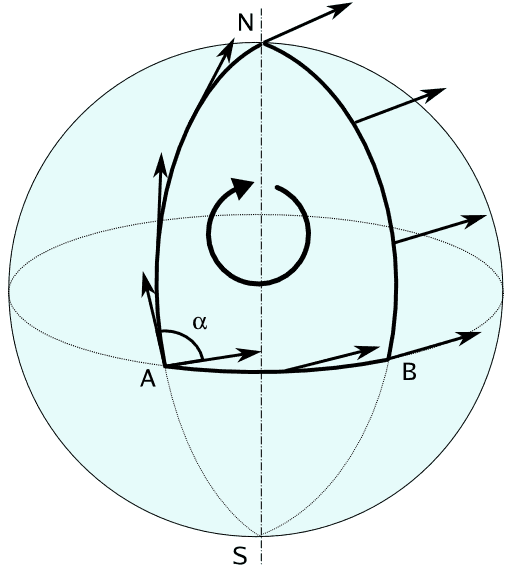
Everyone who is currently studying GR must be familiar with this picture. We find Riemann curvature by paraller transport a "test vector" around and see whether the vector changes its direction.

My question. How does it work with one dimensional Ring? A geomteric ring is intuitively curved but the only parallel transport possible for a vector to the point where it previously started, just give the sampe direction.
images.png
 
on Phys.org
You are mixing up intrinsic and extrinsic curvature. A 1d space has no intrinsic curvature (as you appear to have deduced), but you can embed it in a higher dimensional space where its tangent vector field (also embedded in that space) need not always point in the same direction. This latter is what you are calling "intuitively" curved.

GR cares about intrinsic curvature. Spacetime isn't embedded in a higher dimensional space that we are aware of, so extrinsic curvature isn't a useful concept.
 
Last edited:
  • Like
Likes   Reactions: vanhees71, Dale and Orodruin
Narasoma said:
How does it work with one dimensional Ring?
It doesn't. A one-dimensional manifold cannot have any intrinsic curvature.
 

Similar threads

  • · Replies 8 ·
Replies
8
Views
2K
  • · Replies 26 ·
Replies
26
Views
3K
  • · Replies 8 ·
Replies
8
Views
4K
  • · Replies 9 ·
Replies
9
Views
3K
  • · Replies 7 ·
Replies
7
Views
4K
  • · Replies 6 ·
Replies
6
Views
5K
  • · Replies 6 ·
Replies
6
Views
3K
  • · Replies 36 ·
2
Replies
36
Views
10K
  • · Replies 2 ·
Replies
2
Views
2K
  • · Replies 0 ·
Replies
0
Views
2K