- 7,552
- 3,075
https://en.wikipedia.org/wiki/Carl_H._Brans

https://cas.loyno.edu/news/mar-04-2...partment-physics-passed-away-february-26-2026
Carl Henry Brans, longtime member of the Department of Physics, passed away on February 26, 2026, at the age of 90
(2007) https://loyolamaroon.com/104780/uncategorized/physics-profs-theory-rivals-einsteins/
https://www.loyno.edu/academics/faculty-and-staff-directory/carl-h-brans
https://www.mathgenealogy.org/id.php?id=142953
https://inspirehep.net/authors/1015418
https://en.wikipedia.org/wiki/Brans–Dicke_theory
(1961) Mach's principle and a varying gravitational constant. (library info on: Carl H Brans dissertation, Princeton 1961)
Try browsing https://web.archive.org/web/20160401000000*/http://loyno.edu/~brans/theses/
(1961) Mach's principle and a relativistic theory of gravitation - https://inspirehep.net/literature/2450
C. Brans (Princeton) R.H. Dicke (Princeton)
Phys.Rev. 124 (1961) 925-935
https://doi.org/10.1103/PhysRev.124.925
( also in Part of 100 years of gravity and accelerated frames: The deepest insights of Einstein and Yang-Mills, 142-147 )
(1994) Exotic Smoothness and Physics
J.Math.Phys. 35 (1994) 5494-5506
https://doi.org/10.1063/1.530761
https://arxiv.org/abs/gr-qc/9405010v1
(2007) Exotic Smoothness and Physics [Torsten Asselmeyer-Maluga (Humboldt University, Germany) and Carl H Brans (Loyola University, USA)]
https://doi.org/10.1142/4323
https://www.worldscientific.com/worldscibooks/10.1142/4323
(2016) At the Frontier of Spacetime [Torsten Asselmeyer-Maluga Editor]
Scalar-Tensor Theory, Bells Inequality, Machs Principle, Exotic Smoothness
(see Torsten Asselmeyer-Maluga at https://www.researchgate.net/publication/311330604_At_the_Frontier_of_Spacetime )
(2022) loyno - facebook.com/loynophysics/posts/dr-carl-brans-gives-a-talk-on-questions/136299342480857/
https://siarchives.si.edu/collections/siris_arc_290398
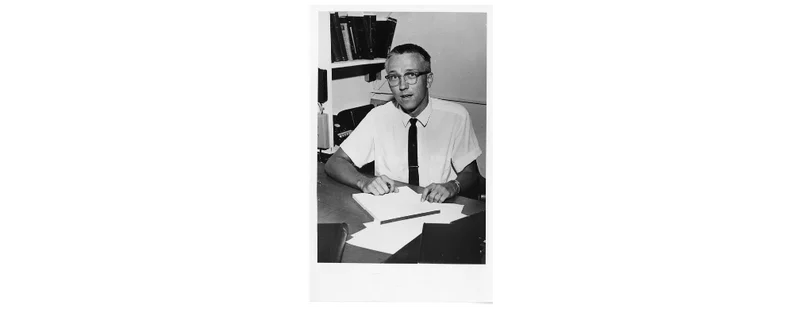
1979 Photographs of Carl Brans by Paul Halmos)
I met Carl in 2002 when I was a faculty member at nearby Dillard University in New Orleans.
I introduced myself when I visited Loyola U. of New Orleans for their physics seminars because they had a small relativity group.
Carl invited me to give a talk on my visual approaches to relativity.
I think my talk went well.
Unfortunately, I was too busy at Dillard to visit him at Loyno regularly after that. Then came Hurricane Katrina in 2005.
I would have liked to learn more about his ideas on exotic smoothness.
https://cas.loyno.edu/news/mar-04-2...partment-physics-passed-away-february-26-2026
Carl Henry Brans, longtime member of the Department of Physics, passed away on February 26, 2026, at the age of 90
loynocas - instagram.com/p/DVeSIqGAKZU/Born December 13, 1935, in Dallas, Texas, Carl showed an early gift for mathematics and a lifelong curiosity about how the universe works. He earned his undergraduate degree from Loyola University New Orleans in 1957 and went on to Princeton University, where he completed his Ph.D. in 1961 under the guidance of Charles Misner and Robert H. Dicke. His doctoral work led to the Brans–Dicke scalar-tensor theory of gravity, an important extension of Einstein’s general relativity that continues to influence theoretical physics and cosmology.
(2007) https://loyolamaroon.com/104780/uncategorized/physics-profs-theory-rivals-einsteins/
https://www.loyno.edu/academics/faculty-and-staff-directory/carl-h-brans
https://www.mathgenealogy.org/id.php?id=142953
https://inspirehep.net/authors/1015418
https://en.wikipedia.org/wiki/Brans–Dicke_theory
(1961) Mach's principle and a varying gravitational constant. (library info on: Carl H Brans dissertation, Princeton 1961)
Try browsing https://web.archive.org/web/20160401000000*/http://loyno.edu/~brans/theses/
(1961) Mach's principle and a relativistic theory of gravitation - https://inspirehep.net/literature/2450
C. Brans (Princeton) R.H. Dicke (Princeton)
Phys.Rev. 124 (1961) 925-935
https://doi.org/10.1103/PhysRev.124.925
( also in Part of 100 years of gravity and accelerated frames: The deepest insights of Einstein and Yang-Mills, 142-147 )
(1994) Exotic Smoothness and Physics
J.Math.Phys. 35 (1994) 5494-5506
https://doi.org/10.1063/1.530761
https://arxiv.org/abs/gr-qc/9405010v1
(2007) Exotic Smoothness and Physics [Torsten Asselmeyer-Maluga (Humboldt University, Germany) and Carl H Brans (Loyola University, USA)]
https://doi.org/10.1142/4323
https://www.worldscientific.com/worldscibooks/10.1142/4323
(2016) At the Frontier of Spacetime [Torsten Asselmeyer-Maluga Editor]
Scalar-Tensor Theory, Bells Inequality, Machs Principle, Exotic Smoothness
(see Torsten Asselmeyer-Maluga at https://www.researchgate.net/publication/311330604_At_the_Frontier_of_Spacetime )
To Carl
...
Carl H. Brans chose to investigate such theories for his undergraduate thesis at Loyola University in New Orleans. It was the beginning of a lifelong engagement with GRT. Even the mathematical beauty of GRT and the unified field theory attracted him. As a 10-year-old boy, he taught himself differential and integral calculus, and difficult books on mathematics and mathematical physics held a great appeal for him. His preference for GRT was a little bit unusual at the time. Since the 1920s, the GRT had lost its prominent role in theoretical physics. The advent of quantum mechanics and elementary particle physics, together with new work on quantum electrodynamics, inspired more interest among physicists in those days.
...
p.xxii
Carl’s Influence on the Movie Interstellar
The ideas that Newton’s gravitational constant G might change from place to place and time to time, and might be controlled by some sort of nongravitational field, were hot topics in the Princeton University physics department when I was a PhD student there in the early 1960s. These ideas had been proposed by Princeton’s Professor Robert H. Dicke and his graduate student Carl Brans in connection with their “Brans-Dicke theory of gravity”, an interesting alternative to Einstein’s general relativity. The Brans-Dicke theory has motivated a number of experiments that searched for varying G, but no convincing variations were ever found. These ideas and experiments motivated my interpretation of some of Interstellar’s gravitational anomalies and how to control them: bulk fields control the strength of G and make it vary. The Professor’s equation, as used in this movie and shown on a blackboard in one sequence, builds on these ideas.
- Kip Thorne, Caltech (see The Science of Interstellar by Kip Thorne, Norton & Company 2014)
(2022) loyno - facebook.com/loynophysics/posts/dr-carl-brans-gives-a-talk-on-questions/136299342480857/
https://siarchives.si.edu/collections/siris_arc_290398
1979 Photographs of Carl Brans by Paul Halmos)
- https://digitalcollections.briscoecenter.org/item/27139
- https://digitalcollections.briscoecenter.org/item/22640
I met Carl in 2002 when I was a faculty member at nearby Dillard University in New Orleans.
I introduced myself when I visited Loyola U. of New Orleans for their physics seminars because they had a small relativity group.
Carl invited me to give a talk on my visual approaches to relativity.
I think my talk went well.
Unfortunately, I was too busy at Dillard to visit him at Loyno regularly after that. Then came Hurricane Katrina in 2005.
I would have liked to learn more about his ideas on exotic smoothness.
Last edited: