Rules of Inference: Get Help with Hypothesis 1 & 2

  • Context: MHB 
  • Thread starter Thread starter Eluki
  • Start date Start date
  • Tags Tags
    Rules
Click For Summary
SUMMARY

This discussion focuses on the relationship between two hypotheses in mathematical logic, specifically Hypothesis 1: "All my pets are dogs or cats" and Hypothesis 2: "If a pet is a cat, it is a feline." Participants emphasize the need for precision in defining the relationship between these hypotheses, as the term "imply" can have multiple interpretations. A detailed proof is provided, demonstrating the logical steps to establish the connection between the hypotheses using rules of inference such as Modus Ponens and Universal Elimination.

PREREQUISITES
  • Understanding of basic logical statements and their forms
  • Familiarity with rules of inference, including Modus Ponens and Universal Elimination
  • Knowledge of existential and universal quantifiers in logic
  • Ability to construct logical proofs in mathematical logic
NEXT STEPS
  • Study the principles of logical implication in mathematical logic
  • Learn about different rules of inference and their applications
  • Explore the use of quantifiers in formal proofs
  • Practice constructing logical proofs using various techniques
USEFUL FOR

This discussion is beneficial for students of mathematical logic, educators teaching logic concepts, and anyone interested in improving their skills in constructing and understanding logical proofs.

Eluki
Messages
1
Reaction score
0
Hi,

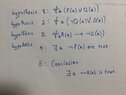
I am havinga bit of challenge with the following question.
What seems confusing to me is th relationship between hypothesis 1 and 2.
I will appreciate all help. View attachment 9403
 

Attachments

  • WhatsApp Image 2019-12-06 at 22.18.24.jpeg
    WhatsApp Image 2019-12-06 at 22.18.24.jpeg
    108.4 KB · Views: 141
Physics news on Phys.org
Welcome to the forum.

Eluki said:
I am having a bit of challenge with the following question.
It would help if you write exactly what the problem is asking you to do. And I mean as precisely as possible: saying "Prove that the hypotheses imply the conclusion" is not precise enough because the word "imply" can have several different meanings in mathematical logic.

Eluki said:
What seems confusing to me is the relationship between hypothesis 1 and 2.
Would you be puzzled if I said that I find confusing the relationship between the following statements: "All my pets are dogs or cats" and "If a pet is a cat, it is a feline"? I suspect you would because it is not even clear what I mean by a relationship: these are two separate statements, nobody claims that they have to be consistent, or follow from each other, or anything like that. What relationship did you find or want to find between hypotheses 1 and 2, and why is this relationship confusing?
 
Here's a proof (fill out the details).
1. Ax (Px v Qx)
2. Ax (~Qx v Sx)
3. Ax (Rx ->~Sx)
4. Ex ~Px
5. Pa v Qa , universal, 1.
6. ~Qa v Sa universal, 2.
7. Ra ->~Sa , universal, 3.
8. ~Pb, existential, 4.
9.Qb ,5,8 DS.
10. ~~Qb, 9, DN.
11. Sb 7,6, DS.
12. ~~Sb ->~Rb 7, MT.
13. ~Rb , 11,12, MP.
14. Ex ~Rx, QED.
 
Eluki said:
Hi,

I am havinga bit of challenge with the following question.
What seems confusing to me is th relationship between hypothesis 1 and 2.
I will appreciate all help. View attachment 9403
proof:
1) $\forall x(P(x)\vee Q(x)$

2)$\forall x( \neg Q(x)\vee S(x))$

3)$\forall x (R(x)\rightarrow\neg S(x))$

4)$\exists x(\neg P(x))$

5) $(P(x)\vee Q(x)$.......from one and using universal elimination UE

6)$ \neg Q(x)\vee S(x)$..........from two UE

7)$ R(x)\rightarrow\neg S(x)$..........from (3),UE

6)$(\neg P(y))$...............hypothesis for existential elimination EE

7)$\neg(P(x)\rightarrow Q(x)$..........(5) using material implication

8).$ \neg\neg Q(x)\rightarrow S(x)$.........(6) using material imlication

9)$Q(x)$...................hypothesis for conditional proof

10)$\neg Q(x)$................hypothesis for contradiction

11)$Q(x)\wedge\neg Q(x)$..............(9)and (10) using AI (addition introdaction)

12)$\neg\neg Q(x)$.................(10)to (11) contradiction

13)$S(x)$....................(8),(12) using Modus Ponens(MP)

14)$Q(x)\rightarrow S(x)$.........from (9) to(13) and using conditional proof

15)$\neg P(x)$.............hypothesis for conditional proof

16) $Q(x)$................using (15), (7) and MP

17)$S(x)$................using (14) and (16) and MP

18)Repeat process from steps (10) to (12) to end up with $\neg\neg S(x)$

19)$\neg\neg S(x)\rightarrow\neg R(x)$......(7) and using contrapositive

20) $\neg R(x)$.................(18),(19) using MP

21)$\neg P(x)\rightarrow\neg R(x)$.......from (15) to(20) and using conditional proof

22)$\forall x(\neg P(x)\rightarrow\neg R(x))$......from (21) and using universal introduction (UI)

23)$\neg P(y)\rightarrow\neg R(y))$............from(22) and using UE where we put x=y

24)$\neg R(y)$.................. (6),(24) and using MP

25)$\exists x(\neg R(x))$................from (24) and using existensial introduction EI

26) $\exists x(\neg R(x))$................from (4) and (6) to (25) and using EE

As you can see the general plan of the proof is to prove 1st $\forall x(\neg P(y)\rightarrow\neg R(y))$ and then using $\neg P(y)$. to prove $\exists\neg R(x)$ using EI and EE
1) Notice the changing of the variables from x to y and then back to x

Now to test your understanding start your own proof by hypothising $\neg P(x)$
and use my proof as help
You may use different rules of inference if you like
 

Similar threads

  • · Replies 30 ·
2
Replies
30
Views
3K
  • · Replies 23 ·
Replies
23
Views
2K
  • · Replies 5 ·
Replies
5
Views
3K
  • · Replies 6 ·
Replies
6
Views
2K
  • · Replies 1 ·
Replies
1
Views
2K
  • · Replies 20 ·
Replies
20
Views
3K
  • · Replies 2 ·
Replies
2
Views
3K
  • · Replies 21 ·
Replies
21
Views
4K
  • · Replies 11 ·
Replies
11
Views
2K
  • · Replies 1 ·
Replies
1
Views
1K