Sampling distribution's magnitude variation

Click For Summary
SUMMARY

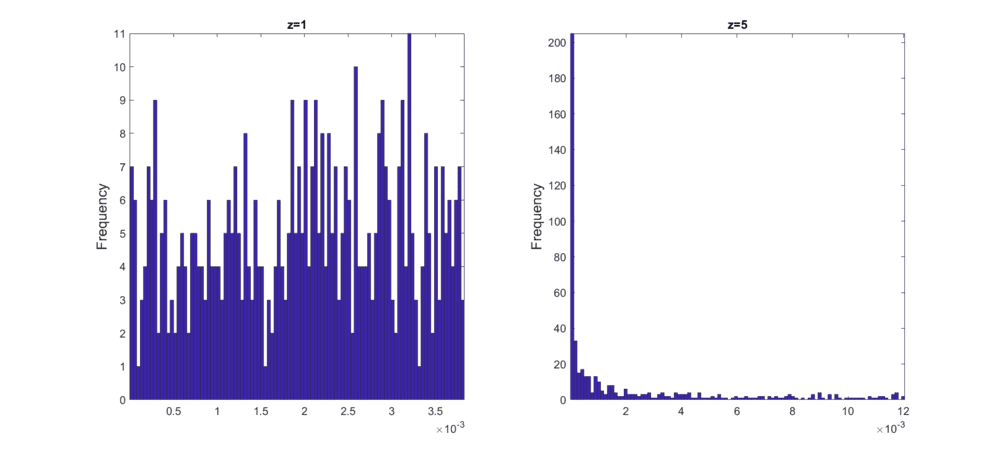
The discussion centers on the effects of varying the exponent z in the generation of a normalized sampling distribution using MATLAB code. For z=1, the distribution is flat with a limited range, while increasing z to 5 results in a wider range of values. The conversation also explores the concept of defining a single random variable X from multiple dependent measurements, emphasizing that the joint distribution of the variables impacts the independence of the samples.

PREREQUISITES
  • Understanding of MATLAB programming and syntax
  • Knowledge of probability distributions and their properties
  • Familiarity with concepts of random variables and joint distributions
  • Basic statistical analysis, particularly histogram interpretation
NEXT STEPS
  • Research the implications of varying exponents in probability distributions
  • Learn about the properties of normalized distributions in MATLAB
  • Explore the concept of joint distributions and their impact on random variables
  • Investigate methods for defining single random variables from dependent samples
USEFUL FOR

Mathematicians, statisticians, data scientists, and anyone interested in the behavior of sampling distributions and random variable definitions in statistical analysis.

roam
Messages
1,265
Reaction score
12
Homework Statement
What is the name of the following distribution, and why does increasing the exponent increase the magnitude variation?
Relevant Equations
Matlab code is shown below.
I have generated a distribution (normalized such that the sum is equal to 1) by using the code:

Matlab:
M=500; % Number of samples
z=1;
SUM = 1;
ns = rand(1,M).^z; % random numbers
TOT = sum(ns);
X = (ns/TOT)*SUM; % Re-scaling
hist(X(1,:),100)

For an exponent ##z=1##, the sampling distribution is "flat", but it also has a shorter range. Enlarging ##z## gives a wider range of numbers. Why? :oldconfused:

Here is a comparison of the results for ##z=1## and ##z=5##:
245307


Also, is it possible to have both a wide range and a "flat" distribution at the same time (i.e. very large numbers being just as likely as the small numbers)?

Explanations would be greatly appreciated.
 
Physics news on Phys.org
roam said:
Problem Statement: What is the name of the following distribution, and why does increasing the exponent increase the magnitude variation?

For an exponent ##z=1##, the sampling distribution is "flat", but it also has a shorter range.

You seem to be saying that you are plotting a histogram of 500 samples from a single random variable. If that is the claim, what random variable is it?

By way of analogy, suppose I take a sample of two numbers as follows. I pick a person at random and measure his height ##H## in inches and his weight ##W## in pounds. I form the two numbers ##X_1 = H/ (H+W)## and ##X_2 = W/(H+W)##. Can I regard ##X_1## and ##X_2## as two independent samples of the same random variable? What would that single random variable be?

To extend this, suppose I pick a person and measure 500 different aspects of that person that have numerical measures - height, weight, minutes spent sleeping today, ounces of water consumed today, ...etc. I take the sum ##TOT## of all the measurements and form a set of 500 numbers by dividing the original measurements by ##TOT##, obtaining the values ##X_1, X_2, ...X_{500}##. Then I histogram these values and regard it as 500 independent measures of the same random variable ##X##. How can I define a random variable ##X## so that would make sense?

I'm not saying it's mathematically absurd to make an attempt to define ##X##. It may be absurd from the point of view of practical applications, but it's a very interesting mathematical question. If we have 500 distinct random variables with some given joint distribution then under what conditions can we define a single random variable ##X## such that 500 independent samples of ##X## can be realized by treating 1 sample from the joint distribution of the 500 different random variables as if they were 500 independent measurements of the same random variable?

In the case where the 500 jointly distributed random variables are independent and identically distributed then we can obviously treat 1 sample of the 500 values as 500 independent realizations of the random variable ##X## , where ##X## has the distribution common to each of the 500 random variables.

However, in your case, you aren't dealing with 500 independently distributed values, since outcome of each value depends on ##TOT##, which is determined jointly from 500 other values.

Unless we can define a single random variable ##X## whose probability density is approximated by your histograms, attempts to answer your question by thinking about the probability density of a single random variable are heading down the wrong track.
 
Last edited:
Question: A clock's minute hand has length 4 and its hour hand has length 3. What is the distance between the tips at the moment when it is increasing most rapidly?(Putnam Exam Question) Answer: Making assumption that both the hands moves at constant angular velocities, the answer is ## \sqrt{7} .## But don't you think this assumption is somewhat doubtful and wrong?

Similar threads

  • · Replies 1 ·
Replies
1
Views
3K
  • · Replies 8 ·
Replies
8
Views
2K
  • · Replies 3 ·
Replies
3
Views
1K
  • · Replies 3 ·
Replies
3
Views
2K
  • · Replies 23 ·
Replies
23
Views
3K
Replies
1
Views
4K
  • · Replies 6 ·
Replies
6
Views
3K
  • · Replies 2 ·
Replies
2
Views
2K
  • · Replies 15 ·
Replies
15
Views
1K
  • · Replies 1 ·
Replies
1
Views
2K