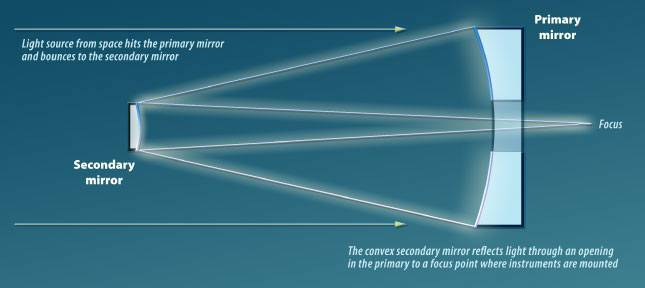
Secondary Mirror in Solar Concentrator Dish Designs

Click For Summary

Discussion Overview

The discussion revolves around the design of solar concentrator dishes, specifically the potential use of a secondary mirror located at the focal point, with the power generator positioned at the center of the dish behind it. Participants explore the advantages and disadvantages of this design compared to standard configurations.

Discussion Character

  • Exploratory
  • Technical explanation
  • Debate/contested

Main Points Raised

  • One participant suggests that using a secondary mirror could lead to full dish utilization, reduced material requirements, a lighter design, and easier maintenance.
  • Another participant raises concerns about the complexity of construction, alignment issues, and the need for cooling of the secondary mirror.
  • It is noted that the shadow created by the secondary mirror could negate some advantages of this design, particularly in relation to the collector's position.
  • A participant highlights that while the secondary mirror design is beneficial for telescopes, the goals of solar concentrators differ, focusing on cost-effectiveness rather than maximal efficiency.
  • Discussion includes the idea that solar collectors do not need to form images but rather direct light to a target, allowing for simpler mirror designs.
  • Concerns are raised about air ionization due to high energy density in focused beams, which could affect transparency.
  • Another participant counters that lasers can be focused well, implying that solar concentrator designs may not face the same issues.

Areas of Agreement / Disagreement

Participants express a range of views on the feasibility and practicality of using a secondary mirror in solar concentrator designs. There is no consensus on whether the advantages outweigh the complications, and multiple competing perspectives remain unresolved.

Contextual Notes

Limitations include assumptions about the quality of the secondary mirror, the impact of shadowing on efficiency, and the varying goals of different types of optical systems.

vladpaln
Messages
12
Reaction score
0
I have been looking at various solar power dish designs. They have one thing in common, they all have their power generators located at the focal point.

Why don't any of the designs use a secondary mirror located at the focal point and the generator located center of dish and right behind it. The design using secondary mirrors is used in all the large telescopes you find in Chile and Hawaii and seems to work fine.

I see several advantages using the secondary mirror design including full dish utilization, less material required, lighter design, and easier maintenance. The only con I can think of is the secondary mirror will have to be of high quality with >99% reflective surface possibly with some kind of cooling (active/passive).

What am I missing??

Standard Design
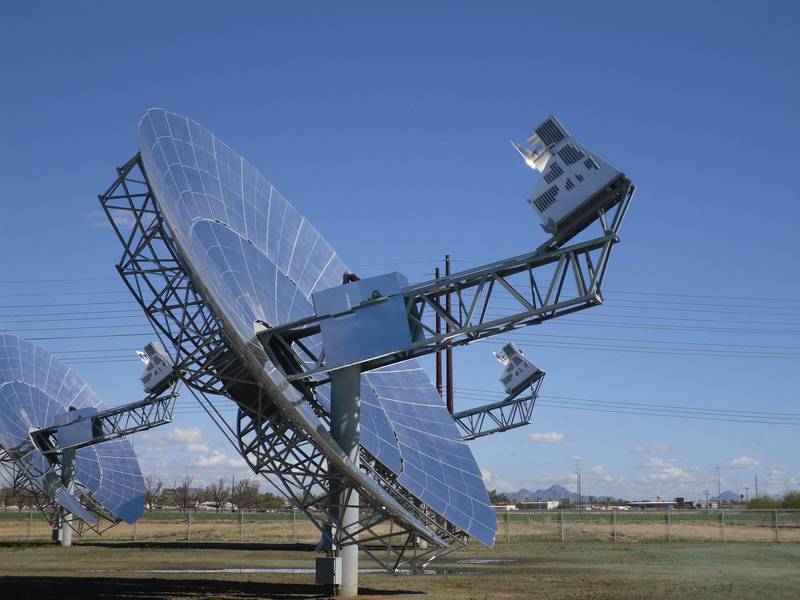
Maricopa_Dish-Stirling_plant_01.jpg


Dish with Secondary Mirror
26cassegrain.jpg
 

Attachments

  • Maricopa_Dish-Stirling_plant_01.jpg
    Maricopa_Dish-Stirling_plant_01.jpg
    56 KB · Views: 759
  • 26cassegrain.jpg
    26cassegrain.jpg
    15.9 KB · Views: 812
Physics news on Phys.org
Probably more complicated to build - needs a better alignment of everything, needs an additional element that is cooled. Support for the secondary mirror might be a bit lighter, okay.

Large telescopes need an excellent resolution, something you don't get with a single mirror, but that is not a concern for these concentrators.
 
It looks as if the tilt mechanism penetrates the dish and creates a strip of shadow. The collector is located in this shadow and there would be no advantage in the sub reflector design in this case.
 
vladpaln said:
full dish utilization
The shadow of the secondary mirror is there, just as the opening on the main mirror.

vladpaln said:
easier maintenance.
Actually, the design on the picture is quite clever. The 'rest' position of the mirror is not only cuts off the heat but the crew will get the generator at convenient height and position for repair/maintenance. Also I have a bet that the support point goes through the center of the structure, so not much power is needed for tracking or positioning. The generator is the counterweight for the mirror.

vladpaln said:
The only con I can think of is the secondary mirror will have to be of high quality with >99% reflective surface possibly with some kind of cooling (active/passive).
That is also true. Just keep in mind, that the goal is not about the maximal efficiency, but about cheap power.
 
Last edited:
vladpaln said:
The design using secondary mirrors is used in all the large telescopes
That cuts down the total length of the optical imaging telescope - which means it can be housed in a smaller building as one benefit.

You may be interested in the optics of solar collectors.
They do not need to focus the light to form an image, but only to direct the light to a target of fixed size ( too small a target and it might melt ).
https://en.wikipedia.org/wiki/Nonimaging_optics

The mirrors can be as simple as polished flat sheets or panels of metal aimed at the target, and since being out in the elements, they will get dusty and dirty so a reflectivity something less than 100% is taken into account in the design for the amount of power one can collect. Need more power - just add a few more panels - and it could be cheaper to do it that way than to form perfect parabolic curves for the individual mirrors as seen in the picture. The dish is parabolic, but each panel mirror does not have to be. Cost goes up with each fabrication step from flat panel to 1-d curve to a 2-d curve, but that is something the designers would calculate and make decisions on.
 
The only limitation I can think of would be a concern for air ionization.
As the energy density increases in the ever tightening focused beam, you
might pass the point where the air ionized and becomes less transparent.
This can be observed with lasers or just a few watts, the power observed at just a meter or two
appears to cycle up and down.
 
Lasers can be focused extremely well. You won't have that problem with solar concentrator designs.
 

Similar threads

  • · Replies 12 ·
Replies
12
Views
3K
  • · Replies 3 ·
Replies
3
Views
2K
  • · Replies 29 ·
Replies
29
Views
5K
  • · Replies 3 ·
Replies
3
Views
2K
  • · Replies 6 ·
Replies
6
Views
4K
  • · Replies 15 ·
Replies
15
Views
3K
  • · Replies 1 ·
Replies
1
Views
2K
  • · Replies 6 ·
Replies
6
Views
2K
Replies
1
Views
3K
  • · Replies 2 ·
Replies
2
Views
2K