Series Expansion & l'Hopital's rule

Click For Summary
SUMMARY

The discussion focuses on the application of l'Hôpital's rule and the derivation of the Maclaurin series for the hyperbolic cotangent function, coth(x). The user seeks assistance in obtaining a series expansion to the fourth degree of x. Dan provides a clear approach by suggesting the user first state the definition of coth(x) and then find the Maclaurin series for e^x and e^-x to substitute into the coth(x) formula.

PREREQUISITES
  • Understanding of l'Hôpital's rule
  • Knowledge of Maclaurin series
  • Familiarity with hyperbolic functions
  • Basic calculus concepts
NEXT STEPS
  • Study the derivation of the Maclaurin series for e^x and e^-x
  • Practice applying l'Hôpital's rule in various calculus problems
  • Explore the properties and applications of hyperbolic functions
  • Learn how to derive series expansions for other functions
USEFUL FOR

Students preparing for calculus exams, particularly those focusing on series expansions and the application of l'Hôpital's rule, as well as educators teaching these concepts.
stuart4512
Messages
3
Reaction score
0
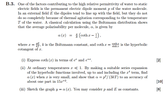
I'm preparing for my exam and have stumbled across this question. I understand how to execute the l'hopital's rule part of this but I just can't get there. I have no idea how to approach this in order to get a suitable series expansion to the 4th degree of x.

View attachment 3664

Thank you
 

Attachments

  • 2012b3.png
    2012b3.png
    18.7 KB · Views: 124
Physics news on Phys.org
stuart4512 said:
I'm preparing for my exam and have stumbled across this question. I understand how to execute the l'hopital's rule part of this but I just can't get there. I have no idea how to approach this in order to get a suitable series expansion to the 4th degree of x.

http://mathhelpboards.com/attachments/calculus-10/3664-series-expansion-amp-lhopitals-rule-2012b3-png

Thank you
For i) you just state the definition of coth(x).

For ii) you need to find the Maclaurin series for e^{x} and e^{-x}.
then plug those expansions into the coth(x) formula.

-Dan
 

Similar threads

  • · Replies 3 ·
Replies
3
Views
2K
  • · Replies 9 ·
Replies
9
Views
3K
  • · Replies 2 ·
Replies
2
Views
2K
  • · Replies 1 ·
Replies
1
Views
2K
  • · Replies 9 ·
Replies
9
Views
2K
  • · Replies 2 ·
Replies
2
Views
2K
  • · Replies 2 ·
Replies
2
Views
2K
  • · Replies 4 ·
Replies
4
Views
2K
  • · Replies 3 ·
Replies
3
Views
2K
  • · Replies 1 ·
Replies
1
Views
2K